Johari Window: Meaning, the Four Quadrants, Examples, and the Owner's Blind Spot

The owner of a ₹60 crore auto-components company in Pune describes himself as approachable. His door is open, his phone is on, anyone can walk in. His senior team describes him, privately and without exception, as a man you do not bring bad news to before eleven in the morning. Both descriptions are sincere. Only one of them is running the company.
The Johari window is a model of self-awareness and interpersonal communication that divides what is known about a person into four areas: open (known to self and to others), blind (known to others, not to self), hidden (known to self, not to others) and unknown (known to no one). It was created by psychologists Joseph Luft and Harrington Ingham in 1955, and its name joins their first names. The model's claim is simple: relationships and teams work better as the open area grows, and the open area grows in only two ways, through feedback and through disclosure.
This page gives the meaning, the four quadrants, how the window moves, the uses in organisational behaviour, worked examples, the advantages and the limits, and the question the model raises for anyone who runs a company. The ten spokes go deeper on each.
What the Johari window means
The Johari window is a two-by-two grid. One axis asks whether something about you is known to you. The other asks whether it is known to the people around you. Four combinations, four panes.
Luft and Ingham first presented it at a group-development programme at the University of California, Los Angeles, in 1955, and Luft developed it further in his 1969 book Of Human Interaction. It was built for groups, not for therapy. It describes how much of a person is available to the people they work with, and how that changes as trust, feedback and disclosure change.
It is a communication model, not a personality test. It does not sort anyone into a type. It maps what is shared and what is not, which is why it has survived seventy years of management training and still appears on every organisational behaviour syllabus in Indian business schools.
The four quadrants
Each pane holds a different kind of information about the same person.
Open area, also called the arena. What you know about yourself and others also know: your role, your stated priorities, your visible habits, the way you run a meeting. Work moves fastest here, because nothing has to be guessed.
Blind area, or blind spot. What others see in you that you do not: the tone you take when a number disappoints you, the person you always side with, the decision that waits until you are in the room. In most organisations this pane grows with seniority, because the people who could tell you have more to lose by doing so.
Hidden area, also called the façade. What you know and choose not to share: the doubt about a new market, the plan to bring a son into the business, the reason a senior manager was moved. Some of it should stay hidden. Much of it costs more hidden than shared.
Unknown area. What neither you nor anyone else has yet seen: how you behave in a crisis you have not faced, a capability no role has asked of you. It shrinks only through new situations and honest observation of them.
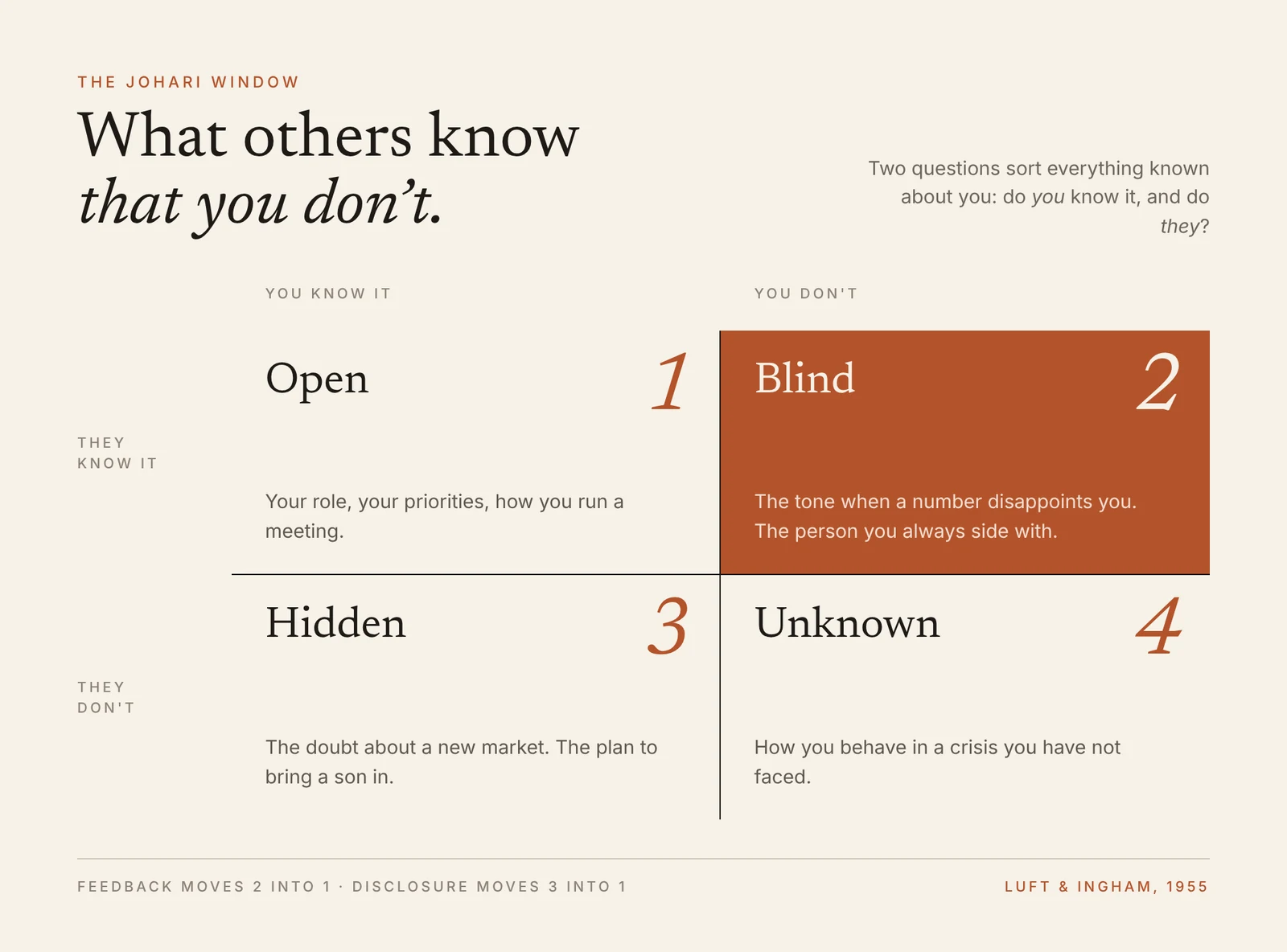
The four quadrants of the Johari window spoke covers each pane in detail: what usually lives there in a company, how large it tends to be for an owner, and what enlarges or shrinks it.
How the window moves
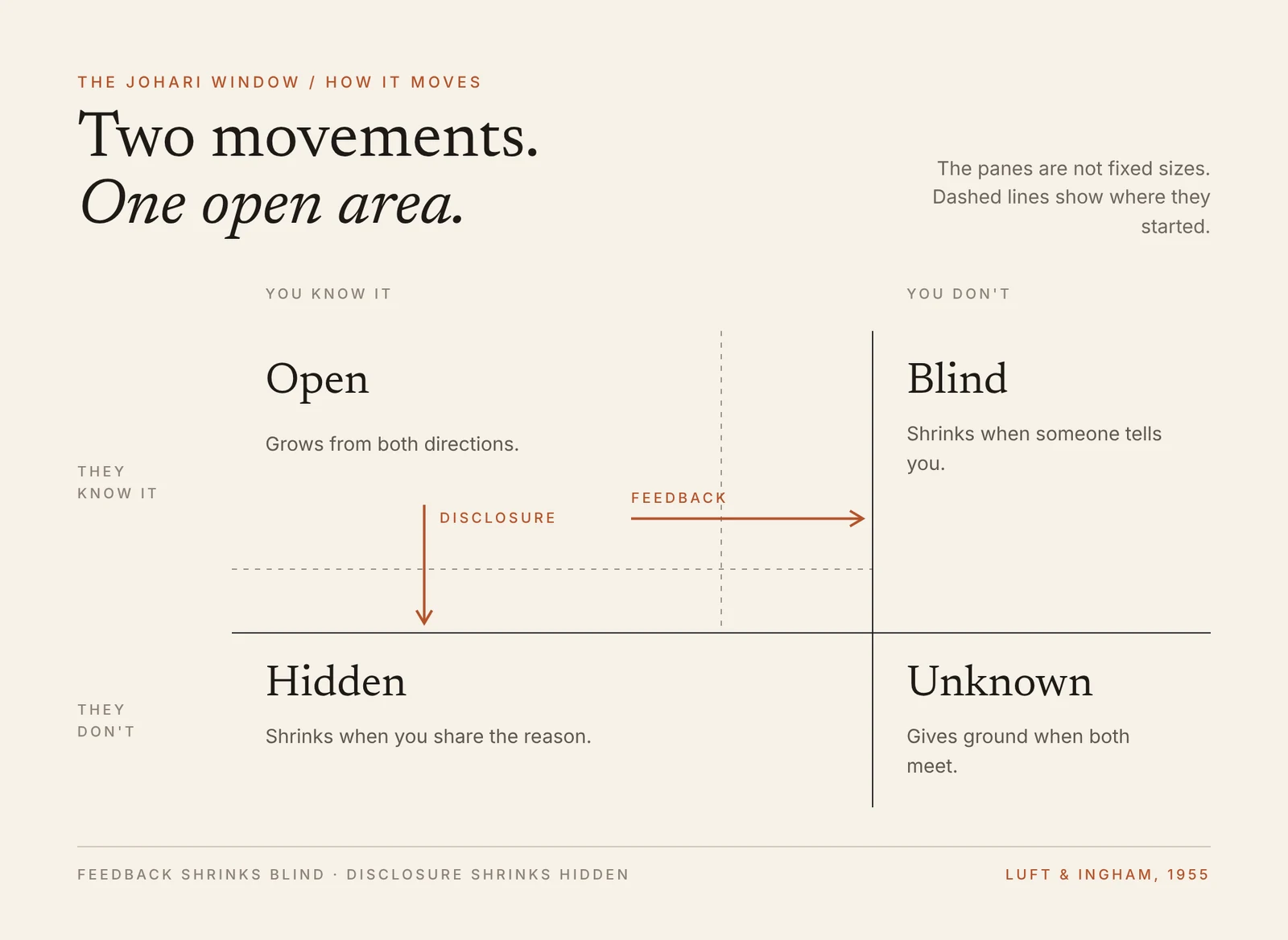
The panes are not fixed sizes. The model's real content is the movement between them.
Feedback shrinks the blind area. When someone tells you what they see, it moves from the blind pane to the open one. This is the slower of the two movements for anyone senior, because it depends on other people's willingness, and willingness falls as power rises. The feedback spoke covers why feedback travels down a company easily and up it badly.
Disclosure shrinks the hidden area. When you share what you know, the reason behind a decision, the constraint you are working under, the thing you are not good at, it moves from the hidden pane to the open one. This movement is entirely in your control. The self-disclosure spoke covers how much a leader should actually say.
Both together shrink the unknown. When feedback and disclosure meet, in a conversation or a hard quarter, things neither party knew become visible. Teams call this learning. The model calls it the unknown area giving ground.
Johari window examples
Three short examples from owner-led companies.
- The approachable owner. Open: his door policy. Blind: the eleven o'clock rule his team has built around his mornings. Hidden: he knows he is short-tempered before his first review of the cash position. Unknown: whether the team would bring bad news earlier if he said so out loud. One disclosure, "I am bad company before I have seen the numbers", would move two panes at once.
- The promoted sales head. Open: her targets and her record. Blind: her team sees her rescue every large deal herself, so nobody below her has closed one in a year. Hidden: she is unsure she wants to manage at all. Unknown: what she would be like with a different role design.
- The second-generation director. Open: his title. Blind: long-serving managers wait for his father's nod after every instruction he gives. Hidden: he knows it and has not raised it. Unknown: how the company would respond to a clear handover of one function.
The Johari window examples spoke gives eight worked examples, each filled across all four panes, including a whole leadership team.
The Johari window exercise
The original exercise uses a fixed list of about fifty-six adjectives. The person picks five or six that describe them. Colleagues pick five or six from the same list for that person. Adjectives chosen by both go in the open pane, by others only in the blind pane, by the person only in the hidden pane, and by nobody in the unknown pane.
It takes under an hour and produces the most useful conversation most leadership teams have all year, provided the answers are anonymous and the owner goes first. The Johari window test spoke gives the questionnaire, a work-behaviour descriptor list adapted for Indian companies, and how to run the session without it becoming a performance review.
Uses of the Johari window in organisational behaviour
In organisational behaviour the model is used in five places.
- Leadership development. Senior people use it to surface blind spots that formal reviews never reach. The blind spot spoke lists the seven most owners share.
- Team formation. New teams use it to build the open area quickly, which shortens the period in which everyone is guessing.
- Feedback culture. It explains why constructive feedback and 360-degree feedback matter, and what they are actually for.
- Interpersonal communication. It is the standard model for explaining how awareness shapes interpersonal communication, and why most disputes start in somebody's blind pane.
- Self-awareness. It splits self-awareness into the part you can build alone and the part only other people can give you.
Advantages and limits
The advantages are its simplicity and its honesty. Anyone can draw it on a whiteboard in a minute. It names the one thing most leadership models avoid, that other people know things about you that you do not, and it gives two concrete ways to act on that.
The limits are real. It depends entirely on honest input, and honesty depends on safety, which in a hierarchical Indian company cannot be assumed. Done badly, with names attached or with the results reaching the appraisal file, the exercise widens the hidden pane rather than the open one. It describes awareness, not fit: a person can have a large open area and still be in the wrong seat. And disclosure has a ceiling. A leader who shares everything is not open, only undefended.
The psychological safety essay covers why teams stop telling the truth, and the organisational silence essay covers what a company sounds like once they have.
The owner's blind pane
Every pane of the window can be worked on by a team. One cannot be worked on easily by the person at the top.
The owner's blind pane is the largest in the company and the least reported. Not because owners resist feedback, though some do, but because everyone who could give it depends on the owner for their salary, their increment and their standing. The information exists. It travels sideways, in the canteen and in the WhatsApp groups the owner is not in, and it stops one level below the cabin. The founder who cannot take feedback essay covers the owner's side of this, and the loyal teams essay covers the team's.
Most failure is not from strategy. It is from misaligned WHO.
A blind pane is not only about personality. It includes how the company itself is shaped around the owner: which decisions route through one person, which roles were designed around one person's habits, which people sit in seats that do not fit how they operate. Those are structural, and they are visible in how the organisation runs before anyone says them aloud. The Business Pulse reads how your organisation actually runs, where decisions form, where they stall and how much still routes through you, from a single company document, with no questions to answer. It is one way to see the pane nobody below you is in a position to describe.
Questions people ask about the Johari window
What is the Johari window in simple words?
A four-pane model of what is known about a person. The open pane is what you and others know. The blind pane is what others see and you do not. The hidden pane is what you know and keep to yourself. The unknown pane is what nobody knows yet. Feedback and disclosure enlarge the open pane.
Who created the Johari window?
American psychologists Joseph Luft and Harrington Ingham, in 1955, at a group-development programme at the University of California, Los Angeles. The name combines their first names, Joe and Harry. Luft later expanded the model in his 1969 book Of Human Interaction.
What are the four quadrants of the Johari window?
Open area (arena): known to self and to others. Blind area (blind spot): known to others, not to self. Hidden area (façade): known to self, not to others. Unknown area: known to neither. Each person's panes are different sizes, and the sizes change over time.
How does the Johari window improve self-awareness?
It separates what you can learn about yourself alone from what only others can tell you. Feedback from others moves information out of the blind area, and choosing to share moves it out of the hidden area. Both enlarge the open area, which is where self-awareness and trust are built.
What is the Johari window used for in organisational behaviour?
Leadership development, team formation, building a feedback culture, explaining interpersonal communication and developing self-awareness. Companies use the adjective exercise in workshops so that colleagues can show each other what they see, and so leaders can surface blind spots formal reviews miss.
What are the limitations of the Johari window?
It depends on honest input, which depends on safety, so in hierarchical teams the results can be polite rather than true. It describes awareness rather than role fit. Linking it to appraisals defeats it. Disclosure also has limits: not everything hidden should become open.
Where to go deeper
- Johari Window Examples — eight worked examples from Indian workplaces, each filled across all four panes.
- The Four Quadrants of the Johari Window — open, blind, hidden and unknown, explained for leaders.
- Johari Window Test — the adjectives exercise, the questionnaire and how to run it with a team.
- Self-Awareness — meaning, types, and why it gets harder the more senior you become.
- Blind Spot Meaning — in leadership, in the Johari window, and the seven blind spots owners share.
- Self-Disclosure — meaning, theory, and how much a leader should actually say.
- Feedback — meaning, types, importance, and why it stops reaching the owner.
- Constructive Feedback — meaning, examples, and how to give it without it becoming personal.
- 360-Degree Feedback — process, questionnaire, and whether a 50-person company should do it.
- Interpersonal Communication — meaning, types, barriers, and what gets filed under it.
- The Founder's Undiscussable — the subject everyone in the company knows not to raise.