Interpersonal Communication: Meaning, Types, Examples, Barriers, and Why Most Workplace Problems Are Filed Under It

A Delhi distribution company of 90 people has sent its managers to a two-day communication workshop. They come back with a new vocabulary and the same problems. The accounts head still does not tell the sales head that a key customer is 120 days overdue. The owner still learns about it last, from the bank.
Interpersonal communication is the exchange of information, meaning and feeling between two or more people, through words, tone, body language, writing and listening, in which each person both sends and receives. It is distinct from intrapersonal communication, which is the conversation a person has with themselves, and from mass communication, which goes one way to many. At work, it is the layer where most problems are noticed and few are caused.
This page gives the meaning, the difference from intrapersonal communication, the types, examples from Indian offices, the barriers, the Johari window as the classic model of interpersonal awareness, and why most problems filed under communication belong somewhere else.
What interpersonal communication means
Interpersonal communication is any exchange between people who can respond to each other. A conversation, a meeting, a phone call, a WhatsApp thread, an email reply.
Three things separate it from simply sending a message.
It runs both ways. Each person is sender and receiver at once. The listener's silence, frown or "okay sir" is part of the message.
It carries a relationship. Every exchange says something about who the two people are to each other. The same sentence from the owner and from a peer is two different messages.
It cannot be taken back. A message once received has been received. A correction adds to it; it does not erase it.
Interpersonal and intrapersonal communication: the difference
Interpersonal communication happens between people. Intrapersonal communication happens inside one person: the thinking, rehearsing, interpreting and self-talk that come before and after every conversation.
The difference matters at work because most interpersonal failures start intrapersonally. A manager decides, inside his own head, that the owner will be angry about a delay. He rehearses the conversation, imagines the reaction, and then does not have the conversation at all. Nothing went wrong between two people. Something went wrong inside one, and it looked like a communication problem from outside.
The owner has the same pattern in reverse. "He should have told me" is often a sentence an owner says to himself for weeks before saying anything to anyone.
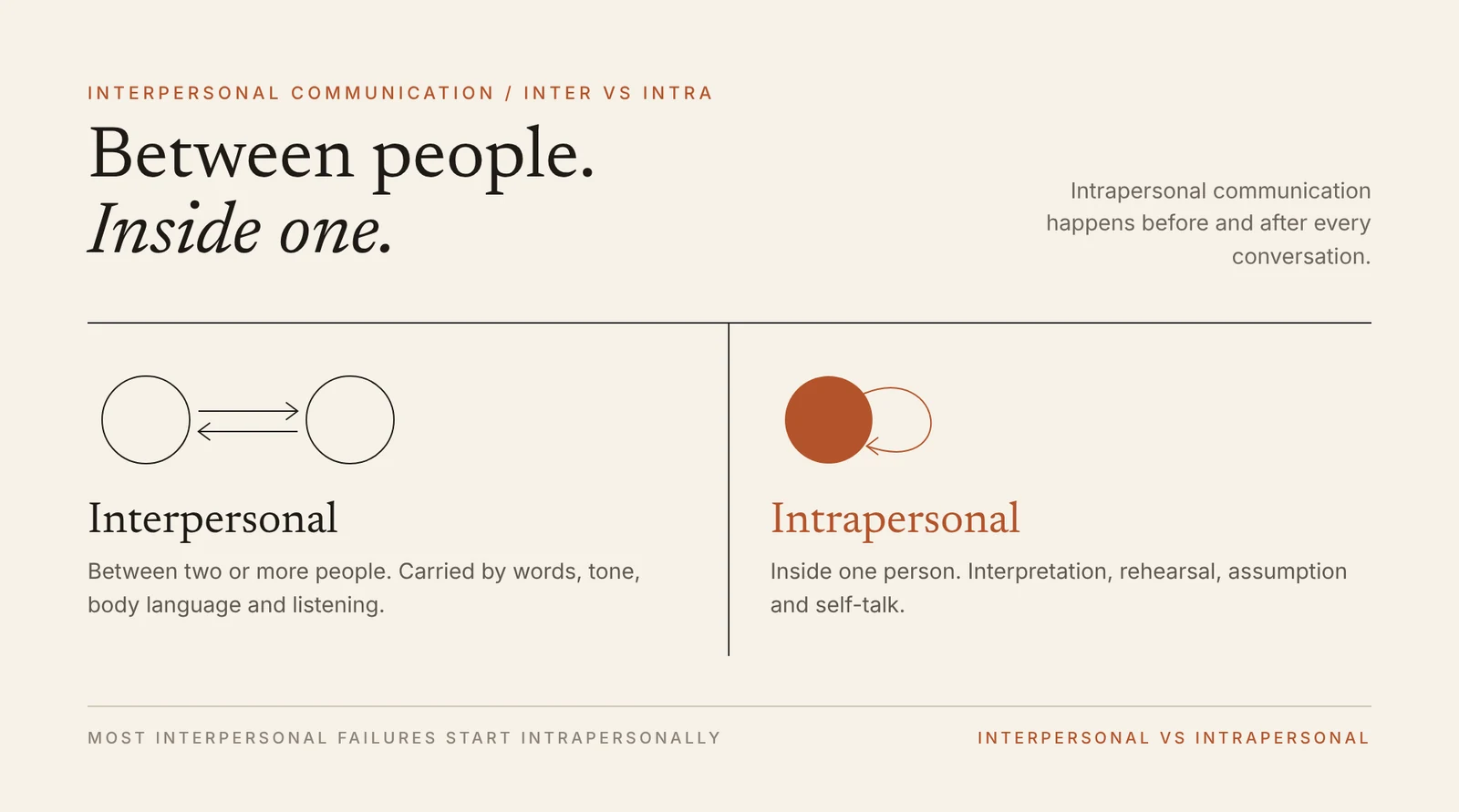
Between people, and inside one. Most workplace failures start in the second panel.
Types of interpersonal communication
By channel, four types.
Verbal. Spoken words, in person or on a call. The words carry the least of the meaning in most face-to-face exchanges.
Non-verbal. Tone, pace, facial expression, posture, eye contact, the time someone is kept waiting, who sits where.
Written. Email, chat, notes. In Indian SMEs the WhatsApp group has become the main written channel, with none of the tone and all of the permanence.
Listening. Often left out of the list and the type that fails most. A person who does not feel heard stops sending.
By size, two types: one-to-one, where the relationship dominates, and small-group, where the hierarchy in the room dominates. The same manager can be candid one-to-one and silent in a meeting where the owner is present. The weight of the room essay is about that second case.
Examples of interpersonal communication at work
The morning call. A Surat textile trader calls his dispatch head at 9:15 every day. The words are about trucks. The message, after two years, is that nothing moves without the owner.
The approval on WhatsApp. A Bengaluru founder replies "ok" to a pricing proposal at 11 pm. The sales head reads approval. The founder meant "ok, I have seen it". The deal goes out at the wrong price.
The quiet review. An Indore pharma distributor's regional manager presents numbers in the monthly meeting. The owner says nothing and moves on. The manager reads the silence as disappointment and spends a week preparing a defence nobody asked for.
The one-to-one that works. A Pune plant head asks a supervisor, privately, what is getting in the way of the night shift. The supervisor tells him. The difference from the meeting is not skill. It is the absence of an audience.
Barriers to interpersonal communication
The textbook lists noise, language, perception and emotion. Indian workplaces add a few of their own.
Hierarchy. "Yes sir" is a complete sentence. It confirms that the message arrived and says nothing about whether it was understood or agreed.
Language and register. A Hindi-speaking supervisor and an English-speaking manager can agree on a plan and mean two different things by it.
Assumption. Each person fills gaps with what they expect. The overdue customer is "probably being handled".
Channel mismatch. Bad news on WhatsApp, praise in private, correction in public: each message in the wrong place.
The owner's tone. Owners underestimate how loudly they speak. A passing comment from the person who signs the salaries is heard as an instruction.
Fear of consequence. Covered in the organisational silence essay: people stop saying what they have learned is costly to say.
The Johari window as a model of interpersonal awareness
The Johari window, built by Joseph Luft and Harrington Ingham in 1955, was designed as a graphic model of interpersonal awareness, and it remains the clearest picture of what happens between two people at work.
It divides what can be known about a person into four panes: open, blind, hidden and unknown. Communication between two people is easy in the open pane. It breaks in the blind pane, where others see something the person does not, and in the hidden pane, where the person knows something others do not. The two movements that improve communication are feedback, which shrinks the blind pane, and self-disclosure, which shrinks the hidden one.
The four quadrants spoke covers each pane, and the blind spot spoke covers the pane owners carry the most of.
Interpersonal communication skills that matter for a leader
Five, in the order they fail.
Listening to the end. Not preparing the reply while the other person speaks.
Saying the reason. Explaining why a decision was made, so people can make the next one without asking.
Matching channel to message. Bad news in person, records in writing, correction in private.
Asking for the bad news. And then not punishing the person who brings it.
Checking understanding. "Tell me what you will do first" instead of "is that clear".
Most communication problems are filed in the wrong place
When work breaks down between two people, the company calls it a communication problem and books a workshop. The workshop rarely helps, because the problem was rarely in the words.
The accounts head in Delhi did not stay silent about the overdue customer for lack of vocabulary. He stayed silent because his role had no authority to chase sales, because the last person who raised a customer issue was told to "stay in your lane", and because he is built to finish work quietly, not to escalate it. That is a role, a culture and a fit problem, and it presents as communication. The workplace communication problems essay sets out the pattern in full.
The Business Pulse reads where that actually sits: how your organisation runs, where decisions form and where they stall, and how much still routes through you. One company document, no questions, free.
Questions people ask about interpersonal communication
What is interpersonal communication in simple words?
It is communication between two or more people who can respond to each other, through words, tone, body language, writing and listening. Each person sends and receives at the same time, and every exchange also says something about the relationship. Conversations, meetings, calls and message threads at work are all interpersonal communication.
What is the difference between interpersonal and intrapersonal communication?
Interpersonal communication happens between people. Intrapersonal communication happens inside one person: thinking, interpreting, rehearsing and self-talk. They are linked, because what a person tells themselves about a conversation decides whether and how it happens. Many workplace silences begin as an intrapersonal assumption about how someone else will react.
What are the types of interpersonal communication?
By channel: verbal, non-verbal, written and listening. By size: one-to-one and small-group. Non-verbal signals such as tone, expression and silence often carry more meaning than the words, and listening is the type most often missing. In Indian workplaces, written chat has become a major channel with its own risks.
What are some examples of interpersonal communication?
A manager giving feedback in a one-to-one, a team discussing a target in a meeting, an owner approving a proposal on WhatsApp, a supervisor explaining a delay on a call, and a colleague's silence after a decision. Each involves a sender and a receiver who can respond, and each carries a relationship message.
What are the barriers to interpersonal communication?
Common barriers are noise, language differences, assumptions, emotion and perception. At work, hierarchy, fear of consequence, the wrong channel for the message and the senior person's tone are the ones that do most damage. In many Indian offices, a polite "yes sir" hides whether a message was understood or agreed.
How does the Johari window relate to interpersonal communication?
Joseph Luft and Harrington Ingham created the Johari window in 1955 as a model of interpersonal awareness. It shows communication working well in the open pane and breaking in the blind and hidden panes. Feedback from others shrinks the blind pane, and self-disclosure shrinks the hidden pane, widening what two people share.
Where to go deeper
Johari Window — the model of interpersonal awareness, the four panes, and the owner's blind spot.
Self-Disclosure — how much a leader should actually say.
Feedback: Meaning and Types — why feedback stops reaching the owner.
Constructive Feedback — how to say the hard thing in an Indian workplace.
Blind Spot Meaning — the seven blind spots business owners share.
Workplace Communication Problems — why they are rarely about communication.
Organisational Silence — what people stop saying, and why.