360-Degree Feedback: Meaning, Process, Questionnaire, and Whether a 50-Person Company Should Do It

The HR head of a 60-person engineering firm in Pune has read about 360-degree feedback and wants to run it before the appraisal cycle. The owner agrees, on one condition: he will see every answer, so he knows who said what. The exercise runs. Every manager is rated "good" or "very good" on every line, and the owner concludes that his leadership team has no problems.
360-degree feedback is a method in which one person receives structured, usually anonymous feedback from the people around them at work: their manager, their peers, the people who report to them, and sometimes clients or vendors, set beside their own self-rating. It exists to show a person how their behaviour is experienced from every direction, not only from above. It is a development method first, and an appraisal input only with great care.
This page gives the meaning, the process, a twelve-item questionnaire, the conditions under which it works in a small company, and the conditions under which it should not be run at all.
What 360-degree feedback means
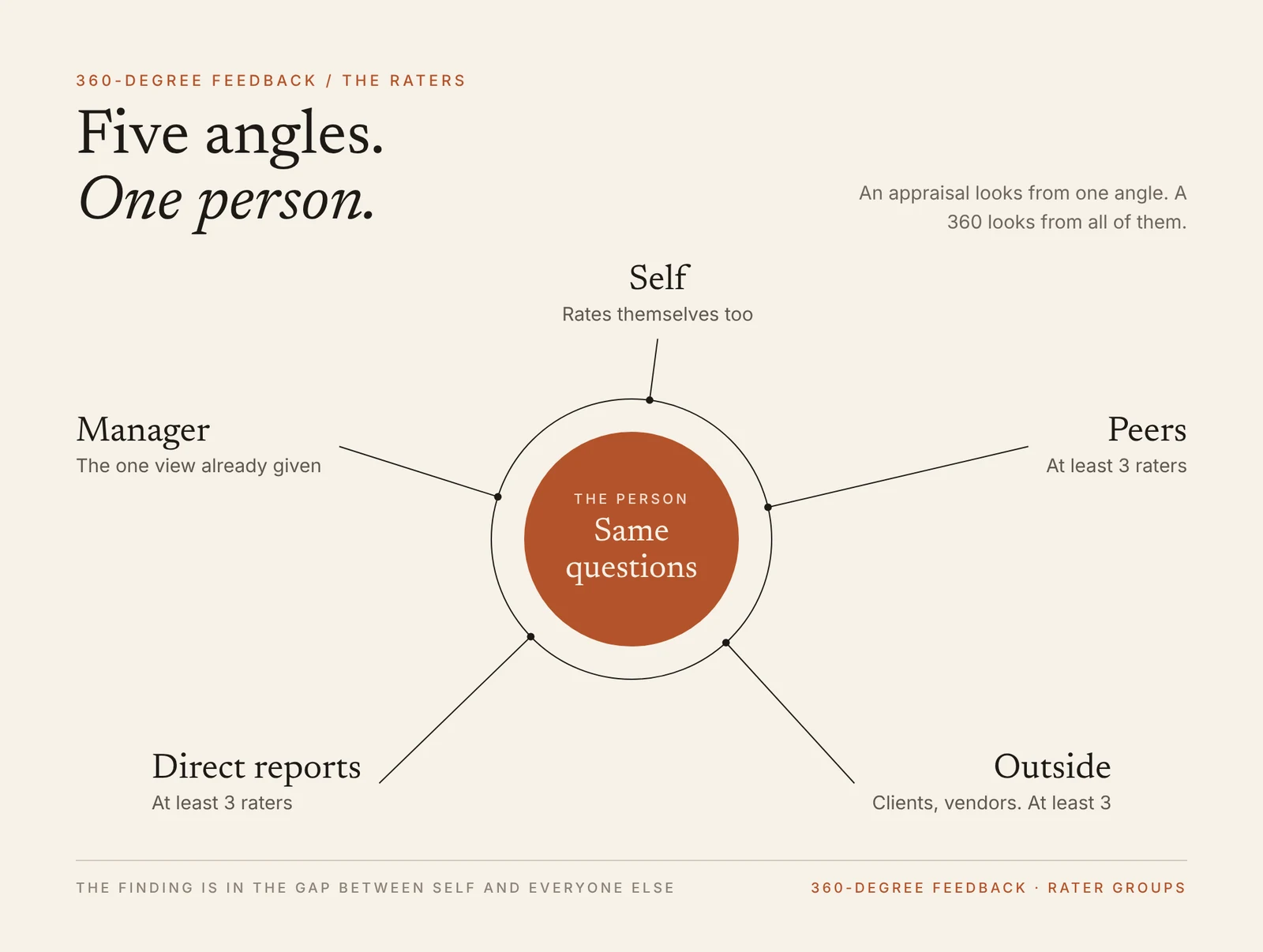
The name describes the geometry. A traditional appraisal looks at a person from one angle, their manager's. A 360 looks from all of them.
The raters usually fall into five groups.
- Self. The person rates themselves on the same questions everyone else answers.
- Manager. The one view the person already gets.
- Peers. People at the same level who depend on the person's work and see how they behave sideways.
- Direct reports. The people who experience the person's decisions, moods and follow-through every day.
- Outside. Clients, distributors or vendors, where the role faces them.
The finding is rarely in any single rating. It is in the gap between the self-rating and everyone else's, and in the gap between how the manager sees someone and how their team does. That gap is the blind pane of the Johari window, written down.
360-degree feedback and the Johari window
A 360 is the most formal way a company has of moving information from the blind pane into the open one.
The four quadrants of the Johari window separate what a person knows about themselves from what others know about them. The blind pane holds what others see and the person does not: the way a sales head interrupts, the way a plant manager goes quiet when a number is bad, the way an owner's "let me think about it" is heard as "no". Everyday feedback shrinks that pane slowly, one conversation at a time. A 360 tries to do it in one pass, with many voices at once.
That is its strength and its risk. Many voices at once can show a pattern no single conversation could. They can also land as a verdict, all at once, with no one in the room to explain it.
Appraisal or development: the decision that decides everything
A 360 used for development is read by the person, with someone they trust, to decide what to change. A 360 used for appraisal feeds a rating, an increment or a promotion.
The moment raters know that their answers will affect someone's increment, the answers change. Peers soften, because they will be rated in return. Reports soften, because they still report to the person. Managers who want to protect a favourite inflate. The instrument stops measuring behaviour and starts measuring relationships.
For a company of 20 to 200 people, the rule is simple. Run the 360 for development only, keep it out of the appraisal file, and say so in writing before anyone answers. Appraisal has its own instruments, and the performance review essay covers why even those miss most of what matters.
The 360-degree feedback process
Six stages, each one short.
- Decide the purpose and write it down. Development, not pay. Who sees the report: the person, and one named reviewer. Nobody else, including the owner.
- Choose the raters. The person proposes, their manager approves. At least three peers and at least three direct reports, so that no answer can be traced to one individual.
- Use a short questionnaire. Ten to fifteen behaviour statements, rated on a five-point scale, plus two open questions. Long forms produce tired answers.
- Collect anonymously, outside the building's politics. A neutral collector, an external firm or a simple form whose results only aggregate. Never through the person's own manager's inbox.
- Read the report with someone. A trusted senior, an HR partner or an outside facilitator. Alone, people read the lowest score and stop.
- Pick two things and tell the raters. Two behaviours to change, shared back with the people who gave the feedback. This is the step that earns honest answers the second time.
A 360-degree feedback questionnaire: twelve items
Rated from 1 (rarely) to 5 (almost always). Every item describes a behaviour someone can observe, not a trait someone has to guess.
- Makes decisions within the time the work needs them.
- Explains the reason behind a decision, not only the decision.
- Follows through on what they say they will do.
- Tells people early when something is going wrong.
- Listens to a disagreement without punishing it later.
- Gives credit in front of others and correction in private.
- Lets people own the work they have been given.
- Is the same person under pressure as on an ordinary day.
- Shares information others need without being asked.
- Treats people from other departments as partners, not obstacles.
- Asks for feedback on their own work.
- Is clear about what good work looks like.
Two open questions close the form. What should this person keep doing? What is one thing this person could do differently that would make your work easier?
The constructive feedback spoke covers how to turn the open answers into a conversation rather than a list of complaints.
Examples of what a 360 shows
The sales head who rates himself 5 on listening. His peers give him 4. His seven reports give him 2. Nobody is lying. He listens to his peers and to the owner, and he does not listen downward. He had no way to know that.
The plant manager the owner thinks is weak. The owner rates her 2 on decision-making. Her team and her peers give her 4. The pattern is not her indecision. It is that every decision she makes is reopened by the owner, so she has stopped making them in his presence. The decision bottleneck essay covers that mechanism.
The owner's son, two years into the business. High scores on energy and ideas. Low scores on follow-through and on explaining reasons. Read together, it is a person running in a seat that needs a different operating nature, not a person who is failing.
Why 360-degree feedback fails in small Indian companies
The method was designed for large organisations, and it travels badly without adjustment.
- Answers are traceable. In a team of four, "anonymous" means nothing. The person knows exactly who wrote the one low score.
- Hierarchy runs deep. In many Indian workplaces, rating a senior honestly feels like a breach of respect, so ratings cluster at the top of the scale.
- The owner wants to see everything. As in the Pune firm above, the moment the owner reads individual answers, the next round is worthless.
- It is tied to increments. Covered above, and the most common reason the results look perfect.
- Nothing happens afterwards. Raters who see no change stop answering honestly. The team that cannot give feedback essay covers what people learn when honesty goes nowhere.
When not to run a 360
Three conditions make a 360 do more harm than good.
When a group has fewer than three possible raters and anonymity cannot hold. When the company is in a restructuring, a layoff or a succession dispute and every answer will be read politically. And when the owner is not willing to go first.
The last one matters most. A 360 that covers every manager and excludes the owner tells the company that feedback flows one way. The owner's own 360 is the one with the widest blind pane, because, as the founder who cannot take feedback essay sets out, the people who see the owner most clearly are the people with the most to lose by saying so.
What a 360 cannot show
Context over conclusions.
A 360 shows how a person's behaviour is experienced. It does not show why. The sales head who does not listen downward may be overloaded, or in a role built for a different kind of person, or copying the owner. Read without that context, a 360 becomes a list of verdicts about a person, and the person defends against it instead of using it.
The Business Pulse reads the layer beneath the ratings: how your organisation actually runs, where decisions form and where they stall, and how much still routes through you. It needs one company document, asks no questions and is free, and it gives the 360 the context it was missing.
Questions people ask about 360-degree feedback
What is 360-degree feedback in simple words?
It is feedback on one person collected from everyone around them at work: their manager, peers, direct reports and sometimes clients, compared with the person's own self-rating. The answers are usually anonymous and grouped, so the person sees how their behaviour is experienced from every direction rather than only from their manager.
What is 360-degree feedback in HRM?
In human resource management it is a multi-rater feedback method used mainly for leadership development and sometimes as one input to appraisal. HR designs the questionnaire, chooses raters with the person's manager, protects anonymity, and arranges for the results to be read with a facilitator. Most practitioners advise keeping it separate from pay decisions.
What questions are asked in 360-degree feedback?
Ten to fifteen statements about observable behaviour, rated on a five-point scale: decision-making, follow-through, listening, sharing information, giving credit, handling disagreement, consistency under pressure. Two open questions usually close the form: what should this person keep doing, and what one change would make your work easier.
What are the advantages and disadvantages of 360-degree feedback?
Advantages: it shows gaps between self-view and others' view, surfaces patterns a single manager cannot see, and gives people below a voice. Disadvantages: anonymity fails in small teams, ratings inflate when tied to pay, results can land as verdicts, and the exercise loses trust when nothing changes afterwards.
How many raters are needed for 360-degree feedback?
At least three in every rater group other than self and manager, and usually eight to twelve in total. With fewer than three peers or three direct reports, answers can be traced to individuals, and people rate politely rather than honestly. Where a group is too small, merge it with another rather than report it separately.
Should a small company use 360-degree feedback?
Yes, for its senior people, if four conditions hold: it is for development and not pay, each rater group has at least three people, answers are collected by someone neutral, and the owner takes part first. Without those conditions, regular one-to-one feedback conversations will surface more and cost less.
Where to go deeper
- Johari Window — the model behind every 360: what you know, what others see, and the panes between.
- Blind Spot Meaning — the seven blind spots business owners share.
- Feedback: Meaning and Types — why feedback flows down easily and up badly.
- Constructive Feedback — how to say the hard thing without it becoming personal.
- Self-Awareness — why it gets harder the more senior you become.
- The Founder Who Cannot Take Feedback — the 360 most companies never run.
- Why the Performance Review Doesn't Work — what appraisal misses.