Constructive Feedback: Meaning, Examples, and How to Give It in an Indian Workplace Without It Becoming Personal

The accounts manager at an Indore pharma distributor sent the quarterly GST reconciliation two days late for the third time. The owner said, in front of four people, that he was not serious about his work. The manager has been precise about deadlines ever since, and has not raised a single problem with the owner in the eight months that followed.
Constructive feedback is feedback given to improve future work rather than to judge past work. It names one specific behaviour, describes its effect, and makes clear what would work better, in a way the person can act on without having to defend who they are. The test is simple: after hearing it, does the person know what to do differently next time? Everything else is either criticism or decoration.
This page gives the meaning, the difference from criticism, the Situation-Behaviour-Impact method, what changes in an Indian workplace, twelve before-and-after examples, and how an owner should receive it.
Constructive feedback meaning
Constructive feedback is corrective information delivered so that it builds the person's ability rather than their defences. The word "constructive" refers to the purpose, not the tone. Feedback can be gentle and useless, or direct and constructive.
It sits inside the wider family of feedback types: it is usually corrective, always specific and descriptive, and pointed at the future. In the Johari window, it is the main way a person learns what sits in their blind area, the things colleagues can see about their work that they cannot.
Constructive feedback, criticism and vague praise
Three kinds of response get called feedback. Only one of them changes anything.
- Destructive criticism judges the person. "You are careless." "You never think before you speak." It produces defence, not change, because the only available response is to argue about character.
- Vague praise or vague complaint judges nothing in particular. "Good job." "This needs more work." The person nods and has no idea what to repeat or fix.
- Constructive feedback describes one event and its effect. "In the client call, you quoted the delivery date before checking with the plant. The client is now expecting stock we do not have. Next time, tell them you will confirm by evening." The person knows exactly what happened and what to do.
The difference is not politeness. Destructive feedback can be said softly. Constructive feedback can be said bluntly. The difference is whether it is about the behaviour or about the person.
How to give constructive feedback: the SBI method
The most widely used structure comes from the Center for Creative Leadership: Situation, Behaviour, Impact. It works because it removes judgement and leaves only what was observed.
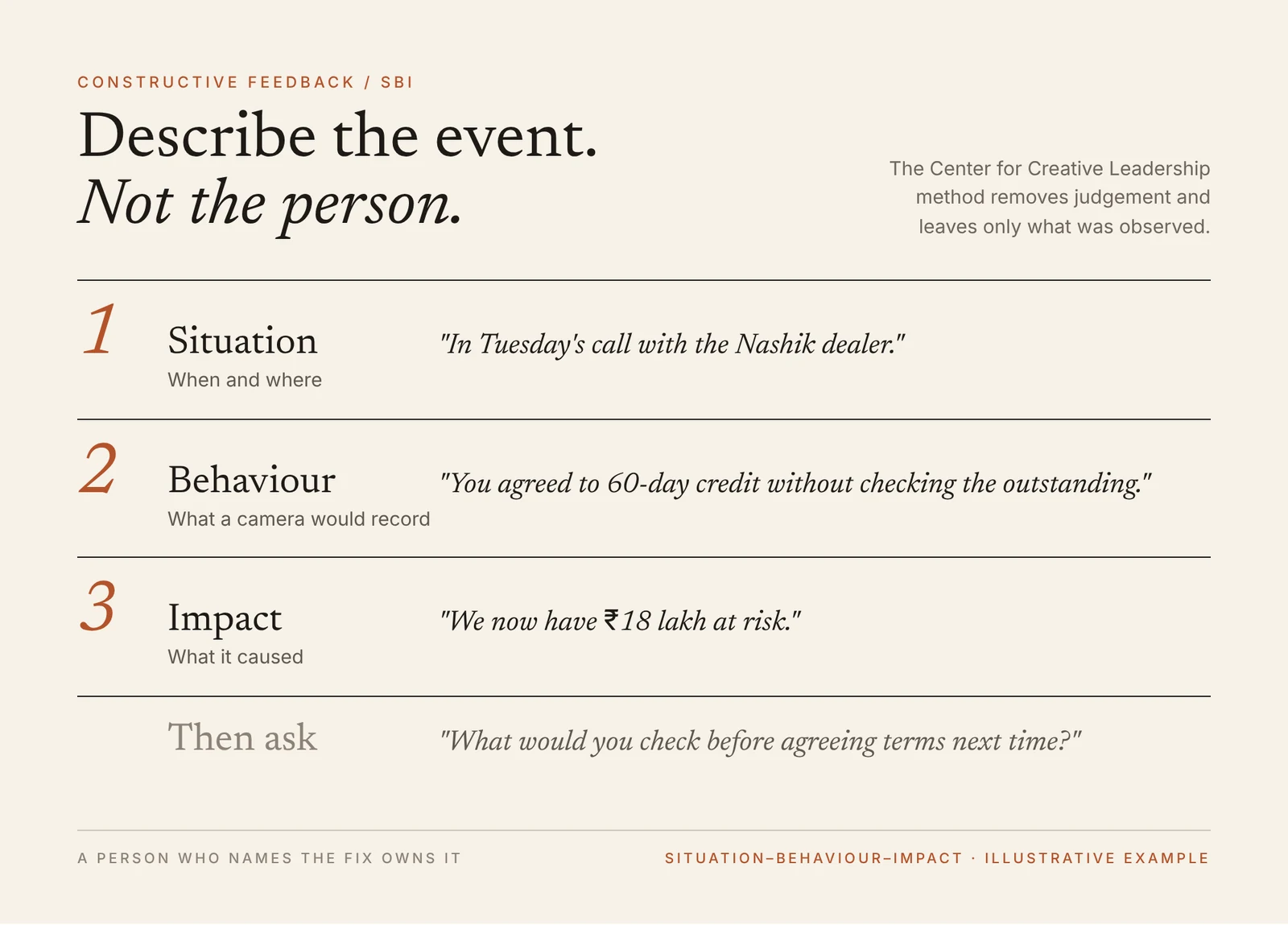
- Situation. When and where. "In Tuesday's call with the Nashik dealer."
- Behaviour. What the person did, as a camera would record it. "You agreed to 60-day credit without checking the current outstanding." Not "you were careless".
- Impact. What it caused. "We now have ₹18 lakh at risk with a dealer already 40 days overdue."
Then add the forward step, which SBI leaves implicit: what would work better, or a question that lets the person find it. "What would you check before agreeing terms next time?" A person who names the fix owns it.
What changes in an Indian workplace
The method travels. The setting needs adjusting.
- Private, always. Correction in front of others costs face, and the person will remember the audience long after they have forgotten the content. Praise can be public. Correction should not be.
- Hierarchy runs both ways. A junior will rarely disagree with feedback from the owner even when it is wrong. Ask for their account of the situation before giving yours, or you will never hear it.
- Family members are not exempt. If the owner's nephew receives no corrective feedback while everyone else does, the whole team notices, and the feedback given to others loses its authority.
- Timing. Within a day or two of the event. Saving it for the annual appraisal turns twelve small corrections into one ambush, as covered in why the performance review does not work.
- Language. Hinglish, regional language, whatever the person thinks in. Feedback understood at eighty percent is acted on at forty.
Constructive feedback examples
Twelve examples, each as it is usually said and as it would work.
- Missed deadline. Before: "You are always late." After: "The stock report came on Thursday instead of Monday. Purchase placed orders on last month's numbers. What got in the way?"
- Interrupting. Before: "Let others talk." After: "In today's review you answered two questions meant for Priya. She has stopped offering views in that meeting."
- Poor client email. Before: "This mail is unprofessional." After: "The mail to Mehta Traders had no order number and no date. They called twice to ask which shipment it was about."
- Not delegating. Before: "Learn to delegate." After: "You redid the dispatch plan Rakesh made. He has now stopped making one and waits for yours."
- Quality slip. Before: "Your work has gone down." After: "Three of the last ten invoices had the wrong HSN code. Two were rejected by the customer's system."
- Vague reporting. Before: "Your updates are useless." After: "The update said the project is on track. It did not say the vendor has not confirmed the install date, which is the thing I needed to know."
- Tone with team. Before: "You are too harsh." After: "When the packing error came up, you raised your voice on the floor. Two people asked HR to move shifts this week."
- Good work, unnoticed. Before: "Well done." After: "You flagged the duplicate vendor payment before it went out. That saved ₹3.2 lakh. Keep that check in the process."
- Overpromising. Before: "Stop making promises." After: "You told the distributor we would match the competitor's scheme. We cannot, and now we have to withdraw it."
- New manager micromanaging. Before: "Trust your team." After: "You asked for hourly updates on a two-day task. The team spent more time reporting than working."
- Avoiding conflict. Before: "Be more assertive." After: "When the production head pushed back on the date, you agreed in the meeting and then told me privately it is impossible. I need that said in the room."
- Feedback to the owner. Before: silence. After: "Sir, when the plan changes on Monday after we have briefed the team on Friday, the team stops trusting Friday briefings."
The last one is the hardest to say and the most valuable to hear. The how to talk to an employee about poor performance essay covers the conversation when the feedback has not worked and the stakes are higher.
How an owner should receive constructive feedback
Most writing on feedback is about giving it. In an owner-led company, receiving it matters more, because the owner's reaction decides whether anyone gives it again.
- Listen to the end. No correction of facts until the person has finished.
- Ask one question. "Can you give me another example?" shows you are taking it seriously and gets you better information.
- Thank them without arguing. You can disagree later, privately, after thinking about it.
- Change something visible. Within a week, and say why. That is the signal that it is safe to speak.
The when the founder cannot take feedback essay covers what happens when this goes wrong, and the when the team cannot give feedback essay covers the mirror case.
When feedback is not the problem
Constructive feedback fixes behaviour. It does not fix a mismatch.
If the same specific, well-delivered feedback has been given three times and nothing has changed, the person may be operating exactly as they are built to operate, in a seat that asks for something else. More feedback will not change that. The why good people underperform essay covers the pattern, and the Business Pulse reads how your organisation actually runs, where decisions form, where they stall, and how much still routes through you, so the pattern is visible before the fourth conversation.
Questions people ask about constructive feedback
What is the meaning of constructive feedback?
Constructive feedback is feedback given to improve future work. It names one specific behaviour, describes its effect, and makes clear what would work better, in a way the person can act on without defending their character. The word refers to its purpose, building ability, rather than to how gently it is said.
What is an example of constructive feedback?
"In Tuesday's dealer call you agreed to 60-day credit without checking the outstanding. We now have ₹18 lakh at risk. Before agreeing terms, check the ledger first." It names the situation, the behaviour and the impact, and points to the next action, without calling the person careless.
How do you give constructive feedback?
Use Situation, Behaviour, Impact: say when it happened, describe what the person did as a camera would, and state the effect. Then ask what would work better next time. Give it privately, within a day or two, about one event, and ask for their account before giving yours.
What is the difference between constructive feedback and criticism?
Criticism judges the person, such as "you are careless", and produces defence. Constructive feedback describes a specific behaviour and its effect, and points to what would work better, so the person can change it. The difference is focus on behaviour rather than character, not softness of tone.
What is the SBI feedback model?
SBI stands for Situation, Behaviour, Impact, a structure developed by the Center for Creative Leadership. The giver describes where and when something happened, what the person observably did, and what effect it had. It removes judgement from feedback and leaves only what was seen and what it caused.
How should a manager respond to constructive feedback?
Listen to the end without correcting, ask for one more example, and thank the person without arguing in the moment. Then change something visible within a week and say why. For an owner, the reaction matters more than the feedback, because it decides whether anyone speaks up again.
Where to go deeper
- Johari Window — the four areas, and how feedback shrinks the blind one.
- Feedback Meaning — definition, types, importance, and why it stops reaching the owner.
- 360-Degree Feedback — when a structured round is worth it in a small company.
- Blind Spot Meaning — the seven blind spots owners share.
- Self-Awareness — why it gets harder the more senior you become.
- The Hard Work of Giving Good Feedback — beyond the template.
- How to Talk to an Employee About Poor Performance — when the stakes are higher.