Blind Spot Meaning: In Leadership, in the Johari Window, and the Seven Blind Spots Business Owners Share

Every eye has a gap in its field of vision, where the optic nerve leaves the retina and there are no light-sensitive cells. Nobody walks around with a dark patch in their sight, because the brain fills the gap with whatever surrounds it. The missing piece does not look missing. It looks like more of the same.
A blind spot is an area a person cannot see from where they stand. In the eye it is the point on the retina with no receptors. In leadership and the Johari window, it is something about you that others can clearly see and you cannot: a habit, a reaction, an effect you have on people. What defines it is that it does not feel like a gap. That is what makes it different from ignorance.
This page gives the meaning in its three senses, the blind spot in the Johari window, seven blind spots business owners commonly share, and how a blind spot gets smaller.
Blind spot meaning, in three senses
The word is used in three ways, and the first explains the other two.
In the eye. The physical blind spot, about 15 degrees from the centre of each eye's field of vision. You can find yours with a dot, a cross and one eye closed. The brain does not show the gap. It completes the picture.
On the road. The area beside and behind a vehicle that the mirrors do not cover. A driver can check every mirror and still miss the scooter in it. Safety depends on knowing the spot exists and turning your head.
In people. A pattern in your own behaviour that is visible to others and invisible to you. The same mechanism applies: the mind fills the gap with a flattering or familiar story, so there is nothing to notice.
The blind spot in the Johari window
The Johari window, created by Joseph Luft and Harrington Ingham in 1955, divides what is true about a person into four areas. The blind area, sometimes called the blind self, is the top-right pane: known to others, not known to self.
It holds things like the way your voice changes when you disagree, the person you visibly favour, the expression you make when a number disappoints you, and the meetings in which you are not actually listening. Colleagues discuss these. You do not, because you have no access to them.
The only way the blind area shrinks is through feedback: someone tells you what they see. The four quadrants spoke covers how each pane grows and shrinks, and the self-awareness spoke explains why the blind area usually grows with seniority rather than shrinking.
A blind spot example from an ordinary office
An Indore pharma distributor prides himself on being calm. He never raises his voice. His managers describe him differently: when he is unhappy he goes quiet, stops looking at the speaker and starts typing on his phone. Everyone in the room knows the proposal is dead. He believes he is still listening.
He is not lying about being calm. By his own definition he is. The blind spot is not in what he feels, it is in what he shows, and his team has spent four years adjusting to a signal he does not know he sends.
Seven blind spots business owners commonly share
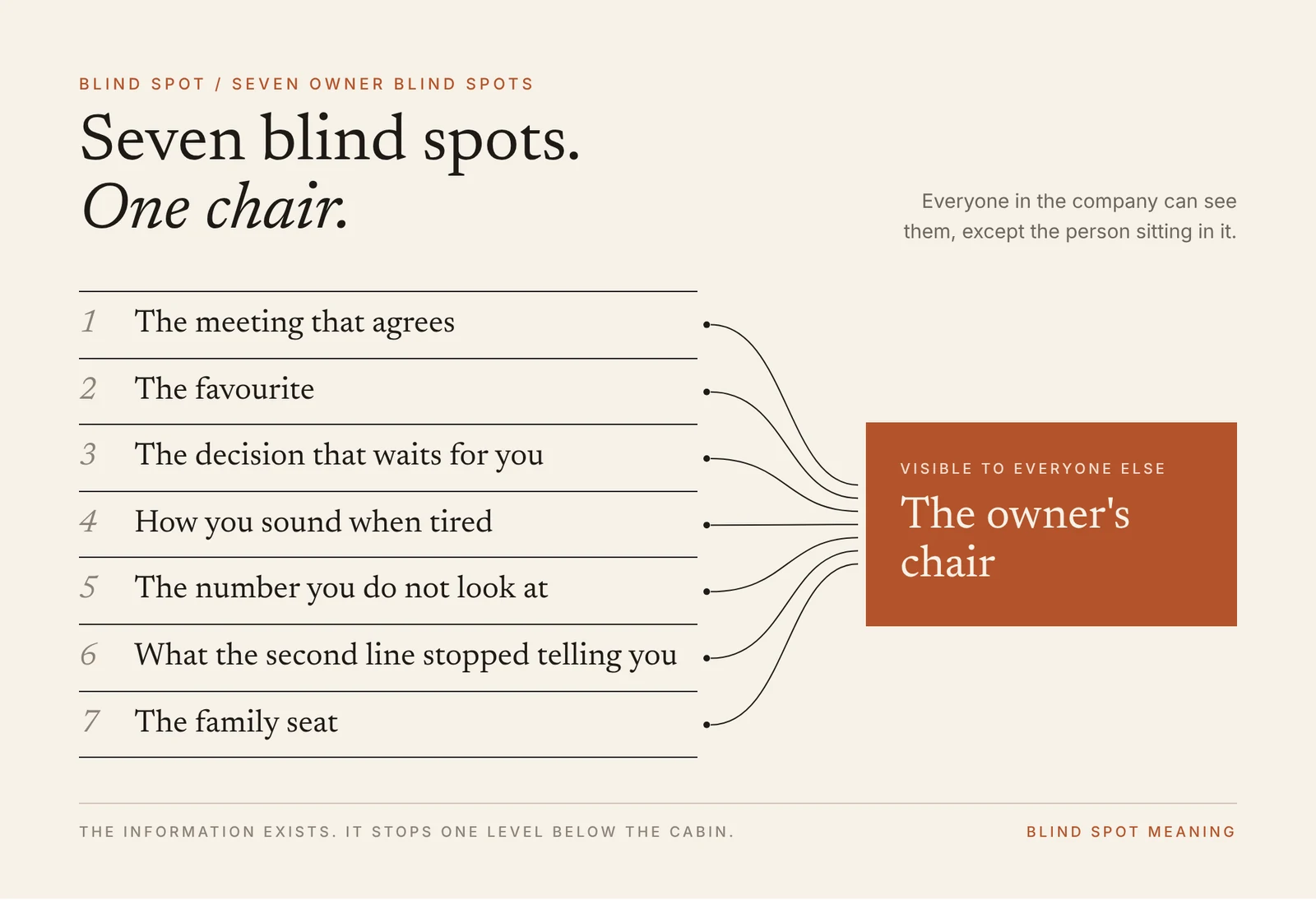
Every owner's set is different. These seven recur often enough in Indian owner-led companies to be worth checking.
- The meeting that agrees. The owner reads agreement as alignment. The team reads the owner's opening view and agrees with it. The leadership team agrees too easily essay covers this one.
- The favourite. Usually the longest-serving manager, or a relative. The owner sees loyalty. Everyone else sees a different set of rules.
- The decision that waits for you. The owner believes he delegates. The team knows that anything important will be reopened when he returns, so they wait. The decision bottleneck essay covers the cost.
- How you sound when tired. The late-evening voice note, the short reply, the Sunday message. The owner forgets it by Monday. The recipient does not.
- The number you do not look at. Every owner has one: receivables over 90 days, a product line that has never made money, attrition in one department. It is not hidden. It is simply never opened.
- What the second line has stopped telling you. The absence of bad news feels like good news. It is usually the opposite. The organisational silence essay describes how it starts.
- The family seat. In family businesses, the owner sees a son or nephew learning the business. The professional managers see a future boss they cannot disagree with, and adjust now.
Why blind spots grow with authority
A junior employee's blind spots are pointed out regularly, by a manager, a peer, a client. An owner's are pointed out rarely, because pointing them out carries a risk for the person doing it.
The owner controls increments, promotions and in many companies the informal standing that matters more than either. Telling him something unwelcome is a bet with an uncertain payoff. Most people decline the bet, reasonably. The why loyal teams miss what honest ones see essay covers what that does to a company over time.
So the blind area of the most powerful person in the company tends to be the largest one in the building, and the least discussed.
How a blind spot gets smaller
A blind spot cannot be found by looking harder, for the same reason the eye's cannot. It needs a second vantage point. Five practices produce one.
- Ask about specific behaviour. "What do I do when I disagree in a meeting?" gets a real answer. "Do I have blind spots?" gets a polite one.
- Make it safe once, visibly. The first person who tells the owner something uncomfortable is watched by everyone. How the owner responds decides whether there will be a second.
- Use a structured exercise. The Johari window test gives people a format and a fixed vocabulary, which makes honesty easier than open conversation does.
- Collect feedback from more than one direction. 360-degree feedback does this formally, with conditions that matter a great deal in a small company.
- Treat the pattern, not the person who raised it. If the response to feedback is a question about who said it, the blind spot has just grown.
The blind spot in the organisation itself
Companies have blind spots the way people do. A pattern in how decisions move, or where they stall, can be visible to every employee and invisible to the person who designed the company, because the company was built around his way of seeing.
The Business Pulse reads how your organisation actually runs, where decisions form, where they stall and how much still routes through you, from one company document and without asking anyone a question. It works as the second vantage point. What the owner does with it stays his call.
Questions people ask about blind spots
What is the meaning of blind spot?
A blind spot is an area you cannot see from your position. In the eye, it is the point on the retina where the optic nerve exits and no light is detected. In people and leadership, it is a pattern in your behaviour that others can clearly see but you cannot, usually because your mind fills the gap with a familiar story.
What is a blind spot in the Johari window?
In the Johari window, the blind area or blind self is information about you that others know and you do not: habits, reactions, mannerisms, the effect you have on people. It is one of four panes, and it shrinks only through feedback, when someone tells you what they observe.
What is an example of a blind spot in psychology?
A manager who believes she is calm but goes silent and stops making eye contact when she disagrees. Her team reads the signal immediately and drops the proposal. She thinks she is still listening. She is accurate about her feelings and unaware of what her behaviour shows.
What are common leadership blind spots?
Reading agreement as alignment, favouring a long-serving manager or relative, believing you delegate while decisions wait for you, how you sound when tired, a number you never open, the silence of the second line, and how professional managers react to a family successor. Each is visible to the team and rarely raised.
Why do leaders have more blind spots than employees?
Because fewer people tell them. Pointing out a leader's blind spot carries risk for the person doing it, since the leader controls pay, promotion and standing. Most people stay silent, so the most senior person in the company often has the least accurate picture of how he comes across.
How do you find your own blind spots?
You cannot find them by reflection alone, because the gap does not feel like a gap. Ask colleagues about specific behaviours, run a structured exercise like the Johari window test, collect feedback from several directions, and respond to the first uncomfortable answer in a way that makes a second one possible.
Where to go deeper
- Johari Window — the meaning, the four quadrants, examples and the owner's blind spot.
- The Four Quadrants of the Johari Window — open, blind, hidden and unknown, explained for leaders.
- Self-Awareness — meaning, types, and why it thins with seniority.
- Feedback — meaning, types, and why it stops reaching the owner.
- 360-Degree Feedback — process, questionnaire, and whether a small company should do it.
- Why Loyal Teams Miss What Honest Ones See — the cost of a team that protects the owner.
- The Founder's Undiscussable — the subject everyone avoids.