Feedback: Meaning, Definition, Types, Importance, and Why It Stops Reaching the Owner

The owner of a 70-person auto-components firm in Pune asks for feedback at the end of every monthly review. The room goes quiet, someone says the new process is working well, and the meeting closes on time. Three weeks later the plant head resigns, and the reason he gives is something he says he raised many times.
Feedback is information about the effect of an action, returned to the person or system that acted, so the next action can be adjusted. At work it means telling someone how their behaviour, work or decision landed: what it produced, how it was received and what it changed. Its value depends less on how it is phrased than on whether it reaches the person who needs it. The last part is where most companies fail, and it fails hardest at the top.
This page gives the meaning and definition of feedback, its use in communication, the types, why it matters, the difference between positive and negative feedback, and why the most senior person in a company receives the least of it.
Feedback meaning and definition
The word comes from engineering. In a control system, part of the output is fed back into the input so the system can correct itself: a thermostat reads the room and switches the heater off. Without that loop the system runs blind and overshoots.
Organisations borrowed the idea directly. A manager acts, the effect is observed, the observation returns to the manager, the manager adjusts. When the loop works, a company corrects small errors before they become expensive ones. When it breaks, the company keeps producing the same error at full speed, and calls it a culture problem later.
In everyday Indian office usage, feedback has narrowed to mean a comment on someone's performance, usually from a senior to a junior, usually during an appraisal. That narrowing is part of the problem. Feedback is any returned signal, in any direction, at any time.
Feedback in communication
In communication models, feedback is the receiver's response that tells the sender whether the message arrived as intended. A nod, a question, a wrong action taken on a clear instruction: all are feedback.
Without it, communication is one-way. The owner who sends a long voice note to the sales group and receives three thumbs-up has sent a message, not completed a communication. He does not know whether it was understood, disagreed with or ignored. The interpersonal communication spoke covers the full loop, and the workplace communication problems essay covers why most of what gets filed as poor communication is something else.
Types of feedback
Seven distinctions are worth knowing. Most feedback is several of these at once.
- Positive or reinforcing. Tells someone what worked so they repeat it. Underused in most Indian SMEs, where good work is treated as the job and only errors are mentioned.
- Negative or corrective. Tells someone what did not work so they change it. The constructive feedback spoke covers how to give it without it becoming personal.
- Formal and informal. Appraisals and reviews are formal. A sentence in the corridor after a client call is informal, and usually more useful because it arrives while the event is fresh.
- Downward, upward and peer. From manager to report, from report to manager, between equals. Each flows at a very different rate.
- Evaluative and descriptive. "Good presentation" judges. "You answered the pricing question before the client finished asking it" describes. Descriptive feedback is usable. Evaluative feedback mostly tells the person how you feel.
- Specific and general. "Be more proactive" is general and unactionable. Feedback attached to one event is specific.
- Feedback and feedforward. Marshall Goldsmith's term for suggestions about the future rather than judgements about the past. It is easier to hear, because nobody can argue with a suggestion about next week.
The difference between positive and negative feedback
Positive feedback strengthens a behaviour. Negative feedback is meant to reduce or redirect one. In systems language the terms mean something slightly different: positive feedback amplifies a change, negative feedback dampens it towards stability. At work, the everyday meaning is the one people use.
Two practical points matter more than the definition. First, negative feedback without positive feedback trains people to hide, because the only time they hear from the owner is when something is wrong. Second, positive feedback that is vague ("well done, team") reinforces nothing in particular. Reinforcement needs the same specificity as correction.
Why feedback is important
Feedback is the only mechanism by which a person or a company learns what its own actions produce. Everything else is assumption.
For an individual, it closes the gap between intention and effect. A manager who believes he is approachable and a team that experiences him as impatient will both be right until someone tells him. In the language of the Johari window, feedback is what shrinks the blind area: the things others can see about you that you cannot. The blind spot spoke covers what typically sits there for an owner.
For a company, feedback is the error-correction system. Every process that works today worked because someone noticed what was not working and said so. A company that cannot carry bad news upward does not have fewer problems. It has older ones.
Why feedback stops reaching the owner
Feedback flows downhill easily and uphill badly. Every layer of authority between two people reduces what the junior one will say.
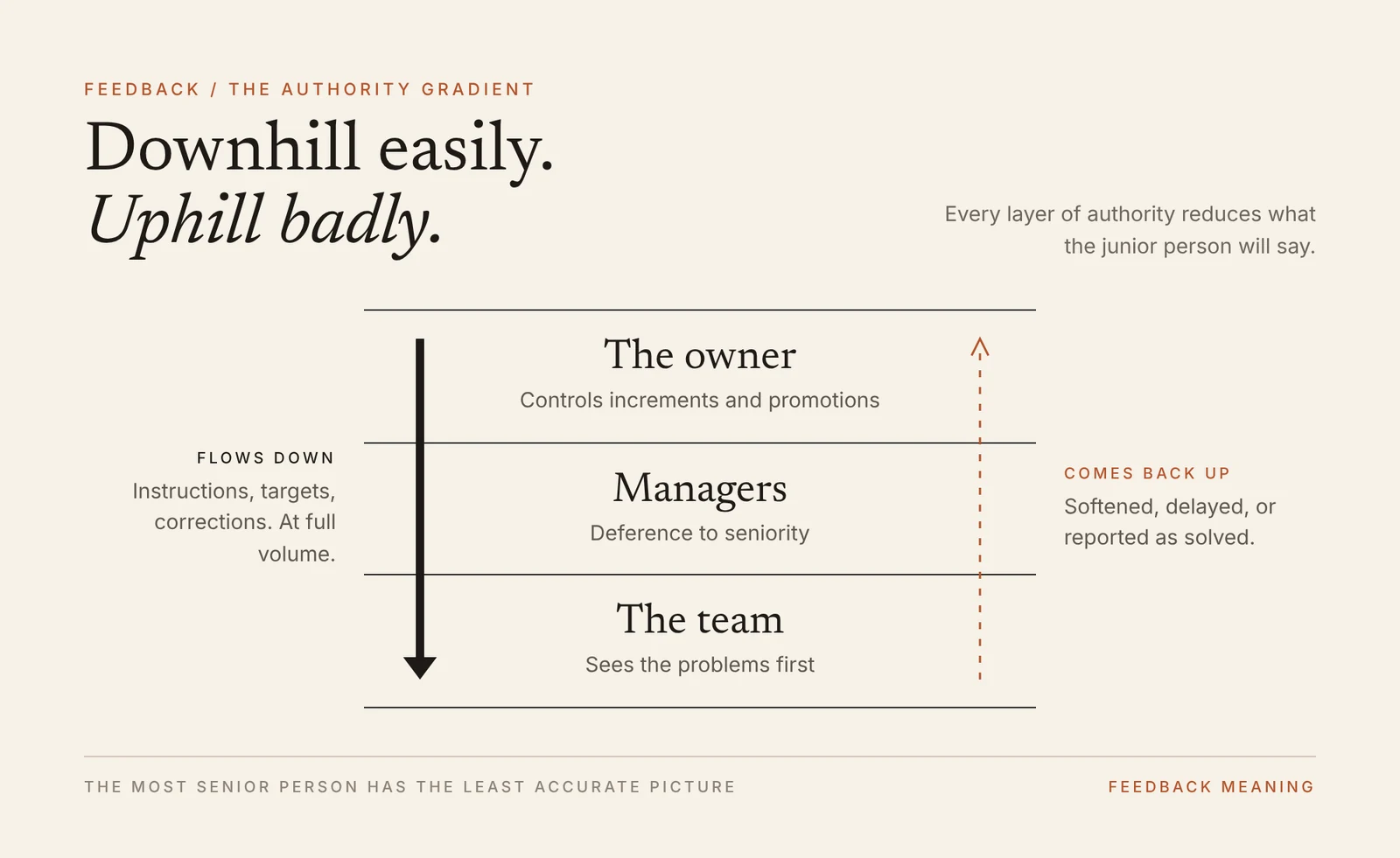
The mechanics are not mysterious. The owner controls increments, promotions and sometimes the job itself. Telling him something unwelcome carries a cost with no visible return. Indian workplace norms add a layer: deference to seniority, the instinct to protect face in front of others, and in family businesses, the difficulty of telling the founder's son that his plan will not work.
So the information the owner receives is filtered at each level. Problems are softened, delayed or reported as solved. The result is the pattern described in why founders cannot take feedback and organisational silence: the most senior person in the company has the least accurate picture of it, and is usually the last to find out.
The owner's own behaviour sets the rate. One defensive reaction in a meeting is remembered for a year. One visible change made because someone spoke up is remembered for longer.
How to get feedback that is true
Asking "any feedback?" at the end of a meeting produces silence. Six things produce more.
- Ask a specific question. "What is one thing about how I run the Monday review that slows you down?" gets an answer. "Any feedback?" does not.
- Ask one person, privately. Groups protect each other. One person in a closed room says more.
- Thank the first uncomfortable answer. Then act on something small within a week, visibly. That is how the second answer arrives.
- Separate it from money. Feedback given in the same conversation as the increment is never honest.
- Use a structured round when the stakes are higher. The 360-degree feedback spoke covers when that is worth doing in a small company, and the Johari window exercise is a lighter version for a leadership team.
- Watch behaviour as well as words. Who stopped speaking in meetings, which decisions keep coming back, who leaves early on review days. That is feedback too.
What feedback cannot show
Feedback tells you how an action landed. It does not tell you why the same thing keeps happening.
When the same correction is given to the same person for the third time, the problem is rarely the feedback. It is usually the fit between how that person operates and what the seat asks of them, or a pattern in how decisions move through the company that no conversation will change. The Business Pulse reads how your organisation actually runs, where decisions form, where they stall, and how much still routes through you, from one company document and without asking anyone a question.
Questions people ask about feedback
What is the meaning of feedback?
Feedback is information about the effect of an action, returned to the person who acted so they can adjust what they do next. At work it covers comments on behaviour, results and decisions, in any direction: from manager to employee, employee to manager, or between colleagues, formally or informally.
What is feedback in communication?
In communication, feedback is the receiver's response that shows the sender whether the message was understood as intended. It can be spoken, written or non-verbal, such as a question, a nod or an action. Without it, communication is only one-way transmission, and the sender cannot know what actually arrived.
What are the types of feedback?
The common types are positive or reinforcing, negative or corrective, formal and informal, downward, upward and peer, evaluative and descriptive, and specific and general. Feedforward, a term from Marshall Goldsmith, refers to suggestions about future behaviour rather than judgements about the past, and is often easier to receive.
What is the difference between positive and negative feedback?
Positive feedback tells someone what worked so they repeat it. Negative feedback tells them what did not work so they change it. Both need to be specific and tied to one event. Negative feedback given without any positive feedback trains people to hide problems rather than raise them.
Why is feedback important in the workplace?
It is the only way a person or company learns what its actions actually produce. It closes the gap between intention and effect, shrinks blind spots, and corrects small errors before they become expensive. A company that cannot carry unwelcome information upward does not have fewer problems, only older ones.
Why do senior leaders get less feedback?
Because each layer of authority raises the cost of saying something unwelcome. The owner controls pay and promotion, so information reaching him is softened or delayed at every level. In Indian workplaces, deference to seniority and protecting face add to the filter. The most senior person often has the least accurate picture.
Where to go deeper
- Johari Window — the four areas of what you and others know about you, and where feedback fits.
- Constructive Feedback — meaning, examples, and how to give it in an Indian workplace.
- 360-Degree Feedback — process, questionnaire, and whether a small company should do it.
- Blind Spot Meaning — the seven blind spots business owners share.
- Interpersonal Communication — meaning, types, barriers, and the full loop.
- When the Founder Cannot Take Feedback — the cost of a filter at the top.
- The Hard Work of Giving Good Feedback — why it takes more than a template.