Self-Disclosure: Meaning, Theory, Examples, and How Much a Leader Should Actually Say

The owner of a Chennai logistics company decided in March to stop bidding for one large client's contracts. He told nobody why. By June his operations head had concluded the company was in trouble, two managers had started interviewing elsewhere, and the sales team was quietly discounting to win anything it could. The reason was simple and harmless. Nobody had been told it.
Self-disclosure is the act of deliberately telling others something about yourself that they would not otherwise know: your reasons, intentions, feelings, experience or uncertainty. In communication theory it is how relationships deepen and trust is built. In the Johari window it is what shrinks the hidden area, the part of you that you know and others do not. At work, it is mostly about reasons.
This page gives the meaning, the theory behind it, examples, the levels of disclosure, and the practical question a leader faces: what to say, and what to keep.
Self-disclosure meaning
Self-disclosure means sharing information about yourself on purpose. Three conditions make it disclosure rather than simple talk: the information is about you, it is not already known, and you chose to share it.
"I am worried about this quarter" is self-disclosure. "Sales are down 12%" is not, because it is about the business and is already in the report. "I turned down that contract because the payment terms would have stretched our working capital for a year" is self-disclosure of the most useful kind for a leader: the reasoning behind a decision.
In the Johari window, created by Joseph Luft and Harrington Ingham in 1955, disclosure is the movement that turns hidden information into open information. The four quadrants spoke shows how that movement changes the shape of the window.
Self-disclosure theory
The best-known account is social penetration theory, developed by Irwin Altman and Dalmas Taylor in 1973. It describes relationships as moving from the surface inward, the way you would peel an onion, along two dimensions.
Breadth. How many areas of your life or work you share: family, health, ambitions, money, doubts.
Depth. How personal the sharing is within each area: from facts to opinions to feelings to the things you are least sure of.
Two further findings matter at work. Disclosure tends to be reciprocal: when one person shares, the other usually matches the level. And it is calibrated: disclosure that jumps too deep, too early, makes people uncomfortable rather than closer.
Levels of self-disclosure
Communication texts often describe disclosure as rising through levels. A workplace version:
- Facts. Where you worked before, how the company started, what your day looks like.
- Reasons. Why you made a decision, what trade-off you weighed, what you chose not to do.
- Opinions. What you actually think of a plan, a market or a proposal, said before the room has formed its view.
- Uncertainty. What you do not know, what worries you, where you might be wrong.
- Feelings and personal history. Pressure, fatigue, a family matter that is affecting your availability.
Most owners disclose comfortably at the first level and rarely at the second, which is the one their team most needs.
Self-disclosure examples at work
- The reason behind a hold. "I am not approving the new branch this year. Not because the numbers are bad, but because I do not yet have a manager I would trust to run it without me." The team now knows what would change the answer.
- A known weakness. A founder telling her new COO, "I lose interest in anything once it is working. Hold me to the follow-through." That one sentence sets up the relationship.
- Uncertainty, stated plainly. "I do not know whether this price increase will hold. We will look at it again in eight weeks." The sales team stops guessing at the owner's confidence.
- Experience that explains a habit. A Surat textile owner explaining that he insists on cash reserves because his father nearly lost the firm in a credit squeeze. The rule stops looking arbitrary.
How much should a leader actually disclose
The useful rule: disclose what helps other people do their work and read your decisions; keep what would burden them or is not yours to share.
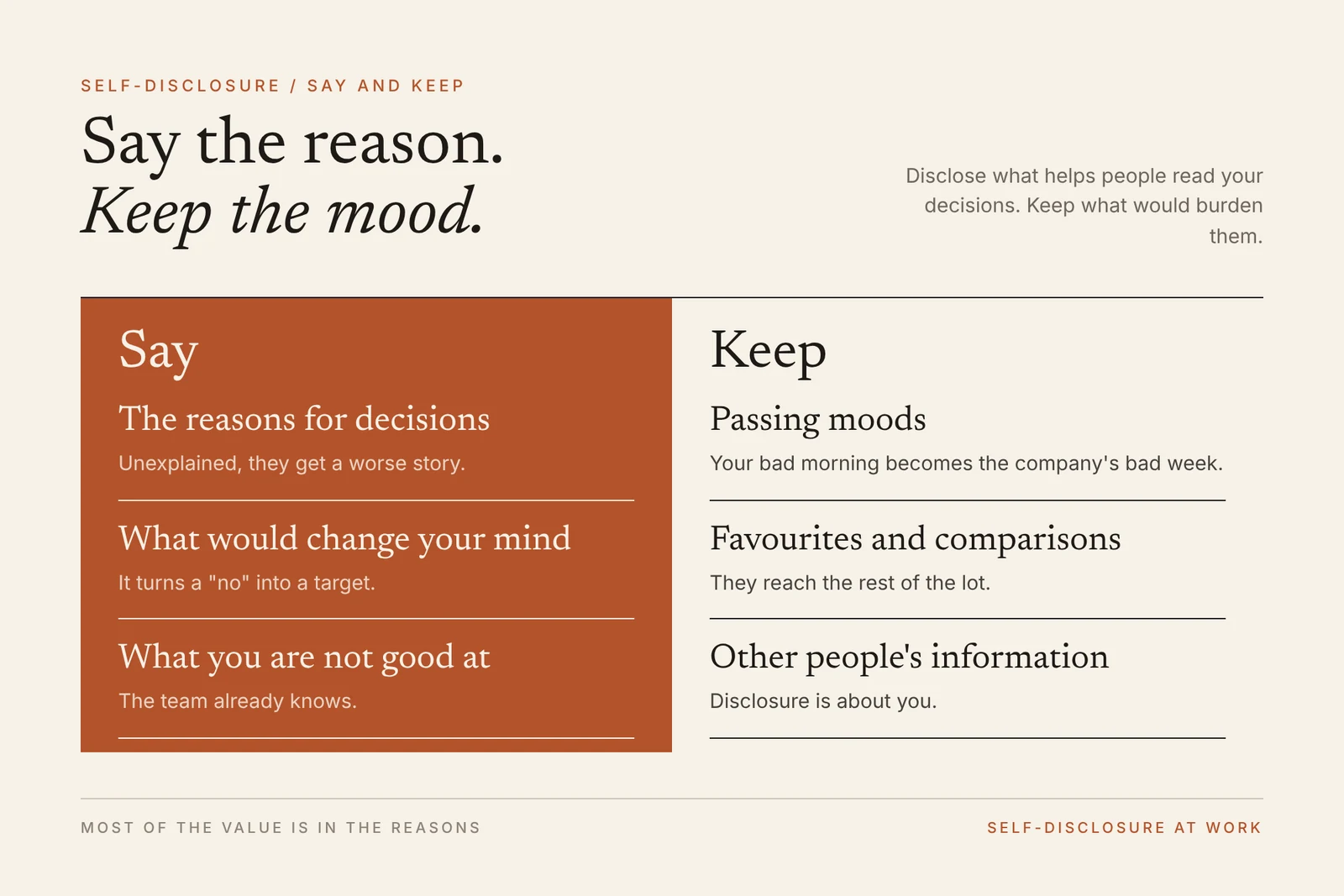
Say: the reasons for decisions. Unexplained decisions are filled in by the team, usually with a worse story than the real one, as the Chennai example shows.
Say: what would change your mind. It turns a "no" into a target.
Say: what you are not good at. The team already knows. Saying it gives them permission to cover it rather than work around it.
Keep: passing moods. An owner's bad morning, announced, becomes the company's bad week.
Keep: favourites and comparisons. "Between us, he is the best of the lot" reaches the rest of the lot.
Keep: other people's information. Disclosure is about you. Sharing a colleague's situation is something else.
Self-disclosure and oversharing
The opposite failure is real. A leader who shares every worry hands the team his anxiety without anything it can act on. A leader who shares personal detail too early, too deep, makes the relationship about him.
The test is direction. Good disclosure gives the listener something useful: context, a reason, a boundary, a way to help. Oversharing asks the listener to carry something. The first builds trust. The second spends it.
The leader who cannot be read essay covers the leader who discloses too little. The trust is infrastructure, not a feeling essay covers what disclosure builds when it is done well.
Disclosure and feedback work together
In the Johari window, disclosure shrinks the hidden area and feedback shrinks the blind spot. They depend on each other. A leader who discloses invites disclosure back, and a team that knows the leader's reasoning finds it easier to tell him where the reasoning is wrong.
That is why the Johari window test works best when the owner goes first. The self-awareness spoke covers the other half of the picture, what the leader knows about himself before he decides what to share.
What the company has not been told
An owner's hidden area does not stay private. The company works around it: decisions read as moods, holds read as trouble, silence read as disapproval. The pattern becomes the company's way of operating.
The Business Pulse reads how your organisation actually runs, where decisions form, where they stall and how much still routes through you, from one company document with no questions to answer. It shows where unexplained decisions are shaping the organisation. The owner decides what to say about them.
Questions people ask about self-disclosure
What is the meaning of self-disclosure?
Self-disclosure is deliberately sharing information about yourself that others would not otherwise know: your reasons, feelings, intentions, experiences or doubts. It differs from ordinary talk because it is personal, not already known, and chosen. In relationships and at work, it is one of the main ways trust and understanding are built.
What is self-disclosure in communication?
In communication, self-disclosure is the process of revealing personal information to another person so they understand you better. Social penetration theory by Altman and Taylor describes it moving from surface facts to deeper feelings over time. Disclosure tends to be reciprocal, so when one person shares, the other usually responds at a similar level.
What is self-disclosure in the Johari window?
In the Johari window, self-disclosure is the movement that shifts information from the hidden area, known to you but not to others, into the open area, known to both. It is paired with feedback, which shrinks the blind area. Together they enlarge the open area, where communication works best.
What are examples of self-disclosure?
Explaining the reasoning behind a business decision, admitting a weakness to a new colleague, saying plainly that you are uncertain about an outcome, or describing a past experience that explains a habit. At work, the most useful disclosure is usually about reasons rather than feelings.
Why is self-disclosure important?
Because people fill information gaps with their own stories, which are often worse than the truth. Disclosure gives others context to read your decisions, invites honesty in return and builds trust. In leaders it matters more, since an unexplained decision by the owner is interpreted by the whole company.
How much should a leader self-disclose?
Enough for others to do their work and understand your decisions: share reasons, what would change your mind, your known weaknesses and genuine uncertainty. Keep passing moods, favourites, other people's information and anything that only asks the listener to carry your anxiety. The test is whether the disclosure gives the listener something useful.
Where to go deeper
- Johari Window — the meaning, the four quadrants, examples and the owner's blind spot.
- The Four Quadrants of the Johari Window — how the hidden area grows and shrinks.
- Self-Awareness — meaning, types, and why it thins with seniority.
- Blind Spot Meaning — the pane that only feedback can shrink.
- Interpersonal Communication — meaning, types, examples and barriers.
- The Leader Who Cannot Be Read — the cost of disclosing too little.
- Trust Is Infrastructure, Not a Feeling — what disclosure builds.