The Four Quadrants of the Johari Window: Open, Blind, Hidden and Unknown, Explained for Leaders

Every owner has a version of the same story. A senior person resigns, and in the exit conversation says something the owner has never heard before, about the way decisions are made or the way a manager behaves. The owner is surprised. Nobody else in the company is.
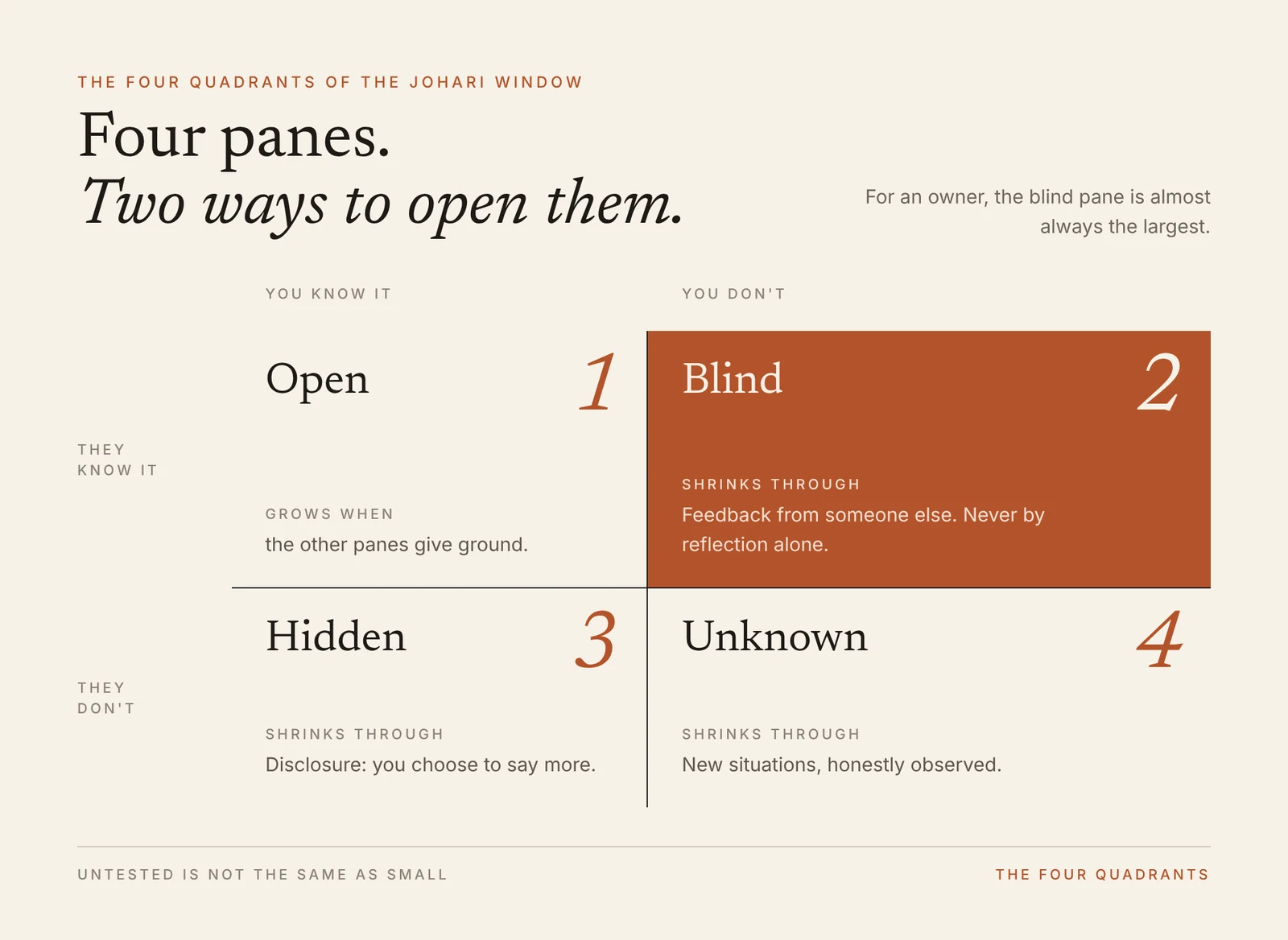
The four quadrants of the Johari window are the open area (known to you and to others), the blind area (known to others but not to you), the hidden area (known to you but kept from others) and the unknown area (known to nobody). The quadrants are not fixed in size: feedback shrinks the blind area, disclosure shrinks the hidden area, and both together enlarge the open area. The owner's surprise in the exit conversation is the blind area becoming visible too late.
This page explains each quadrant: what it holds in a company, why it grows or shrinks, and what it usually looks like for a business owner. The Johari window pillar covers the model as a whole.
Where the four quadrants come from
Joseph Luft and Harrington Ingham, two American psychologists, drew the window in 1955 as a model of interpersonal awareness in groups. The name joins their first names, Joe and Harry. Luft developed it further in his 1969 book Of Human Interaction.
The model has two axes. One asks whether something is known to the self. The other asks whether it is known to others. Two axes, two answers each, four panes. The simplicity is the reason it has lasted seventy years and is still taught in every organisational behaviour course in India.
The panes are sometimes given other names. The open area is also called the arena. The hidden area is also called the façade. The blind area is the blind spot. The unknown area keeps its name.
Quadrant 1: the open area, or arena
The open area holds what you know about yourself and what others also know about you. Your role, your skills, your obvious habits, your stated priorities.
In a company, the open area is where work moves fastest. When a team knows how the owner decides, what he cares about and what he will not accept, people act without checking. When the open area is small, every task carries a hidden question about what the owner will think, and work slows to the speed of asking.
A large open area is not the same as being liked or being transparent about everything. It means the people you work with can anticipate you accurately. That is the most practical definition of trust in an office, and the trust is infrastructure essay develops it.
Quadrant 2: the blind area
The blind area holds what others know about you and you do not. How you sound when you are tired. That your questions read as verdicts. That a particular manager gets away with things because you like him. That the team stops talking when you enter.
For an owner the blind area is almost always the largest of the four, for a structural reason: the people who could fill it in depend on the owner for their salary, their increments and, in a family business, sometimes their relationships at home. Feedback flows down easily in an Indian company and up with great difficulty.
The blind area also holds strengths. People often cannot see what they are good at, because it comes easily to them. The blind spot meaning spoke covers the seven blind spots owners share, and the founder who cannot take feedback essay covers what happens when nobody is allowed to fill this pane in.
The only way to shrink the blind area is feedback from someone else. It cannot be reduced by reflection alone.
Quadrant 3: the hidden area, or façade
The hidden area holds what you know about yourself and keep from others. Doubts about a decision already announced. A health concern. Money worries. The reason you really moved a manager. What you think of your partner's son.
Some of this should stay hidden. Not everything a leader thinks belongs in the Monday meeting, and the self-disclosure spoke covers where the line sits. The cost comes from what is hidden that the team needs: the reasoning behind decisions, the uncertainty the owner feels, the things the owner is not good at and would like someone else to own.
When those stay hidden, people fill the gap with guesses. The guesses are usually worse than the truth. A team that does not know why a decision was made will invent a reason, and the invented reason spreads faster than any announcement.
The way to shrink the hidden area is disclosure: the person choosing to say more.
Quadrant 4: the unknown area
The unknown area holds what neither you nor others know yet. How you would lead through a real crisis. What a quiet manager would do with a function of her own. Whether the son actually wants the business.
The unknown area is not empty. It contains capacity that has never been tested and patterns that have never had the conditions to show themselves. It shrinks through new situations, through feedback and disclosure working together, and through the honest observation of how a person operates under conditions they have not met before.
Companies keep people in the same seat for years and conclude that the unknown area is small. It is untested, which is different.
How the quadrants change size
The window is drawn with four equal panes in textbooks. Real windows are never equal.
- Feedback moves the line between open and blind. Each honest observation from someone else moves something from blind to open.
- Disclosure moves the line between open and hidden. Each deliberate act of saying more moves something from hidden to open.
- Seniority enlarges the blind area. The more power a person holds over others, the less feedback reaches them.
- New roles shrink the unknown area. People find out what they are capable of when the situation demands it.
- Fear shrinks the open area. In a team where honesty is punished, both feedback and disclosure stop, and the open area contracts to job titles.
The psychological safety essay explains the last point at the level of a company.
What the window usually looks like for an owner
A typical owner of a 20 to 200-person Indian company carries a small open area, a large blind area, a medium hidden area and an unknown area that nobody has looked at since the business was founded.
The open area is small because the team knows his decisions and not his reasoning. The blind area is large because nobody below him has a safe way to describe him to himself. The hidden area holds the things owners carry alone: cash, succession, partners, health. The founder loneliness essay is about that pane.
The useful question for an owner is not how large each pane is. It is which pane the company is paying for. Usually it is the blind one.
The pane a company cannot see from inside
A company has a Johari window of its own. Its blind area holds how decisions actually move, where they stall, and how much still waits for one person. Everyone inside the company is too close to it to describe it, and the owner is the closest of all.
The Business Pulse reads how your organisation actually runs, where decisions form, where they stall, and how much still routes through you. It brings the company's blind area into the open from one document, without asking anyone in the company to take the risk of saying it first.
Questions people ask about the Johari window quadrants
What are the four quadrants of the Johari window?
Open (known to self and others), blind (known to others, not to self), hidden (known to self, not to others) and unknown (known to nobody). The open area is also called the arena and the hidden area the façade. The quadrants change size through feedback, disclosure and new experience.
What is the blind area in the Johari window?
The blind area holds what other people know about you that you do not know about yourself: habits of tone, the effect you have on a room, strengths you take for granted. It can only shrink through feedback from others, which is why it tends to be largest for the most senior person in a company.
What is the hidden area in the Johari window?
The hidden area, or façade, holds what you know about yourself and choose not to share: doubts, worries, motives and private information. Some of it should stay private. The part that costs a team is hidden reasoning behind decisions, which people then replace with guesses. Disclosure shrinks it.
What is the arena in the Johari window?
The arena is another name for the open area: what you and others both know about you. Work moves fastest inside it, because people can anticipate how you will respond without checking. A larger arena means fewer misunderstandings and less time spent guessing what the leader wants.
Which quadrant of the Johari window should be the largest?
The open area. The aim of the model is to enlarge the open area by reducing the blind area through feedback and the hidden area through appropriate disclosure. A large open area is associated with clearer communication and higher trust inside a team, and it does not require sharing everything.
How can the unknown area of the Johari window be reduced?
Through new experience, shared discovery and the combination of feedback and disclosure. People learn what they are capable of when a situation demands something new: a new role, a crisis, a project outside their usual work. Keeping someone in the same seat for years leaves the unknown area untested rather than small.
Where to go deeper
- Johari Window — meaning, model, uses and limits, and the owner's blind spot.
- Johari Window Examples — eight worked examples from Indian workplaces.
- Johari Window Test — how to run the adjectives exercise with a team.
- Blind Spot Meaning — in leadership, and the seven blind spots owners share.
- Self-Disclosure — meaning, theory, and how much a leader should say.
- Feedback — meaning, types, and why it stops reaching the owner.
- Trust Is Infrastructure, Not a Feeling — what a large open area does for a company.