Johari Window Examples: Eight Worked Examples From Indian Workplaces (Owner, Manager, Team, New Hire)

The owner of a ₹40 crore textile firm in Surat believes he is approachable. His door is open, his number is on every employee's phone, and he answers WhatsApp at midnight. His managers believe something else: that every conversation with him ends in his decision, so they have stopped bringing him anything unfinished. Both beliefs are sincere. Only one of them is visible to him.
A Johari window example takes one person and fills in the four areas of the model: what they and others both know about them (open), what others see and they do not (blind), what they know and keep from others (hidden), and what nobody yet knows (unknown). Worked examples are the fastest way to understand the model, because the theory only becomes useful once a real person is placed inside it. The eight below are drawn from the kinds of companies Planets 9 works with.
This page gives eight worked examples across owners, managers, teams and new hires, what moved in each window, and the patterns that repeat. The Johari window pillar covers the model itself.
How to read these examples
Each example names the person, fills the four panes, and then records what changed after one deliberate act of feedback or disclosure.
The four panes are the ones Joseph Luft and Harrington Ingham described in 1955. The open area is known to self and to others. The blind area is known to others and not to self. The hidden area is known to self and not to others. The unknown area is known to nobody, yet. The four quadrants spoke explains each pane in detail.
Two rules apply throughout. Feedback from others is what shrinks the blind pane. Disclosure by the person is what shrinks the hidden pane. Neither happens by accident in a company where the person in question is the most senior one in the room.
Example 1: the owner who believes he is approachable
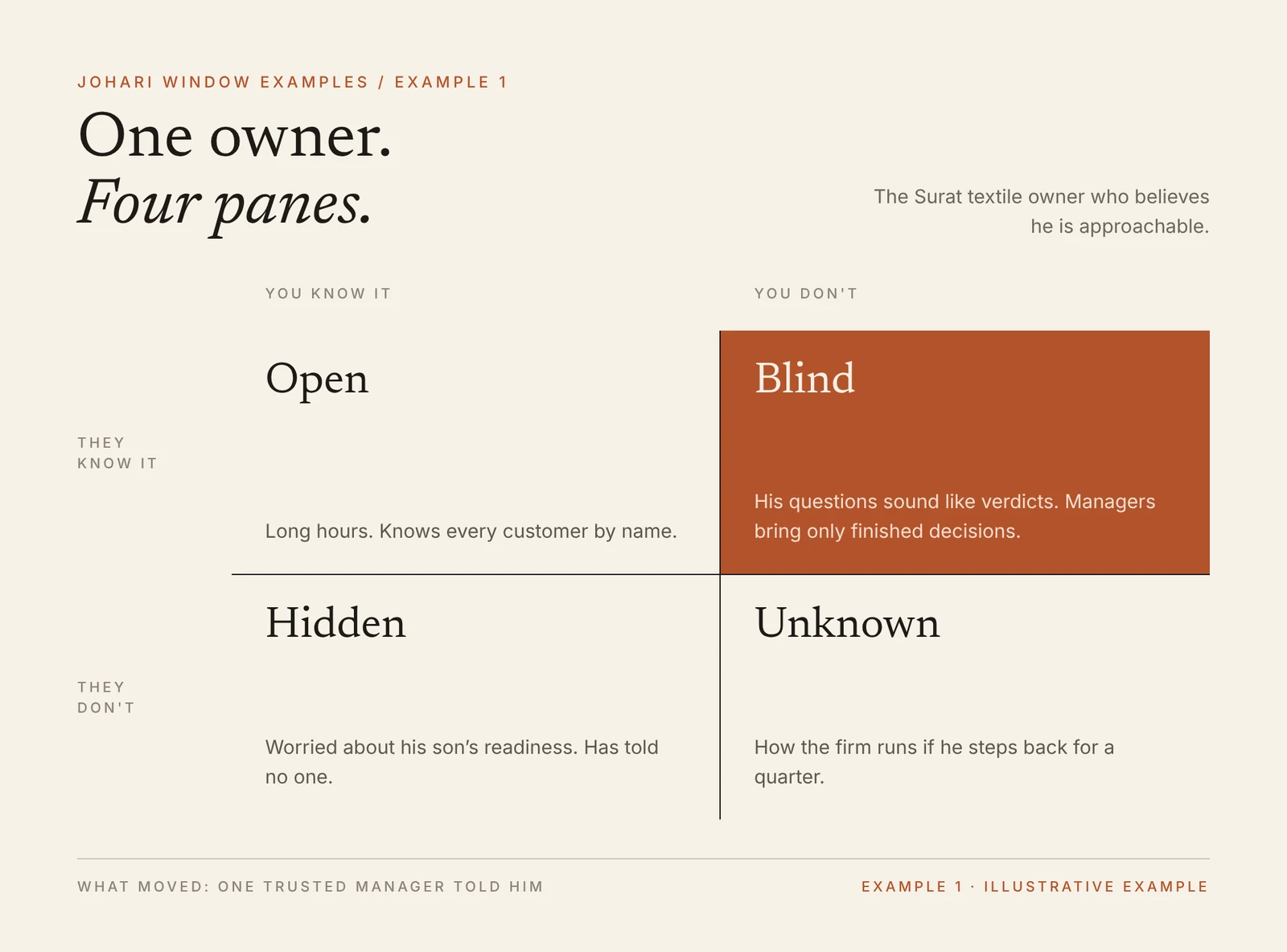
The Surat textile owner from the opening.
- Open: works long hours, knows every customer by name, built the business from one loom shed.
- Blind: his questions sound like verdicts; managers bring him only finished decisions, or none.
- Hidden: he is worried about his son's readiness to take over and has told no one.
- Unknown: how the firm would run if he stepped back for a quarter. Nobody has tested it.
What moved: a general manager he trusted told him, privately, that people had stopped bringing him problems early. The blind pane shrank by one fact. That one fact changed how he ran the Monday meeting, which changed what reached him.
Example 2: the promoted sales head
A Pune auto-components company promotes its best salesperson to head a team of nine.
- Open: excellent with customers, closes large orders, competitive.
- Blind: takes over his team's best deals in the final week, so the team has stopped working the big accounts.
- Hidden: he does not enjoy managing and misses selling.
- Unknown: whether he could lead a team built around him, or only one built around his targets.
What moved: he disclosed the hidden item to the owner. The conversation that followed was about the shape of the role rather than about his performance, and that is the conversation why good people underperform describes.
Example 3: the family-business son
The second generation joins a Delhi distribution business as a director at 27.
- Open: MBA, comfortable with technology, wants to professionalise.
- Blind: senior staff hear every suggestion he makes as a criticism of how his father ran things.
- Hidden: he is not sure he wants this business at all.
- Unknown: what he would build if the inheritance were not assumed.
What moved: very little, for a year, because both the blind and the hidden panes involved his father. That is common. In a family business the window has a second owner, and the succession planning conversation is usually where it finally opens.
Example 4: the new CFO
An Indore pharma distributor hires its first professional CFO from a listed company.
- Open: strong on compliance, numbers, banking relationships.
- Blind: her emails read as instructions to people who do not report to her.
- Hidden: she has already found two things in the books she has not raised yet.
- Unknown: how she will operate when the owner overrides her in front of the bank.
What moved: the owner asked her, at day 45, what she had seen that she had not said. The hidden pane opened. New hires carry a large hidden pane in their first ninety days, and the owner who asks for it gets a better company review than any consultant would produce.
Example 5: the leadership team that always agrees
The Johari window can be filled for a group as well as for a person.
- Open: the team meets every Monday, decisions are taken quickly, nobody fights.
- Blind: the speed comes from everyone waiting for the owner's view and then agreeing with it.
- Hidden: two of the five members think the new plant is a mistake.
- Unknown: what the team would decide if the owner spoke last.
What moved: the owner began speaking last, for three months. The leadership team that agrees too easily essay covers why that single change does so much.
Example 6: the quiet operations manager
A Bengaluru SaaS company of 70 people has an operations manager everyone relies on and nobody notices.
- Open: reliable, precise, never misses a deadline.
- Blind: others see her as the natural next head of delivery; she sees herself as support staff.
- Hidden: she has an offer from a competitor.
- Unknown: how she would lead a function.
What moved: feedback from three peers, given deliberately, shrank her blind pane. She stayed. The quiet leader essay describes the pattern: in many companies the blind pane of the best people holds their own strengths.
Example 7: the new graduate hire
- Open: eager, quick to learn the software, polite.
- Blind: says yes to every request and finishes none of them on time.
- Hidden: does not understand half of what is discussed in team meetings and is afraid to say so.
- Unknown: what she is actually best at.
What moved: a manager who asked "what did you not follow today" at the end of each week for a month. Disclosure opened the hidden pane, feedback shrank the blind one, and the unknown pane began to show what she was good at.
Example 8: two co-founders
- Open: one sells, one builds, both work hard.
- Blind: the team routes every difficult question to the softer partner, which the harder partner reads as disloyalty.
- Hidden: each has a different exit number in mind.
- Unknown: how they would decide a split vote.
What moved: a structured conversation where each wrote the other's window first, then compared. Most of what they had been arguing about was in each other's blind panes.
The patterns that repeat across the examples
Eight different people, four patterns.
- Seniority enlarges the blind pane. The owner and the co-founders had the largest blind areas, because the people around them had the most reason to stay quiet.
- New people carry the largest hidden pane. The CFO and the graduate both knew things that would have helped the company and had no safe moment to say them.
- Strengths hide in the blind pane as often as weaknesses. The operations manager is the reminder that feedback is not only correction.
- One act moves the window. In every case that moved, it took one deliberate conversation, not a programme. The constructive feedback spoke covers how to hold it.
The window you cannot fill in yourself
Every example above has the same constraint. The person could not fill in their own blind pane. Someone else had to.
For an owner, the people best placed to fill it are the people with the most to lose by doing so. That is why owner-led companies run for years with a blind area that everyone else in the building could describe. The founder who cannot take feedback essay is about what that costs.
The Business Pulse reads how your organisation actually runs, where decisions form, where they stall, and how much still routes through you. It shows the owner's blind pane at the level of the company rather than the person, from one company document and without asking anyone to speak up.
Questions people ask about Johari window examples
What is a simple example of the Johari window?
A manager believes she explains tasks clearly (open to her), her team finds the instructions confusing but has not said so (blind), she is anxious about an upcoming review (hidden), and nobody knows how she would handle a crisis (unknown). One honest comment from the team moves the confusion from blind to open.
What is an example of the blind area in the Johari window?
An owner who interrupts people in meetings and does not notice. Everyone in the room knows it, he does not, and the pattern stays in his blind area until someone tells him directly. Blind-area items are often habits of tone, timing and interruption rather than large failings.
What is an example of the hidden area in the Johari window?
A new finance head who has found an error in last year's accounts and has not raised it, or an employee who is unhappy with their role and has told nobody. The hidden area holds what the person knows and has chosen, or felt obliged, to keep private.
How do you use the Johari window in a team?
Fill the window for the team as a whole: what everyone sees about how the team works, what outsiders see that the team does not, what members privately think but do not say, and what has never been tested. Then pick one blind item and one hidden item to move into the open.
Can the Johari window be used in a company?
Yes. It began as a model for group development and works for leadership teams, partner pairs, new hires and family businesses. The model needs one condition to be useful: people must be able to give feedback and disclose without it costing them. Without that condition the window stays where it is.
Is the Johari window a personality test?
No. It is a communication model about what is known and unknown between people. It does not classify anyone into a type. The adjective exercise associated with it is a structured way of gathering feedback, not an assessment of personality. The Johari window test spoke covers the exercise.
Where to go deeper
- Johari Window — meaning, the four quadrants, uses and limits, and the owner's blind spot.
- The Four Quadrants of the Johari Window — open, blind, hidden and unknown, explained for leaders.
- Johari Window Test — the adjectives exercise, run with a team in sixty minutes.
- Blind Spot Meaning — the seven blind spots business owners share.
- Self-Disclosure — how much a leader should actually say.
- Constructive Feedback — how to give it without it becoming personal.
- Why Loyal Teams Miss What Honest Ones See — the cost of a team that protects the owner.