Johari Window Test: How to Run the Adjectives Exercise With Your Team (Questionnaire, Adjective List, Scoring)

An HR executive in a Nashik packaging company downloads a Johari window worksheet, prints thirty copies and hands them out at the annual offsite. Everyone ticks six adjectives about themselves and six about a colleague. The sheets are collected, nobody reads them, and the exercise is remembered as the slide before lunch. The model was sound. The way it was run made it useless.
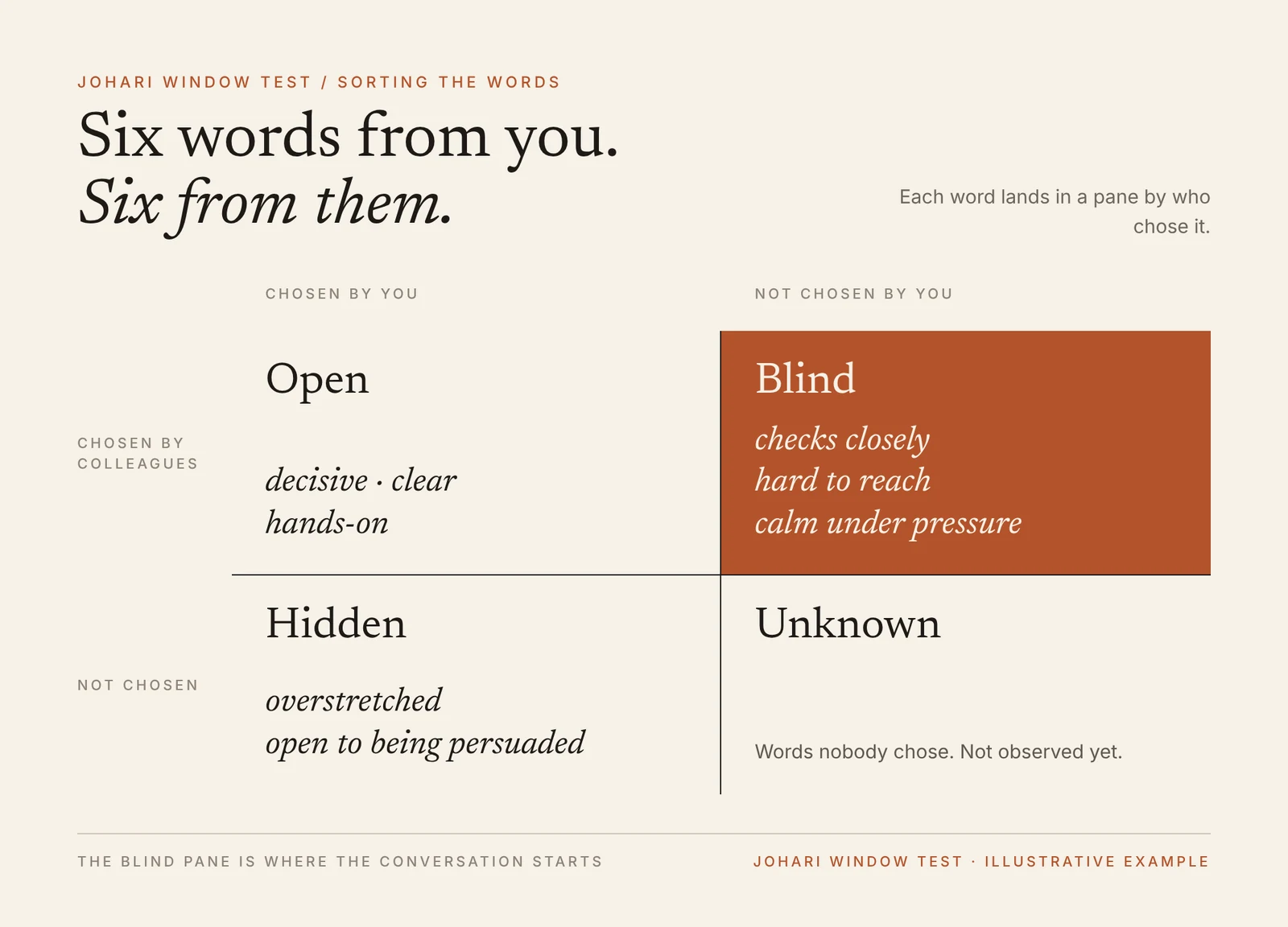
The Johari window test is a structured feedback exercise. A person picks five or six adjectives from a fixed list that they believe describe them; several colleagues pick the same number from the same list to describe that person. Words chosen by both go in the open area, words chosen only by others go in the blind area, and words chosen only by the person go in the hidden area. It is not a personality test and does not score anyone.
This page explains how the original exercise works, gives a work-behaviour adjective list written for owner-led companies, shows how to run it with a leadership team in sixty minutes, and covers what to do with the result. The Johari window pillar explains the model behind it.
How the original Johari exercise works
The exercise associated with Joseph Luft and Harrington Ingham's model uses a list of about 56 adjectives: able, accepting, bold, calm, caring, confident, dependable, logical, patient, proud, warm, witty and so on. Versions of the list vary slightly.
The subject picks five or six words. Each participant picks five or six for the subject from the same list. The words are then sorted into the four panes. Adjectives that nobody chose sit in the unknown area, which in this exercise is a reminder of what has not been observed rather than a finding.
The four quadrants spoke explains each pane. The exercise only populates three of them with real content: open, blind and hidden.
Why the original list is weak for a workplace
The original adjectives describe a person in general: shy, religious, silly, sentimental. In an office most of them are either irrelevant or uncomfortable to choose for a colleague.
A workplace version needs words that describe how a person behaves at work, that a colleague can choose without it feeling like a personal comment, and that point to something the person could act on. Words about decisions, communication, pace, ownership and how the person is in a disagreement do that. Words about temperament do not.
A work-behaviour adjective list for owner-led companies
Thirty descriptors, grouped so that a group of participants does not cluster all its choices in one area. Use the list as written or remove the ones that do not fit your company.
- Decisions: decisive, deliberate, quick to change course, consistent, hard to read, open to being persuaded.
- Communication: clear, brief, detailed, direct, diplomatic, a good listener.
- Pace and load: calm under pressure, urgent, steady, overstretched, reliable on deadlines, hard to reach.
- Ownership: hands-on, delegates well, checks closely, follows through, takes credit, gives credit.
- In disagreement: fair, firm, defensive, conflict-avoiding, willing to admit a mistake, approachable.
Some of these read as criticisms. That is deliberate. A list of only positive words produces a pleasant open area and an empty blind area, which defeats the purpose.
How to run it with a leadership team in sixty minutes
A team of five to eight people is the right size. Fewer and the answers are traceable; more and the hour runs out.
- Before the session (10 minutes, done alone): each person picks six words for themselves and six for each colleague, on paper or a simple form that hides names.
- Collation (done by one neutral person): the words are sorted into each person's window. Only the count of colleagues who chose each word is shown, never who chose it.
- Reading (15 minutes): each person reads their own window privately and marks one blind-area word that surprised them.
- Conversation (30 minutes): each person says the surprising word aloud and asks the group for one example of when they saw it. One example, not a debate.
- Close (5 minutes): each person names one hidden-area word they are willing to move into the open, and says what it means for how they work.
The owner goes first in the conversation, every time. If the most senior person treats a blind-area word as information rather than an accusation, the rest of the room does the same. If the owner argues, the exercise is over and the next one will be politer and emptier.
Anonymity, and the Indian office
The exercise works on one condition: people must be able to choose a critical word for a senior colleague without it costing them.
In most Indian companies that condition is not met by default. Reporting lines are steep, increments are discretionary, and in family businesses the senior colleague may be a relative. A word chosen for the owner by a team of four is traceable within a week.
Three practical rules help. Never run the exercise with fewer than four raters for a person. Never link it to appraisal or increments. Have the collation done by someone outside the reporting line, or outside the company. The team that cannot give feedback essay covers what happens when these conditions are ignored.
What to do with the result
A window full of words is not the outcome. The outcome is one or two things that move.
- Pick one blind word. The one chosen by the most colleagues and by you not at all. Ask for examples and act on one.
- Pick one hidden word. Something you see in yourself that the team does not. Decide whether they need to know it. The self-disclosure spoke covers how to decide.
- Look for strengths in the blind area. People routinely leave out what they are good at. A blind word like "fair" or "calm under pressure" is worth knowing too.
- Repeat in six months with the same list. The movement between two windows says more than either window alone.
The Johari window examples spoke shows what that movement looks like across eight different people.
Online Johari tests and their limits
Several free websites run the exercise: you pick your adjectives, send a link to friends, and the site sorts the results. They are convenient for individuals.
For a company they carry two problems. The adjective list is the general one, not a workplace one. And raters are self-selected, so a manager sends the link to the colleagues most likely to be kind. Run the workplace version in the room, with the conditions above, or do not run it.
Neither version is an assessment. The exercise records what a group of people chose to say on one day. It is a structured way to start a conversation that should have happened anyway.
What the exercise cannot show
The adjectives describe how a person appears to others. They do not describe how decisions move through the company that person runs, which is where an owner's blind area costs the most money.
The Business Pulse reads how your organisation actually runs, where decisions form, where they stall, and how much still routes through you. It looks at the company rather than the person, from one company document, and nobody has to choose a difficult word about the owner.
Questions people ask about the Johari window test
How does the Johari window test work?
You pick five or six adjectives that describe you from a fixed list. Several colleagues or friends pick five or six from the same list to describe you. Words picked by both go in the open area, by others only in the blind area, by you only in the hidden area. Unpicked words form the unknown area.
How many adjectives are in the Johari window list?
The commonly used original list has about 56 adjectives, such as able, bold, calm, caring, dependable, logical, patient and warm. Versions vary slightly. For workplace use a shorter list of around thirty work-behaviour descriptors, covering decisions, communication, pace, ownership and disagreement, gives more useful results.
Is the Johari window a personality test?
No. It is a feedback exercise based on a communication model. It does not assign a type, produce a score or claim to measure personality. It records which descriptors a person and their colleagues chose on one occasion, and its value is in the conversation that follows.
How many people should take part in a Johari window exercise?
At least four raters per person, so that individual choices cannot be traced, and no more than about eight in one session so that every person's window can be discussed. A leadership team of five to eight is the most practical group size inside a company.
Can the Johari window test be done online?
Yes, several free sites run it with the general adjective list and a shareable link. They suit personal use. Inside a company the in-room version with a workplace list, at least four raters, neutral collation and no link to appraisal produces more honest and more usable results.
What should you do after a Johari window exercise?
Pick one blind-area word chosen by several colleagues, ask for one example, and act on it. Pick one hidden-area word and decide whether the team needs to know it. Note strengths that appeared in the blind area. Repeat the exercise in six months with the same list and compare.
Where to go deeper
- Johari Window — meaning, the four quadrants, uses and limits.
- The Four Quadrants of the Johari Window — what each pane holds in a company.
- Johari Window Examples — eight worked examples from Indian workplaces.
- 360-Degree Feedback — the larger, formal version, and whether a small company should run it.
- Constructive Feedback — how to say the difficult word well.
- The Team That Cannot Give Feedback — why the exercise fails when the conditions are missing.