Self-Awareness: Meaning, Types, Examples, and Why It Gets Harder the More Senior You Become

The owner of a Pune auto-components firm describes himself as approachable. His door is open, he says, and anyone can walk in. Over eleven years nobody below the plant head has walked in with bad news. He is right about the door. He has never been told what it feels like to stand in front of it.
Self-awareness is the ability to see yourself clearly: your values, reactions, strengths, limits and patterns, and how they land on the people around you. It has two parts. Internal self-awareness is how well you know yourself. External self-awareness is how well you know how others experience you. A leader can be strong in one and weak in the other. Most leaders who struggle with the second have never been told they struggle with it.
This page gives the meaning, the two types, examples from Indian companies, why self-awareness thins as seniority grows, how the Johari window maps it, and what an owner can actually do about it.
What self-awareness means
Self-awareness means knowing what you are like, and knowing it accurately. Not a flattering version, not the version from your best week, but the pattern that shows up on an ordinary Tuesday when a delivery is late and a client is calling.
The word gets used loosely. People say "self-aware" when they mean self-critical, or introspective, or honest about a weakness they have already decided to keep. Those are related. None of them is the same thing.
A practical test: could the people who work with you describe your patterns, and would your description match theirs? Where the two match, you are self-aware. Where they do not, there is something you are not seeing, and everyone else is.
The two types of self-awareness
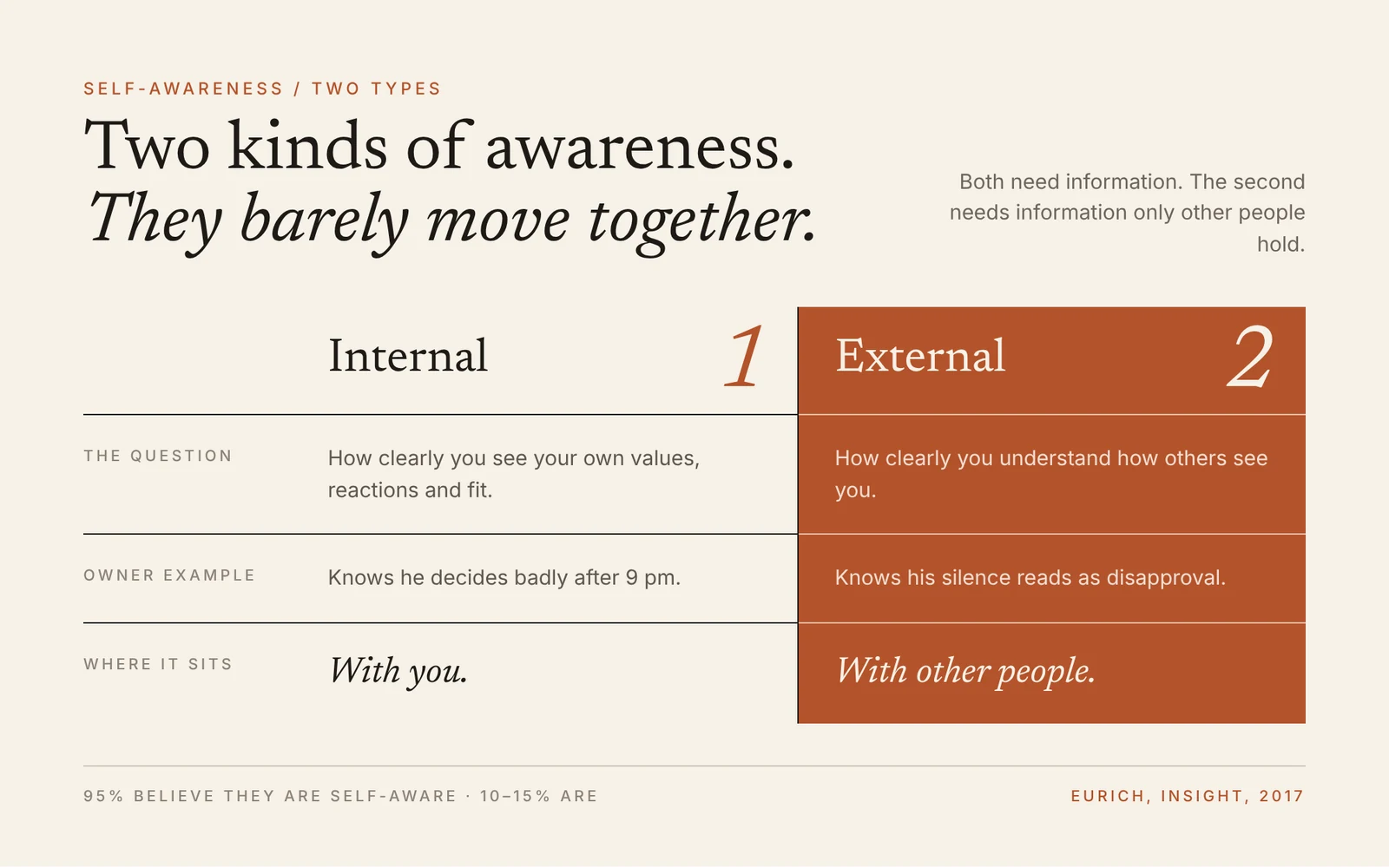
Organisational psychologist Tasha Eurich, in her 2017 book Insight, separated self-awareness into two kinds and found they barely move together.
Internal self-awareness. How clearly you see your own values, passions, aspirations, reactions and fit. The owner who knows he decides badly after 9 pm, or that he is drawn to expansion and bored by consolidation, has this.
External self-awareness. How clearly you understand how other people see you on those same dimensions. The owner who knows that his silence in a review meeting reads to his team as disapproval, even when he is only thinking, has this.
Eurich's research suggested that around 95% of people believe they are self-aware, while only around 10% to 15% actually meet the criteria. The gap is not dishonesty. It is that both kinds of awareness need information, and the second kind needs information that only other people hold.
Self-awareness examples from Indian workplaces
Abstract definitions do not help much. Five examples do.
- The distributor who knows his temper. A Delhi FMCG distributor has learned that he reacts to stock-outs with anger in the first ten minutes and sense after an hour. He now holds every stock-out call after lunch. That is internal self-awareness put to work.
- The founder who did not know she interrupted. A Bengaluru SaaS founder believed she ran collaborative meetings. A new head of product counted: she spoke first on every agenda item and finished two-thirds of other people's sentences. She had high internal awareness and almost no external awareness.
- The second-generation director. A son joining his father's Surat textile firm assumed the staff deferred to him because of his MBA. They deferred because of his surname. He found out when he made a wrong call and nobody stopped him.
- The sales head who knew her limit. Promoted from top salesperson, she told the owner within a month that she was good at closing and poor at building a team, and asked for a strong operations number two. That sentence saved the role.
- The owner who is "always available". Proud that his team can reach him at any hour, he did not see that his availability had taught them to stop deciding. The decision bottleneck essay covers what that costs.
Why self-awareness gets harder the more senior you become
Self-awareness is not a fixed trait. It depends on a supply of honest information, and that supply shrinks as authority grows.
A junior executive gets feedback from a manager, peers and clients every week, much of it unrequested. A department head gets less, because the people below are careful. An owner gets almost none, because the people below depend on him for their salary, their increments and in many family firms their standing in the community.
The result is a gradient. The person whose patterns most affect the company has the least information about them. Eurich's work found that experience and power tended to make people more confident in their self-knowledge, not more accurate. The founder who cannot take feedback essay covers one side of this. The when people optimise for approval essay covers the other: the team learns to show the owner what he wants to see.
In Indian owner-led companies the gradient is steeper. Respect for seniority, "sir" culture and family hierarchy all make it harder to tell the person at the top something unwelcome. None of that is a flaw in the team. It is the environment the owner has built, and it will keep producing silence until something in it changes.
Self-awareness and the Johari window
The Johari window, created by Joseph Luft and Harrington Ingham in 1955, is the clearest picture of the two kinds of self-awareness side by side. It sorts what is true about a person into four areas: known to self and others, known to others but not to self, known to self but not to others, and known to neither.
Internal self-awareness lives in the left column: what you know about yourself. External self-awareness is the size of the blind spot, the area others can see and you cannot. Shrinking it takes feedback. Shrinking the hidden area takes self-disclosure. The four quadrants spoke covers each area in detail.
The importance of self-awareness for a business owner
In an employee, low self-awareness is a personal limit. In an owner, it becomes the company's operating pattern.
The owner who does not know he dislikes conflict builds a company where problems are smoothed over until they are expensive. The owner who does not know he trusts only people who think like him builds a leadership team that agrees too easily, which the leadership team agrees too easily essay describes. The owner who does not know that his approval is the real currency builds a company that performs for him rather than for the customer.
Before WHY, there is WHO.
A strategy is written by a person, and it carries that person's patterns into every department. Self-awareness is the owner's chance to see those patterns before the company has absorbed them.
How to improve self-awareness
Six practices that work for owners and senior leaders, in roughly the order they pay back.
- Ask "what" questions, not "why" questions. Eurich's research found that asking "why did I do that" tends to produce comfortable stories. Asking "what was happening when I did that" produces patterns you can use.
- Find two people who will tell you the truth. Not a committee. Two people, ideally one inside the company and one outside, who have nothing to lose by being straight with you.
- Ask about behaviour, not about yourself. "What do I do in reviews that makes people stop talking?" gets an answer. "Am I a good leader?" gets reassurance.
- Run the Johari exercise with your senior team. The Johari window test spoke gives the method, and the owner going first is what makes it honest.
- Watch what happens after you leave the room. Decisions that reverse after you leave, or wait until you return, are information about you.
- Separate the reaction from the response. Notice the first reaction, wait, then respond. The gap is where internal self-awareness becomes useful.
What the owner cannot see from inside
There is a limit to how far self-reflection goes. The owner is inside the company the way the eye is inside the head: some parts of the view are structurally unavailable. Every report he reads was written by someone who knew he would read it.
That is why an outside reading matters. The Business Pulse reads how your organisation actually runs, where decisions form, where they stall, and how much still routes through you, from one company document and with no questions to answer. It shows the pattern. The owner decides what it means.
Questions people ask about self-awareness
What is self-awareness in simple words?
Self-awareness is knowing yourself accurately: your values, reactions, strengths and limits, and how your behaviour affects other people. It includes both what you can see about yourself and what others see in you that you may not. A self-aware person's description of themselves broadly matches the description given by the people who work with them.
What are the two types of self-awareness?
Internal self-awareness is how clearly you see your own values, reactions and patterns. External self-awareness is how clearly you understand how others see you. Tasha Eurich's research found the two are largely independent, so a leader can know himself well in private and still misread how he lands on his team.
What are some examples of self-awareness at work?
A manager who knows she decides badly when tired and moves big calls to the morning. An owner who learns his silence in meetings reads as disapproval. A promoted salesperson who tells the owner she is strong at closing and weak at building teams. Each one sees a pattern and adjusts the environment around it.
Why is self-awareness important for leaders?
Because a leader's patterns spread. An owner who avoids conflict builds a company that avoids conflict; one who trusts only similar people builds a team that agrees too easily. Self-awareness lets a leader see those patterns before the organisation absorbs them, rather than after they show up in results and resignations.
How is self-awareness related to the Johari window?
The Johari window maps it directly. The open and hidden areas are what you know about yourself, internal self-awareness. The blind area is what others see and you do not, the gap in external self-awareness. Feedback shrinks the blind area, and self-disclosure shrinks the hidden one.
How can a business owner improve self-awareness?
Ask "what" questions about your behaviour rather than "why". Find two people who will be straight with you. Ask about specific behaviours, not about yourself in general. Run a Johari exercise with your senior team and go first. Notice which decisions reverse or stall when you leave the room.
Where to go deeper
- Johari Window — the meaning, the four quadrants, examples and the owner's blind spot.
- Blind Spot Meaning — in leadership, in the Johari window, and the seven owners share.
- Self-Disclosure — how much a leader should actually say.
- Feedback — meaning, types, and why it stops reaching the owner.
- Johari Window Test — how to run the adjectives exercise with your team.
- The Founder Who Cannot Take Feedback — why the information stops arriving.
- The Leader Who Cannot Be Read — when the team cannot see the owner either.