Performance Appraisal: Meaning, Methods, Process, and the Probation Review That Comes First

Every April the owner of a 70-person pharma distributor in Indore sits with a spreadsheet of names and a pool of increment money. Each manager has sent a rating out of five. Almost everyone is a four. The owner adjusts the numbers from memory, the letters go out, and three people resign by June. Nobody calls it an appraisal problem.
Performance appraisal is the periodic, structured evaluation of how an employee has performed in their role against agreed expectations, usually done by the reporting manager and used to give feedback, decide increments and promotions, and plan development. It is also called performance evaluation or performance review, and in most Indian companies it runs once a year. The appraisal is a judgement. Its quality depends entirely on what it was measured against.
This page gives the meaning and definition, the main methods and which suit a small company, the process, why appraisals fail, and the probation review that should come before any of it. The probation period pillar covers the first review every employee goes through.
What performance appraisal means
In HRM, performance appraisal is the formal part of performance management: the point at which a manager looks back over a period and records how well a person did their job.
It serves four purposes, and most companies try to serve all four with one form.
- Feedback. Telling the person what went well and what did not.
- Reward. Deciding increments, bonuses and promotions.
- Development. Identifying what the person needs to learn next.
- Decisions. Confirming, extending, moving or exiting someone.
The tension is that honest feedback and money decisions pull in opposite directions. When the rating sets the increment, both sides negotiate the rating rather than discuss the work.
Methods and techniques of performance appraisal
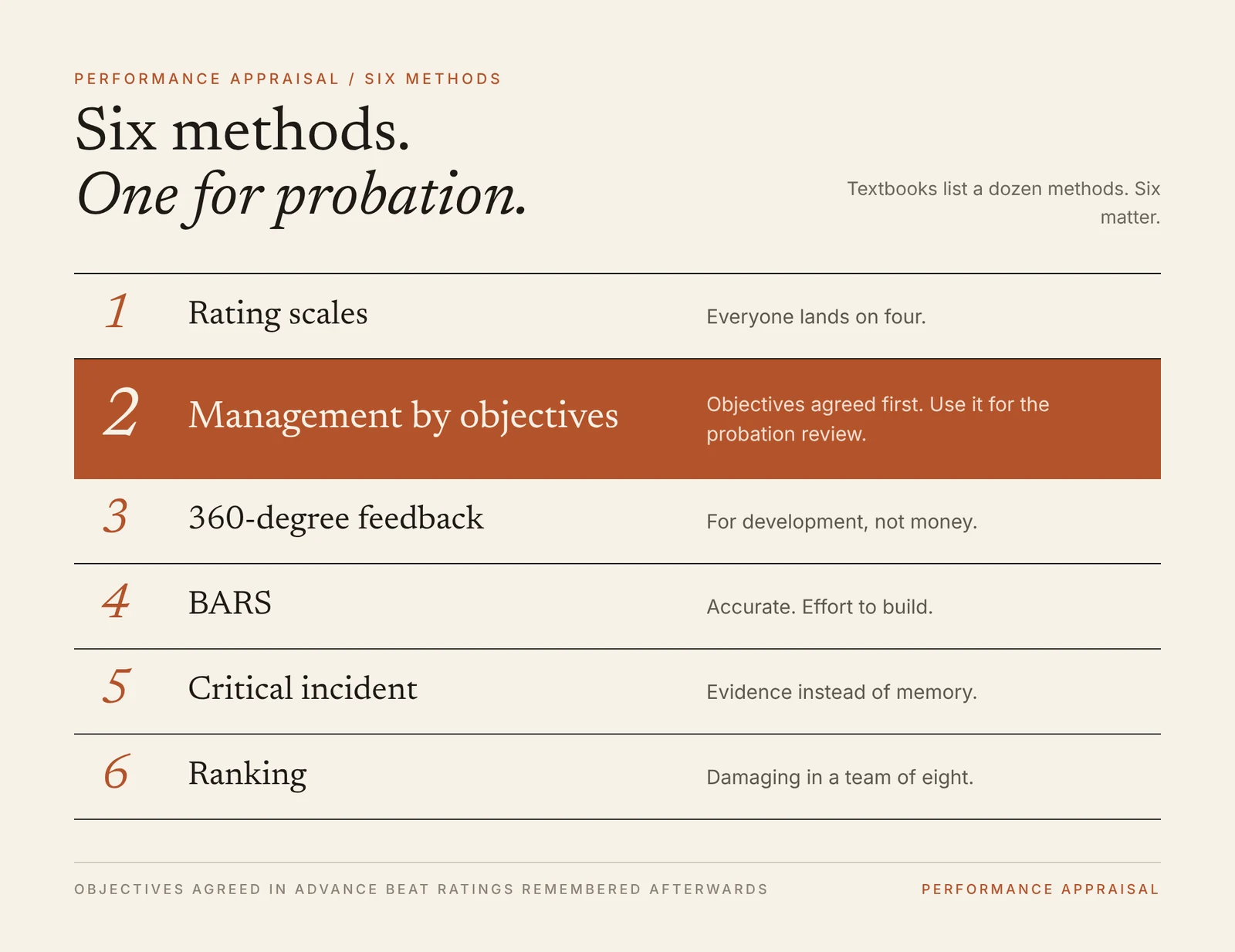
Textbooks list a dozen methods. Six matter in practice.
Rating scales. The person is scored, usually one to five, on a list of qualities or outcomes. Simple, common, and prone to everyone landing on four.
Management by objectives (MBO). Manager and employee agree specific objectives at the start of the period and review them at the end. The best fit for most small companies, because it forces expectations to be written down first.
360-degree feedback. Input from the manager, peers, reports and sometimes clients. Useful for development, risky when tied to money. The 360-degree feedback spoke covers when a 50-person company should use it.
Behaviourally anchored rating scales (BARS). Rating scales where each score is described by an example of real behaviour. More accurate, more effort to build.
Critical incident method. The manager records specific examples of very good and very poor work through the year. It replaces memory with evidence.
Ranking and forced distribution. Employees are ranked against each other or fitted into a curve. Common in large firms, damaging in a team of eight where everyone knows who is ranked last.
The performance appraisal process
Whatever the method, the process has the same six steps.
- Set expectations. At the start of the period, write down the three to five key result areas and how each will be judged. The KRA meaning spoke shows how.
- Observe through the period. Notes, examples, numbers. Not a memory exercise in March.
- Self-assessment. The employee records their own view first. The gap between the two views is often the most useful part.
- The appraisal conversation. Manager and employee discuss the evidence, not the score. The constructive feedback spoke covers how to say the hard parts.
- Record and decide. The rating, the outcome and the reasons, in writing.
- Plan the next period. New expectations, support needed, and the date of the next check-in.
Why appraisals fail in small companies
The form is rarely the problem. Four patterns are.
No expectations were set. The appraisal judges a year of work against standards nobody wrote down. Every rating becomes an opinion.
Recency. The last six weeks count for more than the first ten months, because that is what the manager remembers.
Everyone is a four. Managers avoid the conversation that a two or a five would require, so the scale collapses to one number.
The owner overrides. In owner-led companies the final rating is often adjusted at the top from impressions, which tells managers that their judgement does not count and tells employees that visibility matters more than work. The performance review doesn't work essay covers the deeper reason.
The probation review comes first
Every employee's first appraisal is the probation review, and it is the one that matters most. It decides whether the person is confirmed, extended or let go, and it sets the pattern for every review after it.
A good probation review is MBO in its simplest form. On day one the manager writes down what the person must show by day 90: three to five outcomes, how each will be judged, and the checkpoints in between. At day 90 the review compares the evidence against those outcomes, and the decision follows from the comparison.
Most SMEs skip this. The probation period ends, nobody holds a review, and the person is confirmed by default. The first real appraisal then happens a year later, against expectations that were never stated. The probation confirmation letter and probation extension spokes cover the two written outcomes.
What an appraisal cannot see
Context over conclusions.
An appraisal records whether a person delivered. It rarely records why. A sales executive who missed target may be in the wrong territory, under the wrong manager, or in a role that asks for a way of working that is not theirs. A rating of two looks the same in each case, and the right response is different in each. The why good people underperform essay covers the most common reasons.
The Business Pulse reads how your organisation actually runs, where decisions form, where they stall and how much still routes through you, which is the context an appraisal form leaves out.
Questions people ask about performance appraisal
What is performance appraisal in simple words?
It is a periodic, structured review of how well an employee has done their job against agreed expectations. The reporting manager usually conducts it, records a judgement, gives feedback, and the result is used for increments, promotions, development plans and decisions such as confirmation after probation.
What are the methods of performance appraisal?
The main methods are rating scales, management by objectives, 360-degree feedback, behaviourally anchored rating scales, the critical incident method, and ranking or forced distribution. Small companies get the most from management by objectives, because it makes the manager write down expectations before the period starts.
What is the process of performance appraisal?
Set expectations at the start of the period, observe and record evidence through it, ask the employee for a self-assessment, hold an appraisal conversation about the evidence, record the rating and decision with reasons, and agree expectations and support for the next period.
What is the purpose of performance appraisal?
It gives employees feedback on their work, informs increment, bonus and promotion decisions, identifies development needs, and supports decisions such as confirming, extending or exiting someone. Trying to serve all four purposes with one rating is the most common reason appraisals lose their honesty.
Is there a performance appraisal at the end of probation?
There should be. The probation review is the first appraisal, and it decides whether the employee is confirmed, extended or let go. It works best when the manager wrote down three to five outcomes on day one and compares evidence against them at the end of the probation period.
Why do performance appraisals fail?
Mostly because no expectations were set at the start, so ratings become opinions. Recency bias, managers avoiding hard conversations so everyone gets the same score, and owners overriding managers' ratings from impressions make it worse. The form is rarely the cause.
Where to go deeper
- Probation Period — meaning, duration, rules in India, and what it is actually for.
- KRA Meaning in HR — the expectations an appraisal should be measured against.
- Probation Confirmation Letter — the written outcome of a good probation review.
- Extending Probation — when the review says not yet.
- 360-Degree Feedback — whether a small company should run one.
- Performance Improvement Plan in India — what comes after a poor review.
- Why the Performance Review Doesn't Work — the deeper reason.