Offer Letter: Meaning, Format, What to Include, and the Mistakes Small Companies Make

The founder of a 70-person software company in Bengaluru sends an offer at 11 at night: a two-page PDF on WhatsApp, a title of Senior Manager, a CTC of ₹18 lakh and a joining date six weeks out. The candidate replies with a thumbs-up. Five weeks later he writes to say another company has matched, and he will not be joining. The founder has no signed acceptance, no deadline, and a role that has now been empty for three months.
An offer letter is the written, conditional offer of a job that a company sends a selected candidate before they join. It states the role, the start date, the pay and the main terms, and asks the candidate to accept by a date. It is not yet the contract of employment: in India that is the appointment letter, issued on or after joining. The offer letter is where the relationship is first put in writing, which makes it the first place it can go wrong.
This page gives the meaning, the difference from an appointment letter, what an offer letter should contain, a sample format, the mistakes small companies make, and why offers get dropped. The probation period pillar covers what happens once the person joins.
What an offer letter is, and what it is not
An offer letter is a proposal. The company says: we would like you to do this job, on these terms, from this date. The candidate's signed acceptance turns it into a mutual intention to begin employment.
It is not a full employment contract. It usually does not carry the detailed clauses on conduct, confidentiality, leave, termination and the probation process. Those belong in the appointment letter and the company's HR policy.
It is still a document that matters. Courts and labour authorities read it when there is a dispute about what was promised, and candidates read it far more closely than most owners assume. A vague offer letter tells a good candidate that the company is vague.
Offer letter vs appointment letter
The two are often confused in small companies, and sometimes merged into one document. They do different jobs.
- Timing. The offer letter comes before joining. The appointment letter comes on or after the joining date.
- Purpose. The offer letter secures the candidate's agreement to join. The appointment letter sets out the full terms of employment.
- Detail. The offer letter is short: role, pay, date, a few conditions. The appointment letter carries the pay structure, probation, notice, leave, confidentiality, place of work and conduct.
- Legal standing. Since the four Labour Codes came into force on 21 November 2025, an appointment letter is mandatory for every worker in every sector. The offer letter is good practice, not a legal requirement.
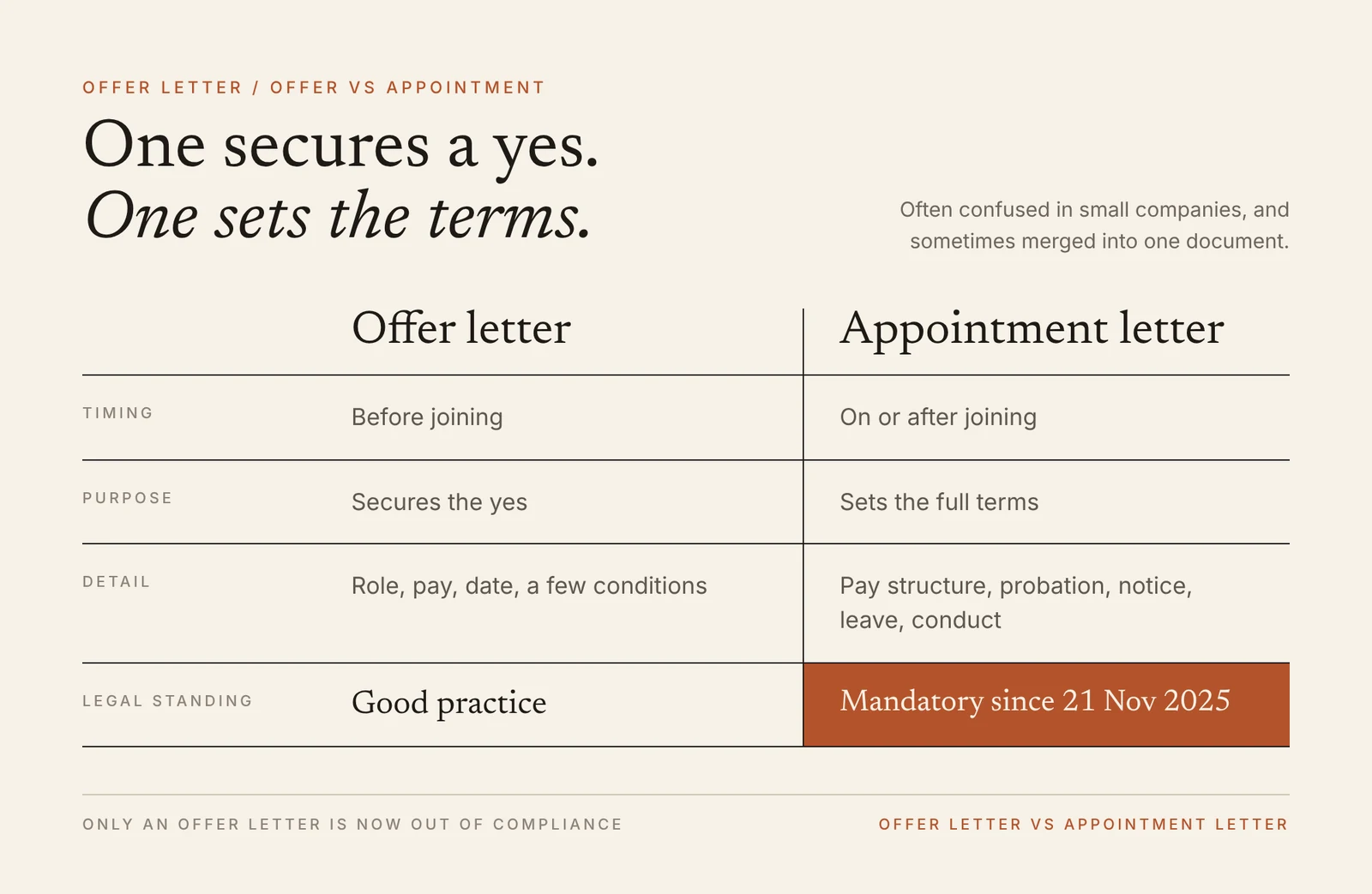
A company that issues only an offer letter, and never an appointment letter, is now out of compliance. A company that issues only an appointment letter, with no offer, loses the chance to fix terms before the person resigns from their current job.
What an offer letter should include
Nine things, most of them one line each.
- The exact role title and who the person reports to. A title without a reporting line invites a different picture in the candidate's head.
- The joining date and the place of work. Including whether the role is office-based, hybrid or field.
- Total pay with the split. CTC alone is not enough. Show fixed pay, variable pay and the basic component, which under the new wage rules must be at least 50% of total remuneration.
- The probation period. Its length, and a line saying confirmation follows a review. The probation period pillar covers how long is reasonable.
- The notice period during probation and after confirmation. The notice during probation spoke covers the usual terms.
- Conditions of the offer. Background verification, documents, relieving letter from the last employer.
- The three to five results the role is expected to deliver in its first year. Rarely included, and the single best defence against a mismatch. The KRA meaning spoke shows how to write them.
- An acceptance deadline. Usually five to seven working days.
- A line saying the full terms follow in the appointment letter.
A sample offer letter format
Written as plain paragraphs, the way most Indian companies issue it. Replace everything in square brackets.
[Company letterhead] · [Date]
Dear [Candidate name],
We are pleased to offer you the position of [Role title] at [Company name], reporting to [Manager name, title]. Your place of work will be [City, office address / hybrid arrangement], and we would like you to join on [Joining date].
Your total annual compensation will be ₹[amount], made up of a fixed component of ₹[amount], of which basic pay is ₹[amount], and a variable component of up to ₹[amount] linked to [what it is linked to]. A detailed pay structure will be part of your appointment letter.
In this role, we will expect you to [result 1], [result 2] and [result 3] in your first twelve months.
You will be on probation for [three / six] months from your joining date. At the end of it we will review your work with you and confirm your appointment in writing. During probation either side may end the employment with [number] days' notice; after confirmation the notice period is [number] days.
This offer is subject to satisfactory background verification and submission of the documents listed in the attached sheet. Please confirm your acceptance by signing and returning a copy of this letter by [date, five to seven working days out]. Your appointment letter, with the full terms of employment, will be issued on your joining date.
We look forward to working with you.
[Name], [Title], [Company name]
Accepted: [Candidate signature], [Date]
The appointment letter spoke gives the matching appointment letter, so the two documents use the same wording for role, pay and probation.
The mistakes small companies make
- A title the role cannot support. Senior Manager with no one to manage. The candidate notices in week two.
- CTC with no split. The first salary slip then looks like a pay cut, and trust is spent before it is earned.
- No probation clause. The appointment letter introduces one later, and the person reads it as a change of terms.
- No acceptance deadline. The offer stays open while the candidate shops it.
- Promises made in the interview that never reach paper. A sales target relaxed for the first quarter, a team of four by March. If it was said, write it or retract it.
Why offers get dropped in India, and what reduces it
Offer-dropping is common in Indian hiring, most of all in technology, sales and mid-level roles, where candidates with long notice periods collect several offers and use each to raise the next. A two- or three-month notice period at the current employer gives them the time to do it.
What reduces it is rarely money. It is contact and clarity.
- Shorten the gap. Ask for an early relieving where possible, and keep the gap between acceptance and joining as short as the notice allows.
- Stay in touch. A call from the manager every two weeks, an invite to one team meeting, the first week's plan shared in advance. The onboarding process spoke treats this as the first phase of onboarding.
- Make the role concrete. Candidates drop vague offers first. The three results in the letter do more than any joining bonus.
What the offer letter cannot tell you
Before WHY, there is WHO.
An offer letter fixes the terms of a decision that has already been made, usually on a résumé, three conversations and a reference call. It cannot tell you whether the person operates the way the role needs: whether a Senior Manager hired for autonomy will take to a company where every decision still goes to the founder, or whether a strong individual performer will work through others. The talent doesn't show in interviews essay covers why, and the wrong hire at the top essay covers what it costs.
The probation period exists to find out, and most companies waste it. The Business Pulse reads how your organisation actually runs, where decisions form and how much still routes through you, which is the context every offer you make is walking into.
Questions people ask about offer letters
What is an offer letter?
An offer letter is a written, conditional offer of employment sent to a selected candidate before joining. It states the role, reporting line, joining date, pay and main conditions, and asks the candidate to accept by a date. The full terms of employment follow later in the appointment letter, issued on or after the joining date.
What is the difference between an offer letter and an appointment letter?
The offer letter comes before joining and secures the candidate's acceptance. The appointment letter comes on or after joining and sets out the full terms: pay structure, probation, notice, leave, confidentiality and conduct. Since 21 November 2025, under the Labour Codes, an appointment letter is mandatory for every worker; an offer letter is good practice.
What should an offer letter include?
The role title and reporting line, joining date and place of work, total pay with the fixed, variable and basic split, the probation period, notice terms during and after probation, conditions such as background verification, the main results expected in the first year, an acceptance deadline, and a line saying the appointment letter will follow.
Is an offer letter legally binding in India?
Once signed by both sides, an offer letter records an agreement on the terms it contains, and it can be relied on if there is a dispute about what was promised. It is not a substitute for the appointment letter, which carries the full employment terms. For a specific dispute, confirm the position with a lawyer.
Can a company withdraw an offer letter?
A company can withdraw an offer, most often when a stated condition is not met, such as failed background verification. Withdrawing after the candidate has resigned from their current job without a stated reason is harder to defend and damages the company's name. State the conditions clearly in the letter, and confirm specific cases with a lawyer.
How long should a candidate get to accept an offer letter?
Five to seven working days is common and fair. It gives the candidate time to read the terms and speak to family, without leaving the offer open while they collect counter-offers. Put the date in the letter, and follow up by phone two days before it if you have not heard back.
Where to go deeper
- Probation Period — meaning, duration, rules in India, and what probation is actually for.
- Appointment Letter — the mandatory letter, its clauses, and a matching sample.
- Onboarding — the 90-day plan that starts the day the offer is accepted.
- KRA Meaning in HR — how to write the results a new hire will be judged on.
- Notice Period During Probation — what notice applies before confirmation.
- How to Hire Executives — the senior-hire process that comes before the offer.
- Hiring for Culture Is Not Hiring for Comfort — the mismatch an offer cannot see.