Onboarding: Meaning, the Employee Onboarding Process, and a 90-Day Plan for a Small Company

A production planner joins a ₹90 crore auto-components company in Pune on a Monday. His laptop arrives on Thursday. His manager is at the Chennai plant that week, so he spends his first days reading SOPs from 2019. At the day-60 review the owner says he is not sharp enough, and the planner says nobody told him what sharp looked like. Both are describing the same eight weeks.
Onboarding is the process of bringing a new employee into a company so that they can do the job well and stay: everything from the day the offer is accepted to the point, usually around ninety days in, when the person works independently. It covers paperwork, induction, role clarity, relationships and early feedback. In most small companies it is treated as the first morning. It is closer to the first quarter.
This page gives the meaning, the difference from induction and orientation, why onboarding decides most probation outcomes, a 90-day plan a small company can run, and the owner's part in it. The probation period pillar covers the review that onboarding feeds.
What onboarding means
Onboarding is everything a company does to turn a hire into a working colleague. It begins before the first day, with the gap between acceptance and joining, and ends when the person can do the job without daily direction.
It has four strands that run together: the formalities (documents, payroll, PF and ESI registration where applicable, systems access), the role (what the job is for and what good looks like), the relationships (who to go to for what), and the feedback (whether it is going well, said early).
Most companies do the first strand thoroughly and the other three by accident.
Onboarding, induction and orientation
The three words are used interchangeably. They are different sizes of the same idea.
- Orientation is the first day or two: the building, the people, the policies, the paperwork.
- Induction is the structured introduction to the company and the role, usually one to five days. The induction training spoke gives a one-day format.
- Onboarding is the whole arc, roughly ninety days, of which orientation and induction are the opening weeks.
Why onboarding decides most probation outcomes
The probation review asks a question: is this person right for this role? Onboarding decides whether that question can be answered honestly.
A person who had no clear expectations, no early feedback and a manager who was rarely available cannot be judged fairly at day ninety. The company ends up in one of two bad places: it confirms by default, because there is nothing specific to point to, or it lets the person go for falling short of a standard that was never stated.
Good onboarding produces evidence. By the time of the review there is a set of written expectations, a record of three conversations about how it is going, and observations from the people the new hire works with. The onboarding intelligence gap essay covers what most companies never learn about a new hire in this window.
A 90-day onboarding plan for a small company
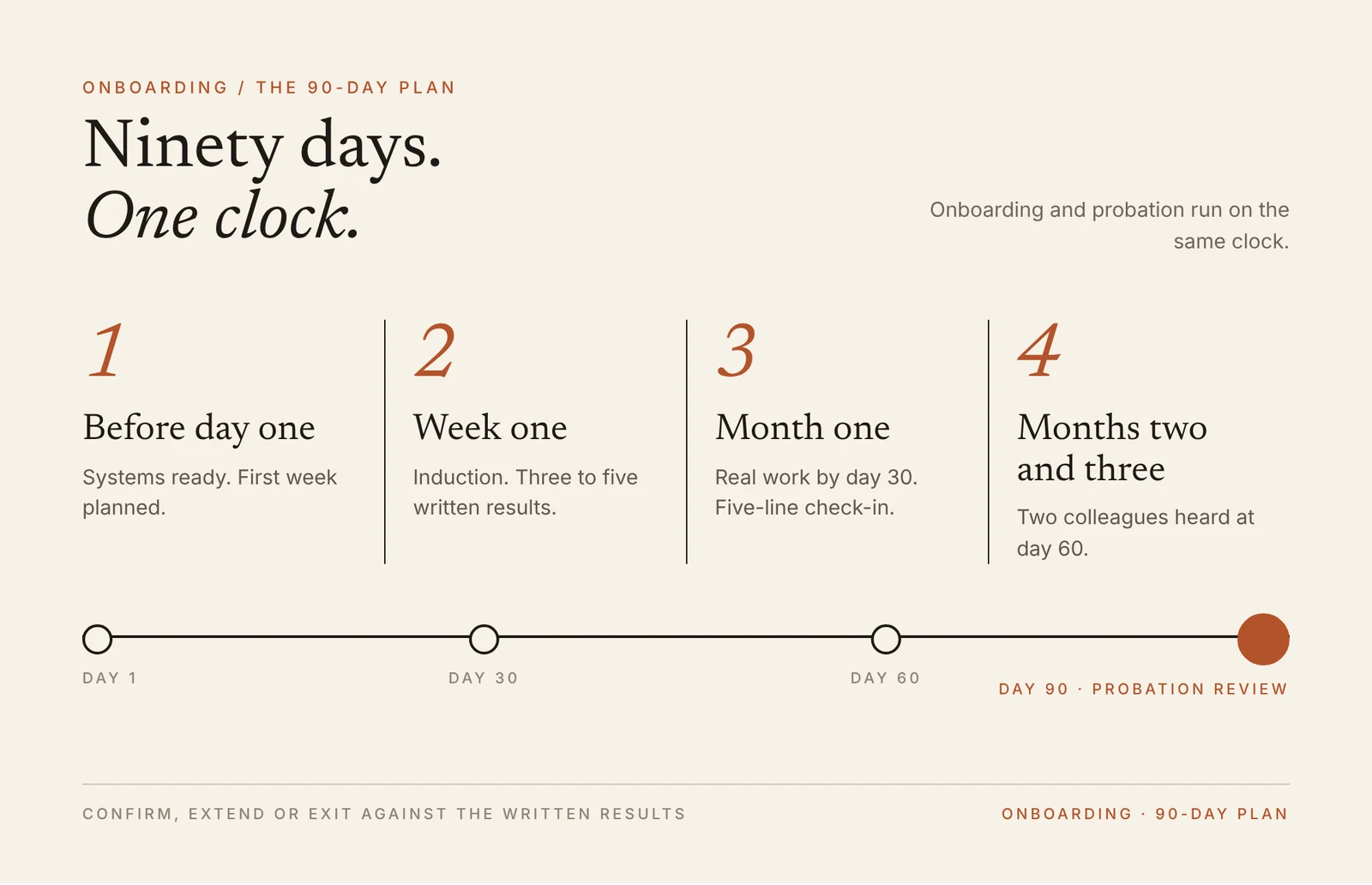
Four phases, matched to the checkpoints of a three-month probation.
Before day one. The gap between acceptance and joining.
- The manager calls the new hire once every two weeks during the notice period.
- The laptop, email, systems access and desk are ready before the first morning.
- The first week's plan is shared in advance, so day one has a shape.
Week one. Orientation and induction.
- A one-day induction covering how the company works, not only its policies.
- Three to five written results the role owns, agreed with the manager. The KRA meaning spoke shows how to write them.
- A named colleague, not the manager, to answer everyday questions.
Month one. First work, first feedback.
- One piece of real work with a visible outcome by day 30.
- The day-30 conversation: what is going well, what is unclear, what the manager has observed. Written down in five lines.
Months two and three. Independence and the review.
- The day-60 conversation, with input from two people the new hire works with.
- The day-90 probation review against the written results, ending in confirmation, extension or exit. The performance appraisal spoke covers how to run it.
The owner's part in onboarding
In a company of 20 to 200 people, the owner does not run onboarding. The owner sets whether it happens.
- Meet every senior hire in week one. Thirty minutes on how decisions are made here, who decides what, and what the owner wants from the role. Most new managers spend months guessing this.
- Ask for the day-30 note. If managers know the owner will read it, it gets written.
- Do not skip the review. Confirmation by default tells everyone that probation is paperwork.
The first ninety days of a new leader essay covers the senior-hire version of this, where the cost of a slow start is highest.
Where onboarding usually fails
- The manager is absent. Travel, a crisis, a busy quarter. The new hire learns the job from whoever is free.
- The role is not written down. The person is told to settle in and learns the expectations at the review.
- The SOPs are old. New hires read process documents that describe how the work was done three years ago. The how to write an SOP spoke covers keeping them current.
- Feedback waits for the review. The first honest conversation happens at day 90, when it is too late to act on.
What onboarding cannot fix
Onboarding can make a well-chosen hire productive faster. It cannot make a person suited to a role that needs a different operating nature: a planner built for steady, structured work placed in a seat that changes every morning, or a self-directed manager placed under an owner who decides everything. Those mismatches show up in onboarding as friction, and are usually read as attitude. The why good people underperform essay covers the pattern.
The Business Pulse reads how your organisation actually runs, where decisions form and where they stall, which is the environment every new hire is being onboarded into.
Questions people ask about onboarding
What is the meaning of onboarding?
Onboarding is the process of bringing a new employee into a company so they can do the job well and stay. It runs from the accepted offer to the point, usually around ninety days in, when the person works independently, and covers formalities, induction, role clarity, working relationships and early feedback.
What is the onboarding process in HR?
In HR, the onboarding process covers pre-joining contact, documentation and payroll setup, systems access, orientation and induction, agreeing the role's expectations, assigning a buddy, and structured check-ins at roughly 30, 60 and 90 days. In a small company it ends with the probation review, which decides confirmation, extension or exit.
What is the difference between onboarding and induction?
Induction is the structured introduction to the company and the role, usually lasting one to five days at the start of employment. Onboarding is the whole process, roughly ninety days, of which induction is the opening part. Induction tells a person how the company works; onboarding makes sure they can work in it.
How long should onboarding take?
For most roles, around ninety days, matching a three-month probation. Senior and specialist roles often need four to six months before the person is fully independent. The length matters less than the structure: written expectations in week one, and honest conversations at day 30, day 60 and the probation review.
What are onboarding best practices for a small company?
Have everything ready before day one, give a one-day induction on how the company works, agree three to five written results for the role, assign a colleague to answer everyday questions, hold short written check-ins at day 30 and day 60, and never skip the probation review.
Who is responsible for onboarding?
The new hire's manager owns it. HR, where there is one, runs the formalities and the schedule. In a company of 20 to 200 people, the owner sets the standard by meeting senior hires in week one and reading the day-30 notes. When nobody owns it, the new hire onboards themselves.
Where to go deeper
- Probation Period — meaning, duration, rules in India, and what probation is actually for.
- Induction Training — who it is for, what to cover, and a one-day format.
- KRA Meaning in HR — writing the results a new hire is judged on.
- Performance Appraisal — methods, process, and the probation review that comes first.
- Probation Confirmation Letter — the letter that closes onboarding.
- Offer Letter — where onboarding actually starts.
- The Long Shadow of a Failed Hire — what an onboarding that never happened costs later.