Probation Period: Meaning, Duration, Rules in India, and What It Is Actually For

A sales executive joins a ₹45 crore Ahmedabad chemicals distributor on the first of the month. His appointment letter says six months' probation. Nobody looks at him closely again until month seven, when payroll asks whether to process the confirmation. The owner says yes, because nothing has gone visibly wrong. A year later he is the problem everyone discusses and nobody can easily remove.
A probation period is a fixed stretch at the start of employment, usually three to six months in India, during which the employer and the new employee test the fit before the job becomes permanent. It is set by the appointment letter and the company's rules, usually carries a shorter notice period, and ends in one of three ways: confirmation, extension or exit. In a job, probation has nothing to do with the criminal-law sense of the word, which is a different search altogether.
This page gives the meaning, the usual durations, where the rules come from in India, what a probationer is paid and owed, how notice works, the three outcomes, and what probation is actually for. The ten spokes go deeper on each.
What probation period means in a job
Probation is a trial with a date on it. The person has been selected, has joined and is being paid, but the employment is not yet confirmed. Either side can end it on short notice while the period runs.
For the employer, it is the one stretch of the relationship in which admitting a hiring mistake is cheap and expected. For the employee, it is the period in which a wrong job can be left without a long notice period or a difficult conversation about loyalty.
A probationer is not a trainee or an intern. A trainee is learning a job, often on a stipend. A probationer has been hired into a real role, on real pay, and is being assessed in it.
How long a probation period lasts
There is no single legal duration for private companies in India. The period is whatever the appointment letter says, within the company's own rules and any state rules that apply.
- Three months is common for junior and operational roles, where the work is visible quickly: sales calls, dispatch, accounts entries.
- Six months is the most common choice for managers and specialists, where the evidence takes longer to arrive.
- Up to a year appears for senior hires and some government roles, where the outcomes of decisions show up slowly.
Length matters less than what happens inside it. A six-month probation in which nobody reviews anything is weaker than a three-month one with three honest checkpoints.
Where the rules come from in India
Probation is governed by a stack of documents, not by one law. An owner should know which layer decides what.
- The appointment letter. It states the length of probation, the notice during probation, and what happens at the end. Under the four Labour Codes, in force from 21 November 2025, an appointment letter is mandatory for every worker in every sector. The appointment letter spoke covers the clauses.
- Standing orders and HR policy. Larger establishments have standing orders; the model versions treat a probationer as someone provisionally employed in a permanent post. Smaller companies rely on an HR policy, which should say the same things the letter says.
- State Shops and Establishments rules. These set leave, working hours and some notice rules, and they vary by state.
- Social security law. PF and ESI apply from the first day where the establishment and the wage are covered. Probation does not pause them.
Specifics vary by state and by headcount, so confirm the exact position for your company with your lawyer or CA before changing a template.
Salary, leave and benefits during probation
A probationer is an employee. Salary is paid as the letter states, PF and ESI apply where covered, and the probation months count towards continuous service for gratuity. Leave accrues according to the state rules and the company's policy, which may restrict when it can be taken but cannot quietly erase what the law grants.
Many companies hold an increment until confirmation. That is a legitimate practice when it is written down and a common source of resentment when it is not. The probation period salary spoke covers what the employer owes and what the letter can set.
Notice during probation
Notice during probation is usually shorter than after confirmation: seven days, fifteen days or a month, against a month to three months later. The point is symmetry. If the fit is wrong, neither side should have to spend a quarter pretending otherwise.
Ending employment during probation still needs care: a written reason that refers to the role and the period, the notice or pay in lieu, and a clean final settlement. The notice period during probation spoke covers resignation on probation and ending it from the employer's side, and the how to terminate an employee in India explainer covers the full process.
A probation that does its job
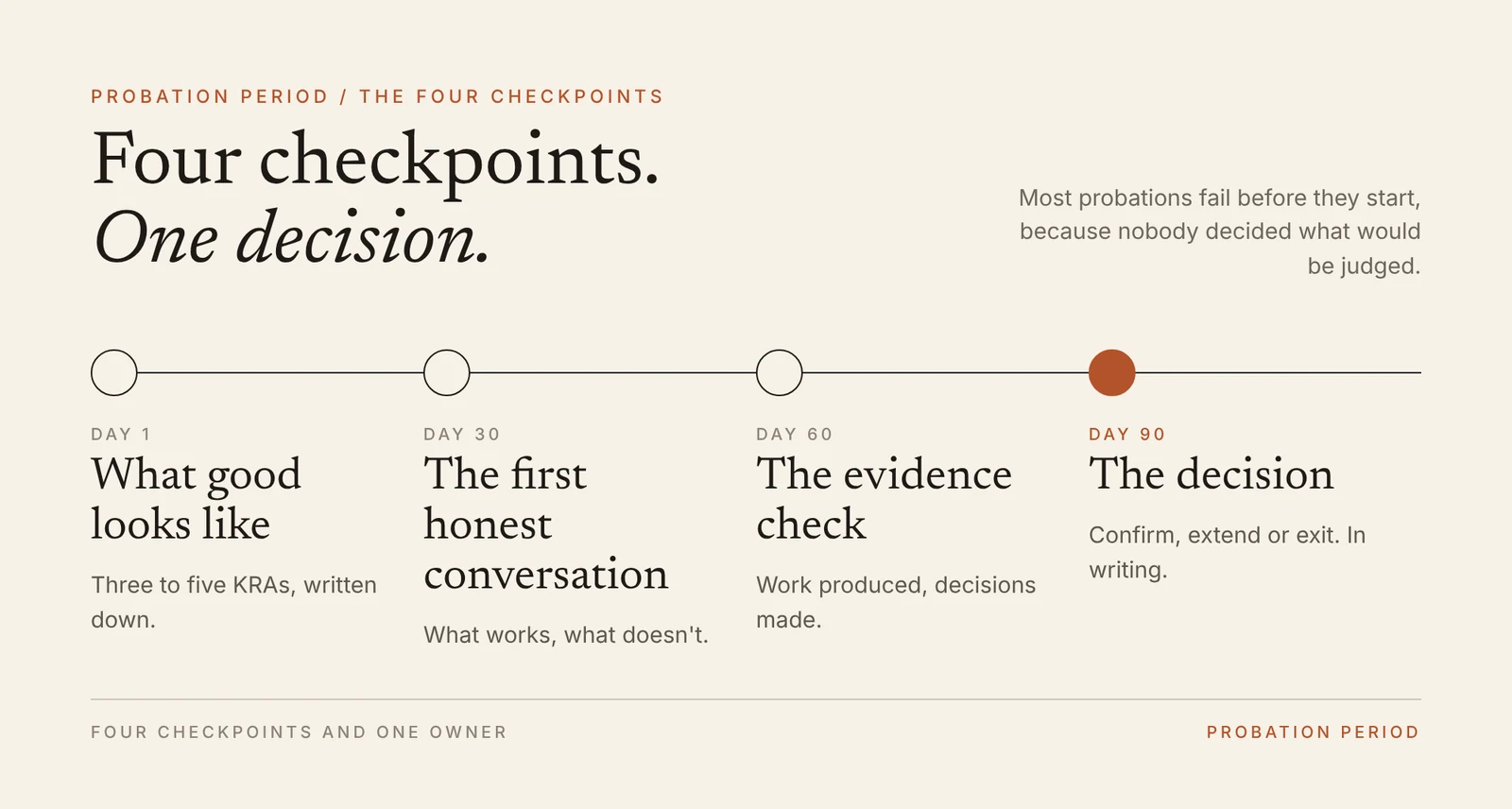
Most probations fail before they start, because nobody decided what would be judged. The person is told to settle in, the manager is busy, and the decision at the end rests on a general impression.
A probation that does its job has four checkpoints and one owner.
- Day 1: what good looks like. Three to five key result areas for the role, written down. The KRA meaning spoke shows how to set them.
- Day 30: the first honest conversation. What is going well, what is not, what the person needs. The onboarding spoke covers what should have happened by now.
- Day 60: the evidence check. Work produced, decisions made, how the person handles the hard part of the role.
- Day 90: the decision. Confirm, extend or exit, in writing, with reasons.
The checkpoints only work if induction and onboarding happened first. A person who was never shown how decisions are made in the company cannot be fairly judged on how they make them. The induction training spoke gives a one-day format.
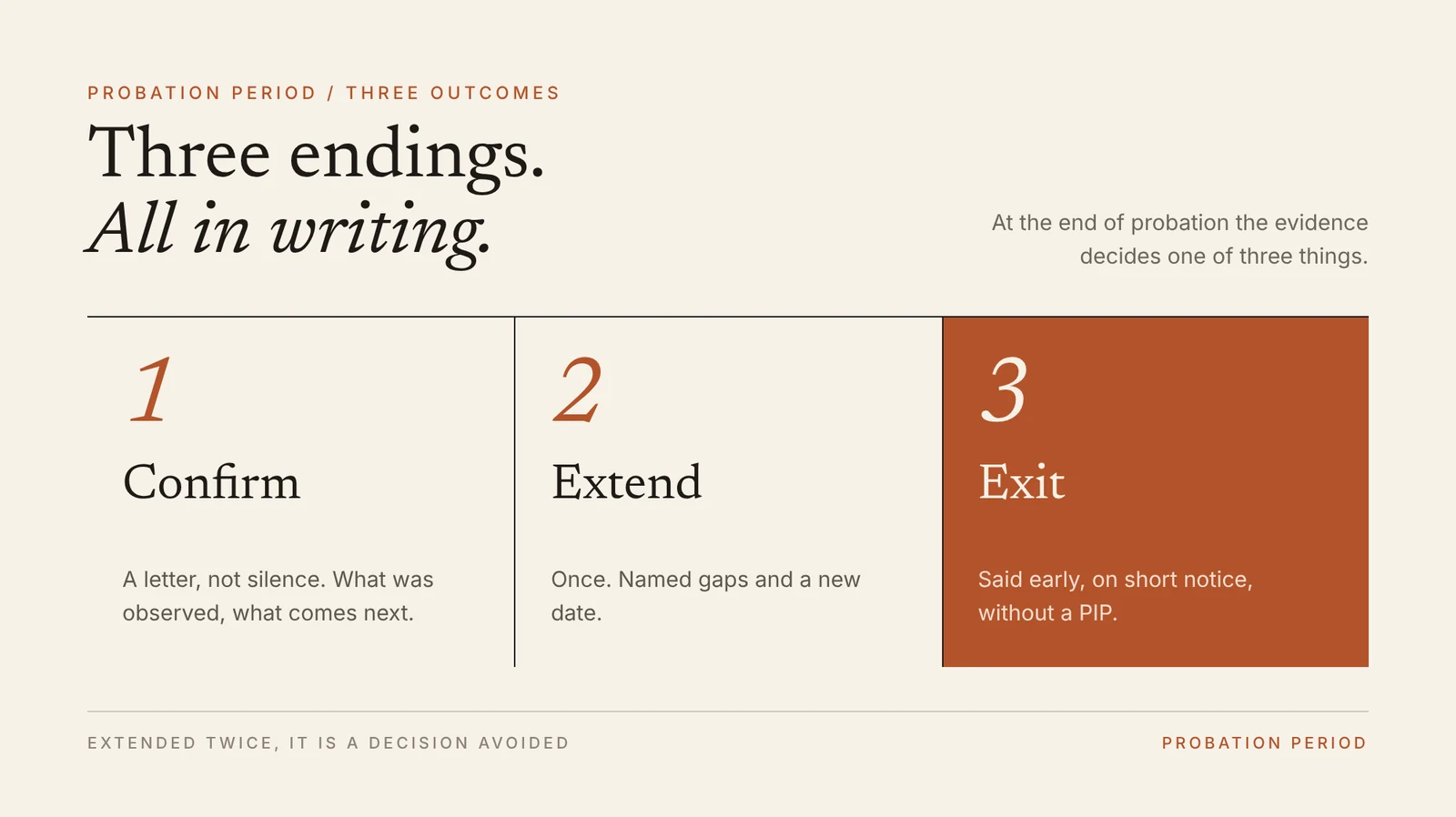
The three ways probation ends
Confirmation. The person becomes a permanent employee. It should come with a letter, not silence, and the letter should say what was observed and what the next six months should bring. The probation confirmation letter spoke has a sample.
Extension. The evidence is not yet clear, and there is a specific reason to believe more time will make it clear. Extension is fair once, with named gaps and a new date. Used twice, it is a decision being avoided. The extending probation spoke covers when and how.
Exit. The fit is wrong. Probation exists so this can be said early, on short notice, without a performance improvement plan. The should I fire this employee essay covers the judgement, and the PIP explainer covers what applies after confirmation, when exits get slower and costlier.
Probation for senior hires
Owners often skip probation for senior people, or write it in and never use it, because judging a general manager feels awkward. That is the hire where it matters most. A senior mismatch costs more, spreads further and takes longer to see, and the wrong hire at the top essay puts a figure on it.
Three adjustments make senior probation workable.
- Longer, with a mid-point. Six months is usually right, with a formal review at month three rather than only at the end.
- Judged on decisions, not output. What the person chose to change, what they chose to leave, and how the team responded. Results lag; decisions show early.
- The owner holds the conversation. A senior probationer reviewed by HR alone learns that the review does not matter. The senior hire who doesn't fit essay covers what usually goes wrong.
Confirmation by default
The most common outcome in owner-led Indian companies is none of the three. It is confirmation by default: the date passes, nobody decides, and payroll treats the person as permanent.
The cost arrives later. A weak fit that could have been ended in a week with a fifteen-day notice now needs a documented performance process, a longer notice, and often a negotiated exit. The cost of keeping an underperformer essay puts numbers to it. Most of that cost was avoidable in month three.
What probation is actually for
Most failure is not from strategy. It is from misaligned WHO.
Probation is usually treated as a test of competence: can the person do the work. Competence is the easier half. Interviews check it reasonably well, and the talent doesn't show in interviews essay covers what they miss. The harder half is fit: whether the way the person operates suits the way the role and the company actually run. A strong operator built for structure can struggle in a company that improvises. A builder can drown in a seat that only maintains.
Fit is visible in ninety days if someone looks for it. The Business Pulse reads how your organisation actually runs, where decisions form, where they stall and how much still routes through you, from a single company document. Knowing that before the next hire is what makes the probation question answerable.
Questions people ask about probation period
What is a probation period in a job?
A fixed trial period at the start of employment, usually three to six months, during which the employer assesses whether the new employee fits the role and the employee assesses the job. The person is paid and employed, but the job is not yet permanent, and notice on either side is usually shorter.
How long is a probation period in India?
There is no single legal duration for private companies. Three months is common for junior roles, six months for managers and specialists, and up to a year for some senior or government roles. The length is whatever the appointment letter states, within the company's rules and applicable state rules.
Is salary paid during probation?
Yes. A probationer is an employee and is paid the salary stated in the appointment letter. PF and ESI apply from the first day where the establishment and wage are covered, and probation counts towards continuous service. Some companies hold an increment until confirmation, which should be written into the letter.
What is the notice period during probation?
Whatever the appointment letter says, usually seven days to one month, shorter than after confirmation. The shorter notice exists so either side can end a poor fit quickly. The employer should still give the reason in writing, pay the notice or salary in lieu, and complete the final settlement.
Can probation be extended?
Yes, if the appointment letter or company policy allows it. Extension is fair once, with the specific gaps named, support offered and a new review date set in writing. Repeated extensions usually mean a decision is being avoided and can create disputes about the employee's status.
What happens if no confirmation letter is given after probation?
In practice the employee is usually treated as confirmed once the period ends and they continue working, though the exact position depends on the appointment letter and policy. Confirmation by default removes the short notice probation allowed, so the decision should always be made and written down.
Where to go deeper
- Probation Period Salary, Leave and Benefits — what the employer owes a probationer and what the letter sets.
- Notice Period During Probation — resigning on probation, and ending it from the employer's side.
- Probation Confirmation Letter — format, sample and what most templates leave out.
- Extending Probation — when it is fair, how long, and the extension letter.
- Appointment Letter — the clauses, the probation clause and the Labour Codes requirement.
- Offer Letter — format, what to include, and how it differs from the appointment letter.
- Onboarding — the employee onboarding process and a 90-day plan for a small company.
- Induction Training — what to cover and a one-day format.
- Performance Appraisal — methods, process and the probation review that comes first.
- KRA Meaning in HR — KRA vs KPI and setting them for a new hire.
- The Long Shadow of a Failed Hire — what a confirmed mismatch costs over years.