KRA Meaning in HR: KRA vs KPI, Examples by Role, and Setting Them for a New Hire on Probation

A Surat textile trader hired a purchase executive and told him on day one to "handle purchase properly". Ninety days later the owner was unhappy and could not say exactly why. The executive was unhappy too, because he had done everything he was asked. Nobody had written down what properly meant.
In HR, KRA stands for key result area: one of the three to six outcome areas a role is responsible for delivering. A KPI, key performance indicator, is the measure that shows how well each KRA is being delivered. The KRA says what the role owns; the KPI says how you will know it is going well. Searches for KRA full form also bring up the KYC Registration Agency used in mutual fund investing; this page covers the HR meaning only.
This page gives the meaning, the difference between KRA and KPI, worked examples for five common roles in a small company, and how to set them for a new hire on day one so the probation period has something real to judge against.
KRA meaning in HR
A key result area is a part of the job where results matter. It is written as an area, not a task: "vendor cost and reliability", not "send purchase orders".
Three things make a KRA useful.
- It is an outcome the role owns. If the person cannot influence it, it is not their KRA.
- There are only a few. Three to six for most roles. A list of fifteen is a job description, and it tells the person nothing about what matters most.
- It can be judged. Each KRA needs at least one way of knowing whether it is going well, which is where the KPI comes in.
KRA vs KPI: the difference
The KRA is the area. The KPI is the measure inside it.
For a sales executive, one KRA is new business. The KPIs inside it could be new accounts opened per month, revenue from new accounts, and conversion from quote to order. For an accounts executive, one KRA is receivables. The KPIs could be days sales outstanding and the value overdue beyond 90 days.
The common mistake is to skip the KRA and jump to numbers. A role then gets a list of targets with no sense of which parts of the job they come from, and the person optimises whatever is measured. The opposite mistake, common in owner-led companies, is to state areas with no measures at all, which is how "handle purchase properly" happens.
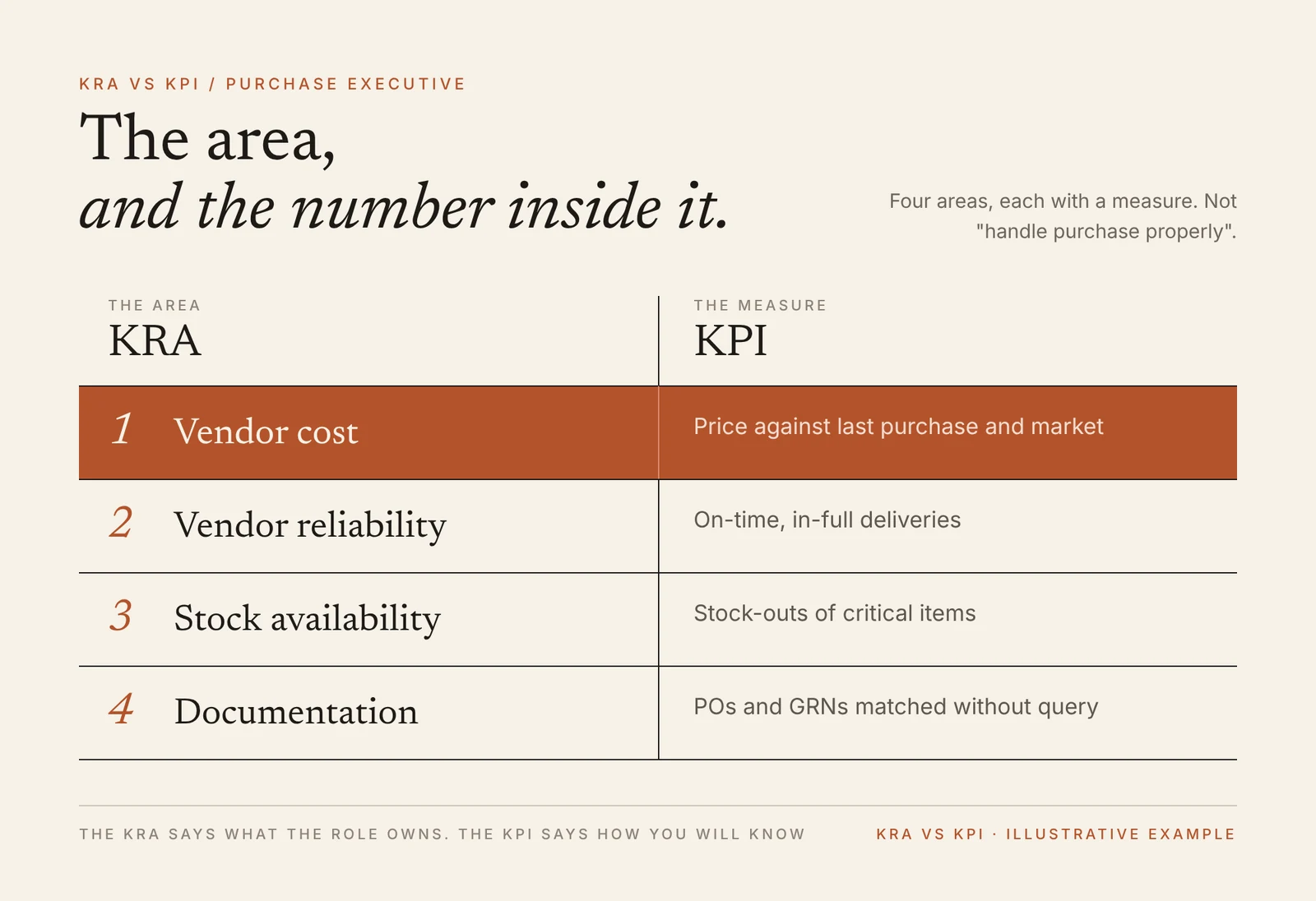
KRA examples for five common roles
Examples from companies of 20 to 200 people. Adjust the measures to your business; keep the number of areas small.
- Sales executive. New business (new accounts, revenue from them). Existing account growth (repeat order value). Collections on own accounts (overdue amount). Pipeline discipline (CRM updated weekly, quotes followed up within two days).
- Purchase executive. Vendor cost (price against last purchase and market). Vendor reliability (on-time, in-full deliveries). Stock availability (stock-outs of critical items). Documentation (POs and GRNs matched without query).
- Accounts executive. Books on time (monthly close by the fifth). Receivables (days outstanding). Statutory compliance (GST, TDS and PF filed on time, no penalties). Accuracy (queries raised by auditors).
- Production supervisor. Output (planned against actual). Quality (rejection rate). Safety (incidents). Team (absenteeism and attrition on the shift).
- HR executive. Hiring (time to fill, joining against offers). Onboarding (new joiners with a written 90-day plan). Records and compliance (files complete, PF and ESI enrolment on day one). Retention (early exits in the first six months).
How to set KRAs for a new hire on probation
The best time to set KRAs is before the person joins. The latest acceptable time is day one.
- Write three to five KRAs for the role. Start from what the role is for: what goes wrong in the business if this seat is empty or badly filled.
- Give each a measure and a 90-day level. Not the full-year target. What a good new person can reasonably show by the end of probation.
- Agree them in the first week. In the induction conversation, with the person, in writing. The induction training spoke gives the one-day format.
- Check at day 30 and day 60. Ten minutes against the written list, so day 90 holds no surprises.
- Review at day 90 against the same list. The probation decision then follows from evidence. The performance appraisal spoke covers the review itself.
A probation period without written KRAs ends in one of two ways: confirmation by default, or a dismissal the person experiences as arbitrary. Both cost more than the hour it takes to write the list.
KRAs, the appointment letter and the confirmation decision
The appointment letter states that the employee is on probation and for how long. It rarely states what will be judged. Attaching the role's KRAs to the appointment letter, or to a short role note signed in the first week, closes that gap.
At the end of probation, the confirmation letter can then refer to the KRAs met and set the KRAs for the next six months. If the evidence says not yet, the probation extension letter can name the specific KRA that is short and what will change.
When the KRAs are met and it still does not work
Sometimes a new hire meets every number and the owner still has a sense that something is off. The team avoids them, decisions slow down around them, or they deliver in a way the company cannot sustain.
That is not a KRA problem. KRAs measure what a person delivers. They do not show how a person operates, or whether that way of operating fits the role and the people around it. The talent doesn't show in interviews essay covers why that is hard to see before joining. The Business Pulse reads how your organisation actually runs, where decisions form, where they stall and how much still routes through you, which is the layer a KRA sheet never reaches.
Questions people ask about KRA
What is the full form of KRA in HR?
In HR, KRA stands for key result area. It is one of a small number of outcome areas a role is responsible for, such as vendor cost and reliability for a purchase executive. In finance, KRA also stands for KYC Registration Agency, which is unrelated to HR and performance management.
What is the difference between KRA and KPI?
A KRA is an area of results a role owns, such as receivables for an accounts executive. A KPI is the measure that shows how well that area is going, such as days sales outstanding. Each KRA usually has one to three KPIs. KRAs say what matters; KPIs say how you will know.
How many KRAs should a role have?
Three to six for most roles. Fewer than three usually misses part of the job; more than six turns the list into a job description and hides what matters most. For a new hire on probation, three to five KRAs with a clear 90-day level for each is enough.
What are KRA examples for a sales executive?
New business, measured by new accounts and revenue from them; existing account growth, measured by repeat order value; collections on own accounts, measured by overdue amount; and pipeline discipline, measured by CRM updates and quote follow-up time. Adjust the measures to the product and the sales cycle.
When should KRAs be set for a new employee?
Before joining if possible, and no later than the first week. They should be agreed with the employee in writing, checked briefly at day 30 and day 60, and used as the basis of the probation review at day 90, so the confirmation decision follows from evidence rather than impression.
Are KRAs the same as a job description?
No. A job description lists duties and tasks. KRAs pick out the few areas where results matter most and attach a measure to each. A job description tells a person what they do; KRAs tell them what they will be judged on, which is what a probation review needs.
Where to go deeper
- Probation Period — meaning, duration, rules in India, and what it is actually for.
- Performance Appraisal — methods, process, and the probation review.
- Induction Training — where KRAs are agreed in the first week.
- Appointment Letter — and why KRAs belong next to it.
- Probation Confirmation Letter — confirming against the KRAs met.
- Employee Not Performing — what to do before you decide.