Probation Confirmation Letter: Format, Sample, and What to Put in It (Free Template)

The accounts executive at a Coimbatore textile exporter finished her six months in March. Nobody said anything, so she kept coming in. In August she asked HR for a confirmation letter because her bank wanted one for a home loan, and HR discovered that nobody had ever decided whether she was confirmed. She had been, by default, for five months.
A probation confirmation letter is the written notice an employer gives an employee at the end of probation, stating that the probation has been completed satisfactorily and that the employee is now confirmed in the role on permanent terms. It names the role, the date of confirmation, any change in pay or benefits, and the notice period that now applies. In most Indian companies it is also the document a bank, a visa officer or a future employer asks for.
This page gives the meaning, when to issue it, the format, a full sample you can adapt, and the two things most templates leave out. The probation period pillar covers the whole period before it.
What a confirmation letter means
Confirmation is the change of status from probationer to permanent employee. The letter is the proof of that change.
Three things move with it. The notice period usually lengthens, from the short probation notice to the full notice in the appointment letter. Any increment or benefit promised on confirmation becomes due. And the employer's ability to end the employment quickly, on the grounds that the person did not clear probation, ends.
That last point is why the letter matters to the company as much as to the employee. Once the date passes, the company has accepted the person in the seat, whether or not anyone thought about it.
When to issue it
On or a few days before the last day of probation, after the probation review, never weeks later.
The review comes first. A manager who has watched the person for three or six months sits with them, goes through what the role needed and what was observed, and recommends confirmation, an extension, or exit. The letter records the decision that conversation produced. The performance appraisal spoke covers how to run that first review.
Issuing the letter late is common and costly. A person who has not heard anything assumes they are confirmed, and in most cases the law and the courts will agree with them.
Confirmation by default, and why it is a problem
Many appointment letters say that an employee will be deemed confirmed unless told otherwise. Many others say nothing. Either way, a company that lets the date pass has confirmed the person.
The problem is not legal. It is that nobody decided. The manager who had doubts in month two did not raise them, the owner never asked, and the person now sits in a permanent seat on the strength of silence. Six months later the doubts return as a performance problem, and the company is in the territory of the employee not performing conversation, with a much longer notice period and a confirmed employee.
The fix is a calendar entry thirty days before every probation end date, owned by the manager, not by HR.
What to put in a confirmation letter
The essential elements, in this order.
- Date and reference number. For your records and the employee's.
- Employee details. Name, employee code, designation and department.
- The statement of confirmation. That probation, which began on the date of joining, has been completed satisfactorily, and the employee is confirmed with effect from a stated date.
- Pay and benefits. Either "your terms remain as in your appointment letter" or the revised CTC with the basic, allowance and deduction split.
- Notice period. The notice that now applies on either side.
- Other terms unchanged. A line saying all other terms of the appointment letter continue.
- Signature. Signed by someone with authority to appoint, usually the owner or HR head, with an acknowledgement line for the employee.
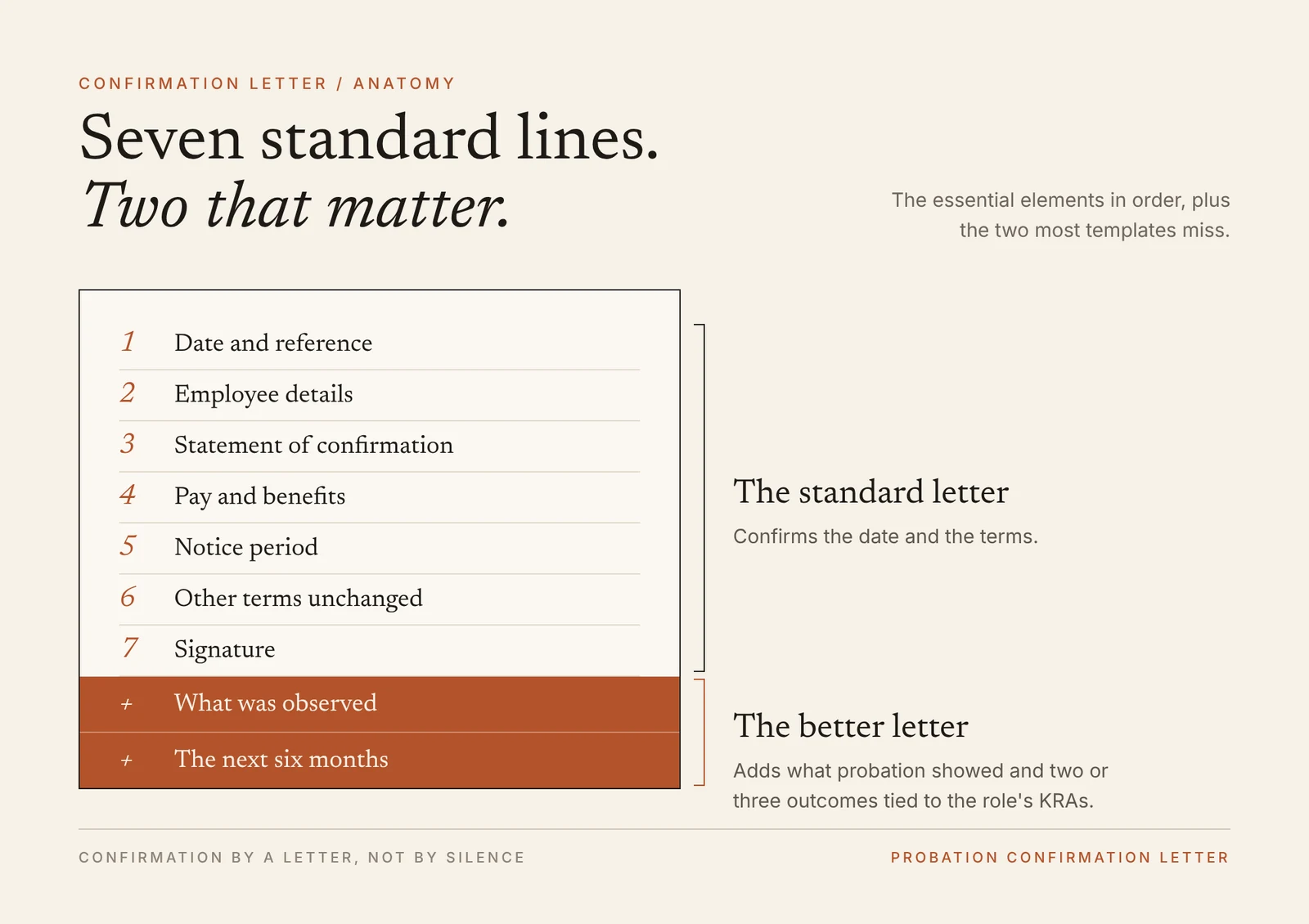
The two things most templates leave out
Every template online stops at the seven elements. Two more turn a formality into something the employee will remember.
What was observed. Two or three sentences on what the person actually did well in probation, in specific terms: "You closed the vendor reconciliation backlog in your first eight weeks, and the plant team now sends queries to you directly." A generic "your performance has been satisfactory" tells the person nobody was watching.
What the role expects next. Two or three outcomes for the next six months, tied to the role's key result areas. Confirmation is the start of the permanent role, not the end of the trial, and the letter is the only moment when the company has the person's full attention to say so.
Sample confirmation letter
Adapt the wording; keep the structure.
[Company letterhead]
Date: [date]
Ref: [HR/CONF/2026/014]
To
[Employee name]
[Designation], [Department]
Employee code: [code]
Subject: Confirmation of employment
Dear [first name],
Your probation period with [Company name], which began on [date of joining], ended on [date]. We are pleased to confirm your employment as [designation] with effect from [confirmation date].
In your probation you [one or two specific observations, for example: brought the monthly vendor reconciliation up to date and set up the weekly ageing report the purchase team now uses]. That is the standard we will hold the role to.
For the next six months, we expect the role to deliver [two or three outcomes, for example: month-end close within five working days; zero unreconciled vendor balances above ₹50,000].
From [confirmation date], your [revised annual CTC is ₹[amount], with the split set out in the annexure / terms of remuneration remain as in your appointment letter dated [date]]. The notice period on either side is now [period]. All other terms of your appointment letter continue unchanged.
Congratulations, and welcome to the permanent team.
For [Company name]
[Name], [Designation]
[Signature]
I acknowledge receipt of this letter.
[Employee signature and date]
Employment confirmation letter for a bank or visa
A different document with a similar name. Banks, landlords and embassies ask for an employment confirmation letter, which states that the person is currently employed, since when, in what role and at what salary.
It carries no decision. Issue it on letterhead, addressed "To whom it may concern", signed by HR, and keep salary figures to what the requester actually needs. Many companies keep a standard format for it alongside the probation confirmation letter so the two are not confused.
The decision behind the letter
A confirmation letter is easy to write. The decision it records is not, and most companies make it on two inputs: no complaints, and the manager's general sense.
Neither looks at the question probation exists to answer, which is whether this person is built for this seat: the pace it runs at, the decisions it owns, the people it depends on. The talent that does not show in interviews essay covers why the hiring process misses this, and probation is the company's one chance to see it before the decision becomes permanent. The Business Pulse reads how your organisation actually runs, where decisions form and where they stall, from one company document and with no questions to answer, which is the context a confirmation decision rarely has.
Questions people ask about confirmation letters
What is a confirmation letter in a job?
It is the letter an employer issues at the end of probation, stating that the employee has completed probation satisfactorily and is confirmed in the role on permanent terms from a stated date. It usually confirms the pay that now applies, the longer notice period, and that all other terms of the appointment letter continue unchanged.
When should a confirmation letter be issued?
On or a few days before the last day of probation, immediately after the probation review. Issuing it weeks later is common but leaves the person unsure of their status, and in most cases a company that lets the probation end date pass without a decision is treated as having confirmed the employee anyway.
What if I do not receive a confirmation letter after probation?
If the appointment letter says the employee is deemed confirmed unless told otherwise, the employee is usually treated as confirmed once the date passes. If it is silent, the position depends on the letter, company policy and state rules. Ask HR in writing; employers should treat the request as a prompt to decide and issue the letter.
What should a confirmation letter include?
Date and reference, employee name, code and designation, a clear statement of confirmation with the effective date, the pay that now applies, the new notice period, a line that other terms continue, and an authorised signature with an acknowledgement line. The better letters add specific observations from probation and expected outcomes for the next six months.
Is a salary increment given on confirmation?
Only if the appointment letter or company policy promises one. Many Indian companies give a small increment or move the employee onto full benefits at confirmation, but it is a practice, not a legal requirement. Whatever the company intends, it should be written in the appointment letter and repeated in the confirmation letter.
What is the difference between a confirmation letter and an employment confirmation letter?
A probation confirmation letter records a decision: the employee has cleared probation and is now permanent. An employment confirmation letter, often requested by banks, landlords or embassies, simply certifies that the person currently works for the company, since when, in which role and sometimes at what salary. It carries no change of status.
Where to go deeper
- Probation Period — meaning, duration, rules in India, and what it is actually for.
- Extending Probation — when it is fair, how long, and the extension letter.
- Appointment Letter — the clauses, including the probation clause, written properly.
- Performance Appraisal — and the probation review that comes first.
- KRA Meaning in HR — the outcomes a confirmation letter should point to.
- Notice Period During Probation — how notice changes at confirmation.
- Employee Not Performing — what happens when the doubts arrive after confirmation.