Induction Training: Meaning, Who It Is Given To, What to Cover, and a One-Day Format

The new accounts executive at a Rajkot engineering firm spent her first morning in the conference room with a laptop, a printed leave policy and a slide deck from 2019. At lunch someone showed her the canteen. By evening she knew the company's founding year and nothing about who signs off a vendor payment. That was the induction.
Induction training is the structured introduction a company gives a new employee in the first days of joining: the organisation, its people, its rules, the role and the way work actually gets done. It is given to new employees, including new joiners transferred from another location or promoted into a new function, and is usually completed within the first day or week. It is the first part of onboarding, not the whole of it.
This page gives the meaning, who it is for, what to cover, a one-day format a small company can run, and the three things owners leave out. The probation period pillar explains why the first week shapes the confirmation decision months later.
What induction training means
Induction training is the company introducing itself to the person it has just hired. It answers the questions every new joiner has and few ask out loud: where things are, who decides what, what the rules are, and what a good first month looks like.
In most textbooks it appears as the first stage of training and development. In most Indian SMEs it appears as a half-day of forms, a tour and a handshake with the owner, after which the new person is left beside someone busy.
The difference between the two is not budget. It is whether anyone has written down what a new person needs to know in their first week.
Who induction training is given to
Induction training is given to new employees. That is the exam answer, and it is correct.
It is also given, in a shorter form, to three groups companies forget.
- Internal transfers. A sales manager moving from the Pune branch to the Ahmedabad plant is new to that plant, its people and its habits.
- Promoted employees. The supervisor who becomes a manager needs an induction into the new role, not the company. Without it, they keep doing the old job.
- Returning employees. Someone back after a long leave walks into changed systems, changed people and changed priorities.
Induction, onboarding and orientation
The three words are used interchangeably, and they describe different lengths of time.
Orientation is an event: a tour, an introduction, a set of documents. It takes hours.
Induction is a short programme: the company, the rules, the role, the systems. It takes a day to a week.
Onboarding is the whole process of making a new person productive and settled, from before day one to the end of the first ninety days. Induction sits inside it. The onboarding process spoke gives the 90-day plan, and the onboarding intelligence gap essay covers why most new-hire failures are decided in this window.
What to cover in induction training
A useful induction covers six things, in this order.
- The company. What it sells, to whom, how it makes money and where it is trying to go this year. Five minutes from the owner is worth an hour of slides.
- The people. Who the new person reports to, who they will work with daily, and who decides the things that affect their work.
- The rules. Attendance, leave, expenses, conduct and the POSH policy, with the written documents handed over and the questions answered.
- The role. What the job is for, the three to five key result areas it owns, and what good looks like at day 30 and day 90. The KRA meaning spoke covers how to set them.
- The systems. Email, the ERP or Tally, the CRM, the shared drives, the WhatsApp groups that actually run the place.
- The probation. How long it is, what will be reviewed and when, and who will review it. The appointment letter states the terms; induction is where they are explained.
A one-day induction format for a small company
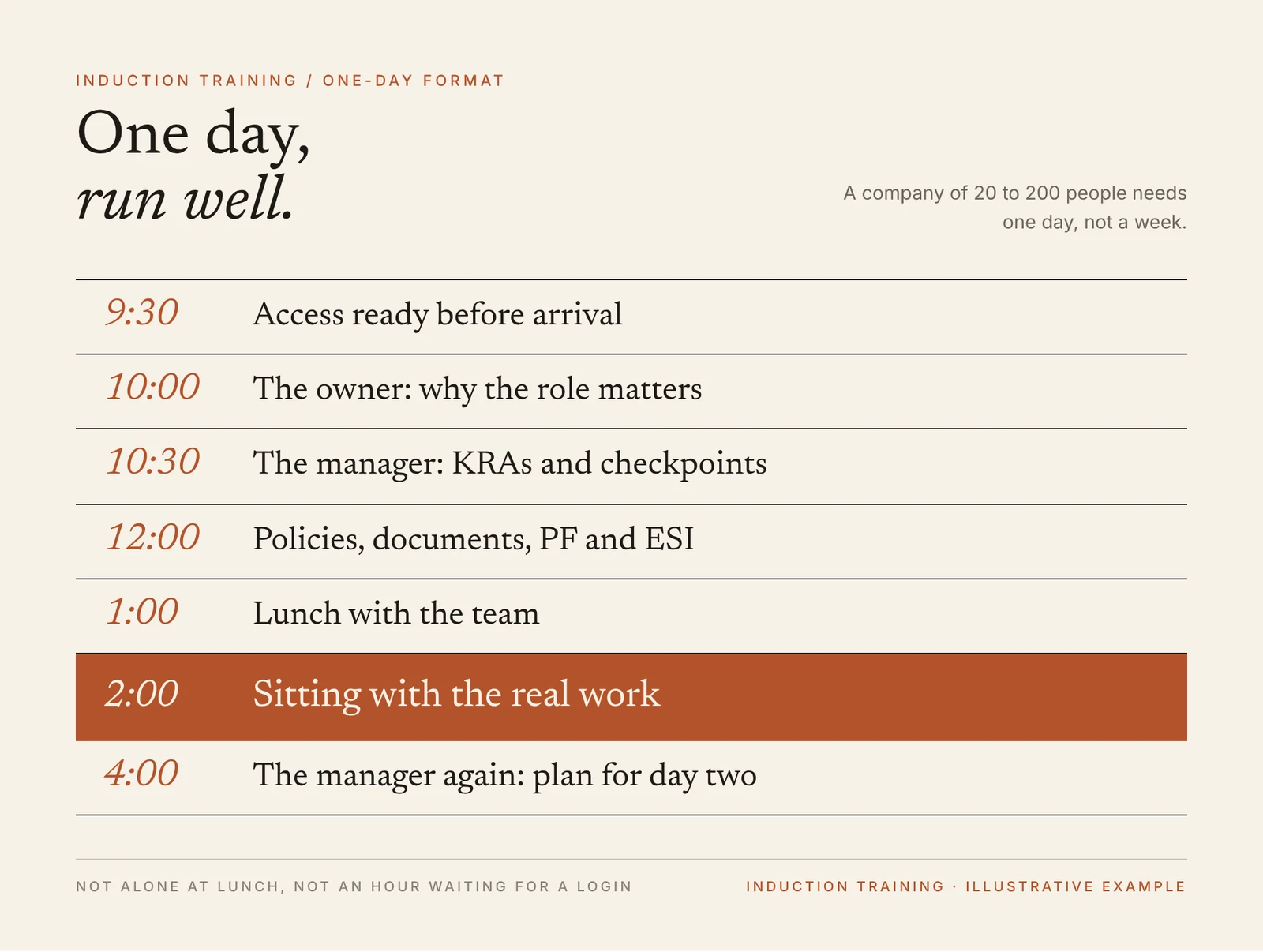
A company of 20 to 200 people does not need a week-long programme. It needs one well-run day and a clear plan for the next eighty-nine.
- 9:30 to 10:00, before anything else. Desk, laptop, email and access ready before the person arrives. Nothing signals a careless company faster than an hour spent waiting for a login.
- 10:00 to 10:30, the owner or the most senior person available. Why the company exists, where it is going, and why this role matters to that.
- 10:30 to 12:00, the manager. The role, the KRAs, the first month's work, and the probation checkpoints with dates.
- 12:00 to 1:00, HR or the office manager. Policies, documents, PF and ESI enrolment, leave rules, and the written handbook.
- 1:00 to 2:00, lunch with the team. Not alone, and not with HR.
- 2:00 to 4:00, the work itself. Sitting with the person who currently does the closest job, watching real work happen.
- 4:00 to 4:30, the manager again. What made sense, what did not, and the plan for day two.
The three things owners leave out
Most induction checklists cover the company, the rules and the systems. Three things are almost always missing, and they are the ones a new person needs most.
How decisions are actually made here. Not the org chart. Which decisions the manager takes, which need the owner, which can be taken by the person themselves, and what happens when nobody is sure. In owner-led companies this is the single most expensive thing a new joiner learns by mistake. The delegation of authority spoke covers how to write it down.
Who to ask. A named person for each kind of question: the system, the customer, the process, the policy. Without it, the new person asks whoever sits nearest, and learns that person's habits as the company's rules.
What good looks like. A specific picture of good work in this role at this company: a good proposal, a good dispatch day, a good month. New people calibrate to the first example they see. Give them a good one.
Why induction decides more than it seems
Induction looks like administration. It is the first evidence a new person has about what kind of company they have joined, and they form a judgement within days.
It is also where the company starts its own judgement. The probation review at day 90 is only as good as the expectations set on day one. A manager who never stated what good looks like cannot fairly say it was not met. The performance appraisal spoke covers the probation review that follows.
And it is where a quieter question first becomes visible: whether this person, in this role, under this manager, is likely to fit how the company actually works. Skills show up in an interview. Fit shows up in the first weeks. The Business Pulse reads how your organisation actually runs, where decisions form, where they stall and how much still routes through you, which is the context a new hire walks into and an induction rarely describes.
Questions people ask about induction training
What is induction training?
Induction training is the structured introduction a company gives new employees in their first days: the organisation, its people, its rules, the role and the systems. It is the first part of onboarding and is usually completed within a day or a week of joining, before the person settles into regular work.
Induction training is given to whom?
It is given to new employees joining the organisation. A shorter version is also useful for employees transferred to a new location or function, employees promoted into a new role, and people returning after a long leave, because each of them is new to the situation they are walking into.
What is the difference between induction and onboarding?
Induction is a short programme covering the company, rules, role and systems, usually a day to a week. Onboarding is the whole process of making a new employee productive and settled, from before day one to the end of the first ninety days. Induction is one stage inside onboarding.
What should be included in an induction programme?
The company and its direction, the people the new joiner will work with, policies and documents, the role and its key result areas, the software and systems, and the probation terms. The most useful additions are how decisions are made, who to ask about what, and an example of good work.
How long should induction training last?
For a company of 20 to 200 people, one well-planned day is usually enough, followed by short check-ins through the first month. Senior or technical roles may need a longer programme of a week, spread across the functions the person will depend on.
Who should conduct induction training in a small company?
Several people, each covering what they know best: the owner or a senior leader on purpose and direction, the reporting manager on the role and expectations, HR or the office manager on policies and documents, and a colleague doing similar work on how the job is actually done.
Where to go deeper
- Probation Period — meaning, duration, rules in India, and what it is actually for.
- Onboarding Process — the 90-day plan that induction begins.
- KRA Meaning in HR — setting key result areas for a new hire on day one.
- Appointment Letter — the terms an induction should explain.
- Performance Appraisal — and the probation review that comes first.
- The Onboarding Intelligence Gap — why new hires fail in the first ninety days.