Appointment Letter: Meaning, Format, What It Must Include in India (and How It Differs From an Offer Letter)

A Ghaziabad electrical contractor with ninety people on the payroll had issued appointment letters to eleven of them, the office staff. The site supervisors, electricians and helpers had joined on a phone call and a handshake. When the four Labour Codes came into force in November 2025, the owner discovered that the handshake was no longer enough, and that seventy-nine letters were now overdue.
An appointment letter is the formal written document an employer issues to an employee at the time of joining, setting out the terms of employment: designation, date of joining, place of work, reporting line, salary and its components, probation, working hours, leave, notice period and the other conditions of service. Since 21 November 2025, under India's Labour Codes, every worker in every sector must be given one. It is the contract most disputes are later decided on.
This page gives the meaning, how it differs from an offer letter, the clauses it must carry, the probation clause written properly, and a sample. The probation period pillar covers what the probation clause sets in motion.
What an appointment letter means
It is the employer's written statement of the job and its terms, signed by an authorised person and acknowledged by the employee.
It is issued on or before the date of joining. It replaces, rather than repeats, the offer letter, which was conditional and sent before the person accepted. Where the two differ, the appointment letter is the one that governs.
For a small company it is also the one document that records what the owner promised. Everything that was said at interview and not written here will be remembered differently by each side within a year.
Appointment letter vs offer letter
The offer letter comes first and is short: role, CTC, joining date, conditions such as references or documents, and a deadline to accept. It is a proposal.
The appointment letter comes on joining and is complete: every term of employment, including probation, notice, leave, confidentiality and the right to transfer. It is the contract.
Some companies merge the two into one detailed offer, which is legally possible but leaves a gap: if anything changes between offer and joining, there is no document that records the final terms. The offer letter spoke covers the offer stage and its mistakes.
Is an appointment letter mandatory in India?
Yes. The four Labour Codes came into force on 21 November 2025, and appointment letters are now mandatory for all workers across all sectors, including those previously hired informally.
For an owner-led company, this changes the practice of hiring site, shop-floor and field staff by word of mouth. Every one of them now needs a letter. The details of format and timing can vary with state rules, so confirm the requirements for your state with your lawyer or CA.
What an appointment letter must include
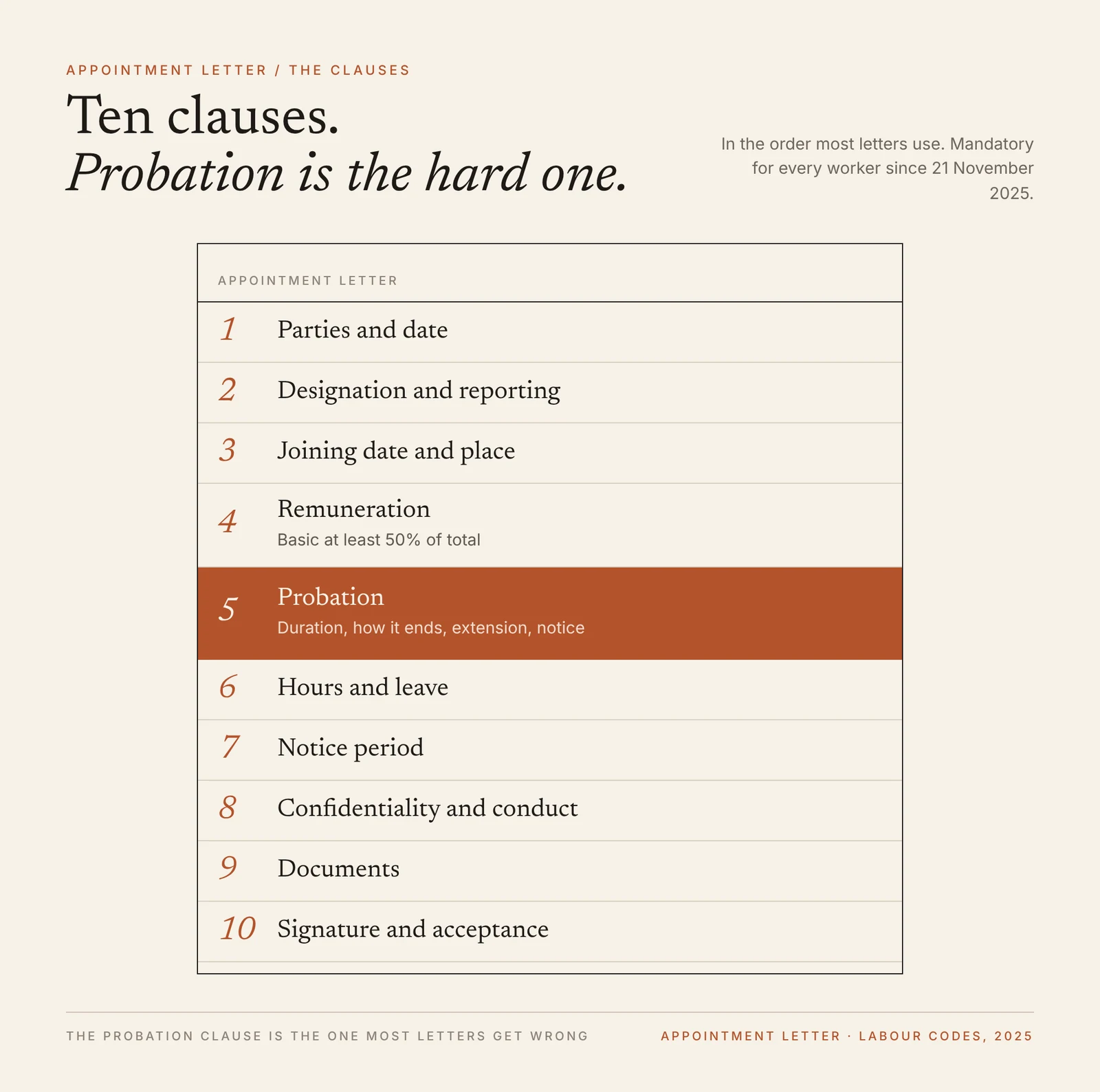
The clauses, in the order most letters use.
- Parties and date. Company name and address, employee name and address, date of issue.
- Designation and department. The title and the function, plus the person they report to by designation, not by name.
- Date of joining and place of work. With a transfer clause if the company has more than one location.
- Remuneration. Annual CTC with the split into basic, allowances, employer contributions and deductions. Under the Labour Codes, basic wage must be at least 50% of total remuneration, which affects how the split is drawn.
- Probation. Duration, how it ends, whether it can be extended, notice during probation. The clause below.
- Working hours and leave. Hours, weekly off, leave entitlements, or a reference to the leave policy.
- Notice period. After confirmation, on either side.
- Confidentiality and conduct. Protection of company information and adherence to company policies.
- Documents. What the employee must submit and by when.
- Signature and acceptance. An authorised signatory and the employee's acknowledgement.
The probation clause, written properly
Most probation clauses say one sentence: "You will be on probation for six months." That sentence leaves four questions open, and each becomes an argument later.
A complete clause answers all four.
- How long. The duration, from the date of joining.
- How it ends. By a written confirmation after a review, not by silence.
- Whether it can be extended. Once, by up to a stated period, in writing before the original end date.
- What notice applies during it. On either side, and how it differs from notice after confirmation.
Sample clause: "You will be on probation for [six] months from your date of joining. At the end of this period your performance will be reviewed, and your confirmation will be communicated in writing. The company may, before the end of the probation period, extend it once by up to [three] months by written notice. During probation, either party may end the employment by giving [fifteen days'] notice or salary in lieu of notice."
The probation extension and notice period during probation spokes cover what that clause sets up.
Sample appointment letter
[Company letterhead]
Date: [date]
Ref: [HR/APPT/2026/031]
To
[Employee name]
[Address]
Subject: Letter of appointment
Dear [first name],
We are pleased to appoint you as [designation] in our [department] at [location], with effect from [date of joining]. You will report to the [designation of manager].
Your annual cost to company will be ₹[amount], with the components set out in Annexure A. Your basic wage forms [at least 50]% of total remuneration.
[Probation clause as above.]
Your working hours are [hours], [days] a week, with [weekly off]. Your leave entitlements are as per the company leave policy, a copy of which is attached.
After confirmation, either party may end this employment by giving [notice period] notice in writing or salary in lieu of notice.
You will keep confidential all information relating to the company, its customers and suppliers, during and after your employment, and will follow the company's policies as amended from time to time.
You may be transferred to any of the company's locations, with reasonable notice, as business requires.
Please submit [documents] by [date], and sign the duplicate copy of this letter to confirm your acceptance.
For [Company name]
[Name], [Designation]
[Signature]
I accept the terms of this appointment.
[Employee signature and date]
What the letter cannot say
An appointment letter fixes the terms of the seat. It cannot say whether the person in it is the right one.
That question is decided in probation, and most companies arrive at the end of it with a letter, a calendar date and a manager's impression. The talent that does not show in interviews essay covers what hiring misses. The Business Pulse reads how your organisation actually runs, where decisions form and where they stall, from one company document, which is the context the letter was never meant to hold.
Questions people ask about appointment letters
What is an appointment letter?
It is the formal document an employer gives an employee at joining, setting out the terms of employment: designation, joining date, place of work, reporting line, salary and its split, probation, hours, leave, notice period and conditions such as confidentiality. Signed by both sides, it is the employment contract that most later questions are decided on.
Is an appointment letter mandatory in India?
Yes. Under the four Labour Codes, which came into force on 21 November 2025, appointment letters are mandatory for all workers in all sectors, including workers previously hired informally. Format and timing details can vary with state rules, so employers should confirm the exact requirements for their state with a lawyer or CA.
What is the difference between an offer letter and an appointment letter?
An offer letter is a conditional proposal sent before joining, with the role, CTC, joining date and conditions, and a deadline to accept. An appointment letter is issued on joining and contains every term of employment. Where the two differ, the appointment letter governs, which is why it should be complete.
What should an appointment letter include?
Parties and date, designation and reporting line, joining date and place of work, remuneration with its split, a probation clause, working hours and leave, notice period, confidentiality and conduct, required documents, and signatures. Under the Labour Codes, the salary split should keep basic wage at no less than half of total remuneration.
Can an appointment letter be issued after joining?
It should be issued on or before the date of joining. Issuing it late leaves the period in between governed only by what was said, which is where disputes start. Companies that hired staff without letters before the Labour Codes should issue letters to all of them now, with the original joining dates.
Is probation mentioned in the appointment letter?
It should be, and in full: the duration, how probation ends, whether it can be extended and by how much, and the notice that applies during it. A single line stating "six months' probation" leaves the most common later disputes, about extension and notice, unanswered.
Where to go deeper
- Probation Period — meaning, duration, rules in India, and what it is actually for.
- Offer Letter — format, what to include, and the mistakes small companies make.
- Probation Confirmation Letter — the letter that ends probation.
- Extending Probation — when it is fair and the extension letter.
- Probation Period Salary — pay, leave and benefits during probation.
- Onboarding — what happens after the letter is signed.
- How to Hire Executives — the stage before the letter.