Why SOPs Fail: 6 Reasons Employees Stop Following Procedures (and the One Nobody Names)

The SOPs were written properly. Observed, tested, numbered, issued, trained. Six months later the sales manager is quoting from memory, the dispatch checklist is signed in one pen at the end of the day, and the owner is approving purchases on WhatsApp again. Nobody decided to abandon the procedures. They just stopped.
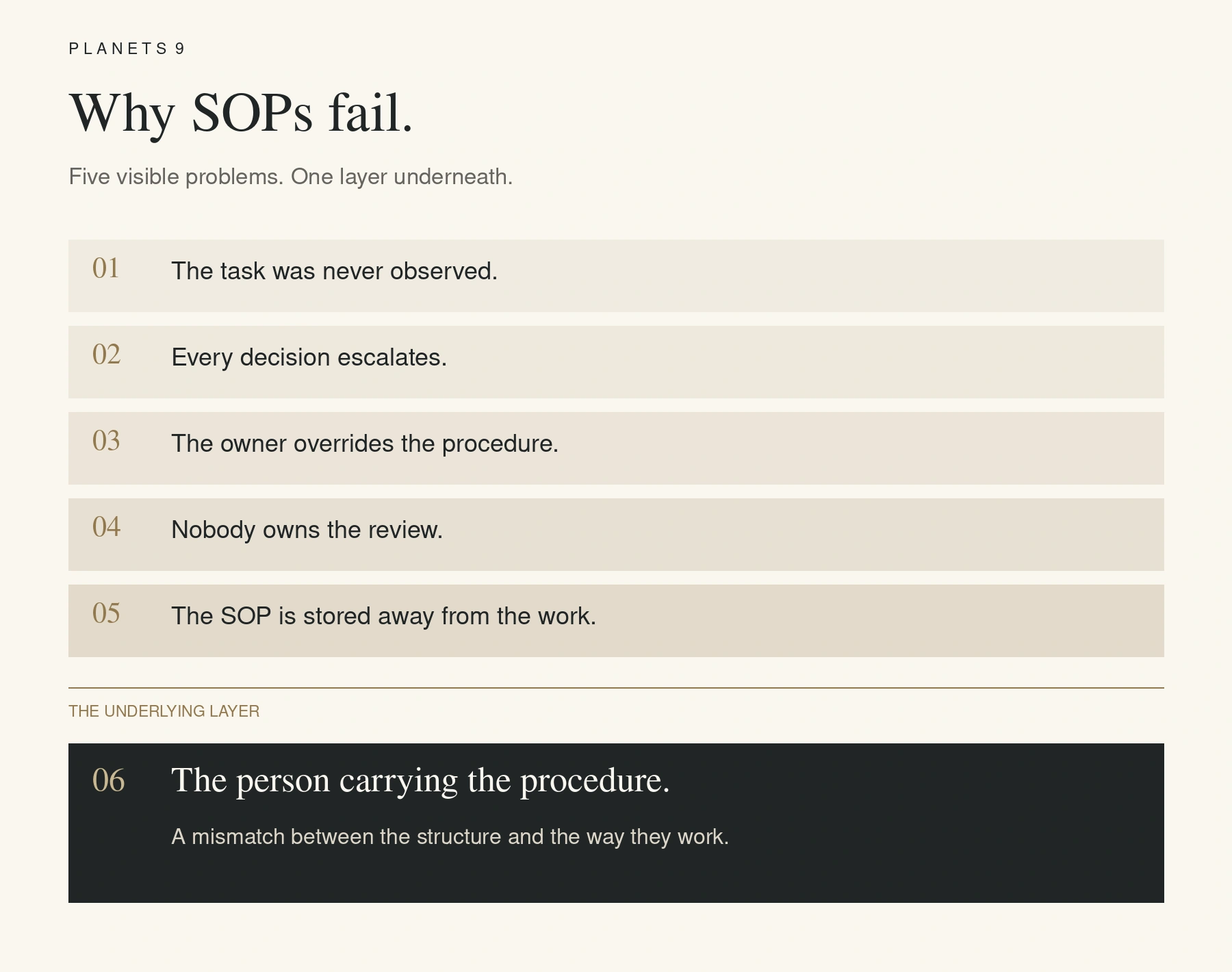
SOPs fail for six reasons: they describe a task that was never observed; they stop at every decision with "escalate"; the owner overrides them in person; nobody owns their review; they are stored where the work is not; and, underneath all of these, the person assigned to carry the procedure is not built to carry it. The first five are fixable with method. The sixth is the one no SOP guide discusses, and it decides whether the other five fixes hold.
This page takes each in turn, with the sign that it is happening and the correction, and then stays on the sixth.
1. The SOP describes a task nobody watched
The procedure was written from the owner's memory, from a template, or by a language model asked for "an SOP for purchase orders". It is plausible. It is not what happens. The team notices within a day, follows it for a week out of politeness, and returns to the way the work actually gets done.
The sign: people can recite the SOP and cannot describe the last time they used it.
The correction: rewrite from observation. Two performers, two instances, every divergence resolved into a rule. The seven-step method exists for this reason.
2. The SOP stops at every decision with "escalate to management"
The procedure lists the steps and, at each point where judgement is needed, sends the question upward. The paperwork changes; the phone traffic does not. The team has a document that tells them, in writing, to ask the owner.
The sign: the owner's daily interruptions are the same after the SOPs as before.
The correction: write the rule. A rupee threshold, a category, a condition. Below it, the performer decides and records. Above it, a named role decides, and the owner only for the top band. Setting those numbers is the hardest part of writing an SOP and the only part that changes how the company runs. The decision bottleneck essay covers how to set them.
3. The owner overrides the SOP in person
The purchase SOP says two quotes above ₹50,000. The owner knows the vendor, trusts him, and approves a single quote on a phone call because the delivery is urgent. The decision is correct. The lesson the team takes from it is that the SOP is what you follow when sir is not looking.
Every override in person moves the decision back to the owner. Three overrides and the SOP is a suggestion.
The sign: staff check with the owner before following the procedure, "just to confirm".
The correction: the owner follows the SOP, or changes it, and never does a third thing. If the two-quote rule is wrong for trusted vendors, write an approved-vendor exception into the document. If the rule is right, take the extra day. The document and the owner's behaviour must say the same thing, because when they differ the team believes the behaviour.
4. Nobody owns the review
The software was upgraded in March. The supplier changed in June. GST rules moved in the budget. The SOP still says what it said at issue, and the first person who follows it exactly gets it wrong. After that, everyone knows the SOPs are out of date, and the whole set is discounted, not just the one.
The sign: a review date on the document that has passed, with no revision entry.
The correction: a name on every SOP, a review date, and one role, usually operations or quality, that keeps the register and chases the dates. Six months for customer-facing and compliance procedures, twelve for the rest, immediately on any system or supplier change.
5. The SOP lives where the work does not
The procedures are in a folder on the server, or in a binder in the manager's cabin, or attached to an email from the consultant. The work happens on the floor, at the desk, in the field. Nobody walks to the binder mid-task.
The sign: the master copy is pristine.
The correction: put the SOP where the task happens. Laminated at the workstation. Pinned in the shared folder the team already opens. Inside the ERP or CRM as a checklist, if the system allows it. A one-page procedure at the point of use beats a perfect one in a cupboard.
6. The person carrying the procedure is not built to carry it
This is the one underneath the other five.
Every SOP is carried by a person, and people relate to written structure in different ways. It is not a matter of competence or attitude; it is closer to operating nature. Some people run a checklist with relief: the structure frees them to do the task well. Some experience the same checklist as a constraint, follow it for a month, and route around it as soon as they are confident, not from defiance but because their way of working is to hold the outcome and improvise the path. Some follow it exactly, indefinitely, and never notice when it has stopped making sense.
The same SOP in those three hands produces three different results. In the first it works. In the second it decays. In the third it ossifies and produces the wrong output faithfully.
Most SOP failures that survive the first five corrections are this. The procedure was right. The owner held the line. The review happened. And the sales manager, who is very good at closing and constitutionally unable to work from a list, was made the owner of a fourteen-step quotation procedure. Nothing in the document could have made that hold.
Most failure is not from strategy. It is from misaligned WHO.
The SOP was the strategy. It was fine. What was misaligned was the fit between the structure and the person asked to inhabit it.
The sign: the same SOP works in one team and fails in another with no difference in the document.
The correction is not in the document. It is in who owns which procedure, and in whether the owner of the company can see how each person in the business actually relates to structure, authority and pressure before assigning it. Some procedures need a person who holds standards. Some need a person who improves them. A few need a person who will follow them under pressure without deviation. Matching those is a people decision, and most owners make it on availability and loyalty because they have never been able to see the other thing.
How the six interact
The first five reasons are visible and each has a procedural fix. The sixth is not visible from the documents and does not have one. It shows up as the first five recurring after they have been fixed: the procedure that keeps drifting back to "ask sir" in one department only, the checklist that is always backfilled by one person, the review that one manager never does.
When an SOP keeps failing after it has been observed, rule-set, held, reviewed and placed correctly, stop rewriting the document. Look at who is carrying it.
Questions people ask about why SOPs fail
Why do employees not follow SOPs?
Because the SOP describes a task differently from how it is actually done, because it sends every decision upward, because the owner overrides it, because it is out of date, or because it is stored away from the work. When all five are fixed and the SOP still fails, the person assigned to it is not suited to carry that kind of structure.
How do you get employees to follow SOPs?
Write from observation, put a rule at every decision, follow the SOP yourself without exception, review it on a date, keep it at the point of use, and assign each procedure to a person who works well within written structure. Training alone does not do it.
What is SOP compliance?
The degree to which a procedure is followed as written, measured through the records the SOP names: registers filled at the time, checklists signed per instance, system entries made at the step. Low compliance is information about the SOP or the person, not only about discipline.
Should SOPs be flexible?
The steps should be exact and the decision rules explicit. Flexibility belongs in the rules themselves, as thresholds and exceptions written into the document, not in how faithfully the steps are followed. An SOP that is "flexible" in practice is one that has stopped being followed.
What happens when the owner does not follow the SOP?
The team learns that the procedure applies to them and not to the decision that matters, and the decision moves back to the owner. In owner-run companies this is the single most common reason SOPs decay, and it is covered in the owner dependency guide.
See who is carrying the structure
The five procedural fixes above are within any owner's reach. The sixth requires seeing something most owners have only ever guessed at: how each person in the business actually operates when given structure, authority and pressure. Who holds a standard. Who improves it. Who quietly routes around it.
The Business Pulse reads how your organisation actually runs, where decisions form, where they stall, and how much still routes through you. Fifteen minutes, answered as the owner, before the next SOP is assigned to the person who happens to be available.
Where to go deeper
How to Write an SOP — the method that prevents reasons one and two.
SOPs for a Small Business, Department by Department — the first ten, in order.
The Decision Bottleneck — setting the thresholds that reason two depends on.
The Founder Who Micromanages — the override pattern from the owner's side.
What Is an SOP? — the full guide.