Authority and Responsibility: Fayol's Principle, and the One-Page Matrix That Fixes the Mismatch

The sales manager owns the quarter's number. He cannot approve a 5% discount. The plant head is answerable for on-time dispatch. He cannot sanction overtime. Both are held responsible for outcomes they are not permitted to produce, and both have learned the only move that works, which is to ask the owner.
Authority and responsibility is Fayol's second principle: authority is the right to give orders and the power to require obedience; responsibility is the obligation to answer for the result. The two must correspond. Whoever is held responsible for an outcome must have the authority to produce it, and whoever holds authority is answerable for how it is used. Fayol added that the fear of responsibility is as common as the abuse of authority, and that a good manager must be willing to carry both.
This page gives the principle, the three ways it is violated in owner-run companies, and the one-page instrument that fixes it.
What the principle says
Fayol distinguished official authority, which comes from the position, from personal authority, which comes from intelligence, experience, moral worth and the ability to lead. He said the second is an indispensable complement to the first: a manager with the position but no personal authority will not be followed, and one with personal authority but no position will be resented.
Responsibility, in his account, is the "natural consequence and essential counterpart" of authority. Wherever authority is exercised, responsibility arises. The principle is that the two must be kept in balance: no authority without corresponding responsibility, and no responsibility without corresponding authority.
Later writers added a third term, accountability, the obligation to report on the use of authority and to answer for results, and noted that accountability cannot be delegated. The person who hands authority down remains accountable upward. The delegation of authority spoke covers that mechanism.
The three ways the principle breaks
Responsibility without authority
The commonest in SMEs. Titles are given, targets are set, and the power to act stays with the owner. The department head is accountable for outcomes he can only influence by persuading the owner to act. Two things follow: decisions queue at the top, and the manager stops owning the outcome, because he has learned that he does not control it.
The sign is a manager who reports problems rather than solving them. He is not weak. He is accurately describing his authority.
Authority without responsibility
Rarer, and usually a family matter. A family member holds signing power, or a de facto veto, without being answerable for any result. The team routes around them, decisions are unmade in private, and nobody can say who is accountable for what happened. Fayol's phrase for this was that authority without responsibility is "the abuse of power".
Authority that exists on paper and not in practice
The manager has a written limit of ₹2 lakh for purchase approval. He uses it once; the owner questions the decision in front of the team; he never uses it again. Formal authority was granted and personal authority was withdrawn at the first exercise. From then on the limit is decoration and the manager asks.
This is the failure that persists after the org chart is fixed, and it is the one owners do not see, because from where they sit they gave the authority.
The instrument: a one-page authority matrix
The fix for the first two failures is a document, and it is short.
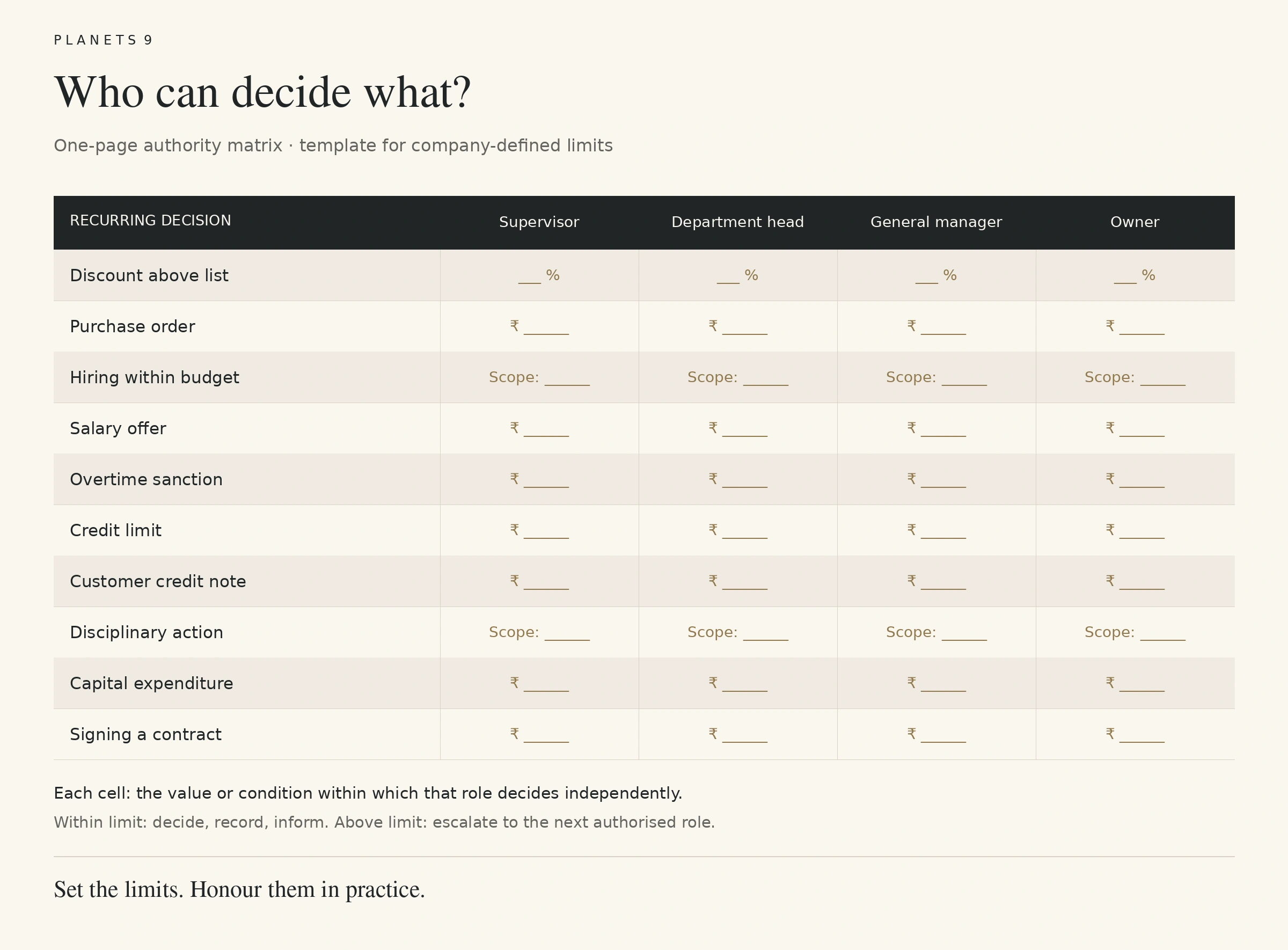
Down the left, the decisions the company makes repeatedly: discount above list, purchase order, hiring within budget, salary offer, overtime sanction, credit limit, customer credit note, disciplinary action, capital expenditure, signing a contract. Across the top, the roles: supervisor, department head, general manager, owner. In each cell, the limit: the value or condition up to which that role decides alone, records the decision, and informs upward. Above the limit, it goes to the next role.
Ten rows, four columns, one page. Every manager can see what he decides. Every decision that reaches the owner does so because the matrix sends it there, not because nobody knew who could decide. The decision bottleneck essay is about setting the numbers; the SOP examples show the thresholds written into procedures.
Two rules make it hold. The owner does not decide below the line, even when asked, even when he could. And a decision within the limit that turns out badly is reviewed as a decision, not reversed as a mistake, or the third failure above begins.
The failure the matrix cannot fix
Authority can be granted. Whether a person will hold it is a different question.
Some managers take an authority limit and use it fully from the first week. Some take the same limit, use it once, feel the weight, and quietly hand it back by asking. Fayol saw this and called it the fear of responsibility: "generally feared as much as authority is sought". It is not a character flaw. It is closer to how a person is built to relate to risk and to the owner, and no matrix changes it.
The owner who has written the authority matrix and still finds every decision on his desk has usually not failed at the principle. He has granted authority to someone who is not built to carry it, and the choice of who carries which authority is the layer under the matrix. The Business Pulse reads how the organisation actually runs, where decisions form and where they stall, and is the instrument for that question.
Questions people ask about authority and responsibility
What is the principle of authority and responsibility?
Fayol's second principle: authority is the right to give orders and require obedience; responsibility is the obligation to answer for results. They must correspond, so that whoever is responsible for an outcome has the authority to produce it.
What is the difference between authority and responsibility?
Authority is a right, flowing downward from the position. Responsibility is an obligation, flowing upward to whoever granted the authority. Authority can be delegated; ultimate responsibility, or accountability, cannot.
What is the difference between responsibility and accountability?
Responsibility is the obligation to perform the assigned work. Accountability is the obligation to answer for the result and report on the use of authority. A manager can share responsibility with a team; accountability stays with the manager.
What happens when responsibility exceeds authority?
The person cannot produce the result they are answerable for, decisions escalate, and they stop owning outcomes. It is the commonest management failure in owner-run companies.
What is an example of authority and responsibility?
A sales manager responsible for the quarterly target with the authority to approve discounts up to 10%, hire within the sanctioned headcount and set territory allocations. Responsibility for the number is matched by authority over the levers that produce it.
Can authority be delegated?
Yes. Accountability cannot. The manager who delegates authority to a subordinate remains answerable to his own superior for the result. The delegation of authority spoke covers the mechanics.
Where to go deeper
Principles of Management — all 14, decoded.
Delegation of Authority — moving authority without it coming back.
Centralisation and Decentralisation — how much authority sits where.
Unity of Command — one source of authority per person.
The Decision Bottleneck — setting the thresholds in the matrix.