Scalar Chain: Fayol's Principle, the Gang Plank, and the Company That Has a Hub Instead

Draw the line of authority in a textbook company and you get a ladder: owner, general manager, department head, supervisor, worker. Draw it in a forty-person Indian company and you get a wheel. Every spoke ends at the owner. There is no chain because there is only one link.
The scalar chain is Fayol's ninth principle: the unbroken line of authority running from the top of the organisation to the bottom, through every level, along which orders pass downward and reports pass upward. Fayol added the gang plank, sometimes called Fayol's bridge: two people at the same level in different chains may communicate directly, with their superiors' knowledge, rather than sending every message up one chain and down the other. The principle is about two things at once: that authority should have a defined route, and that the route should not be so rigid that it slows the work.
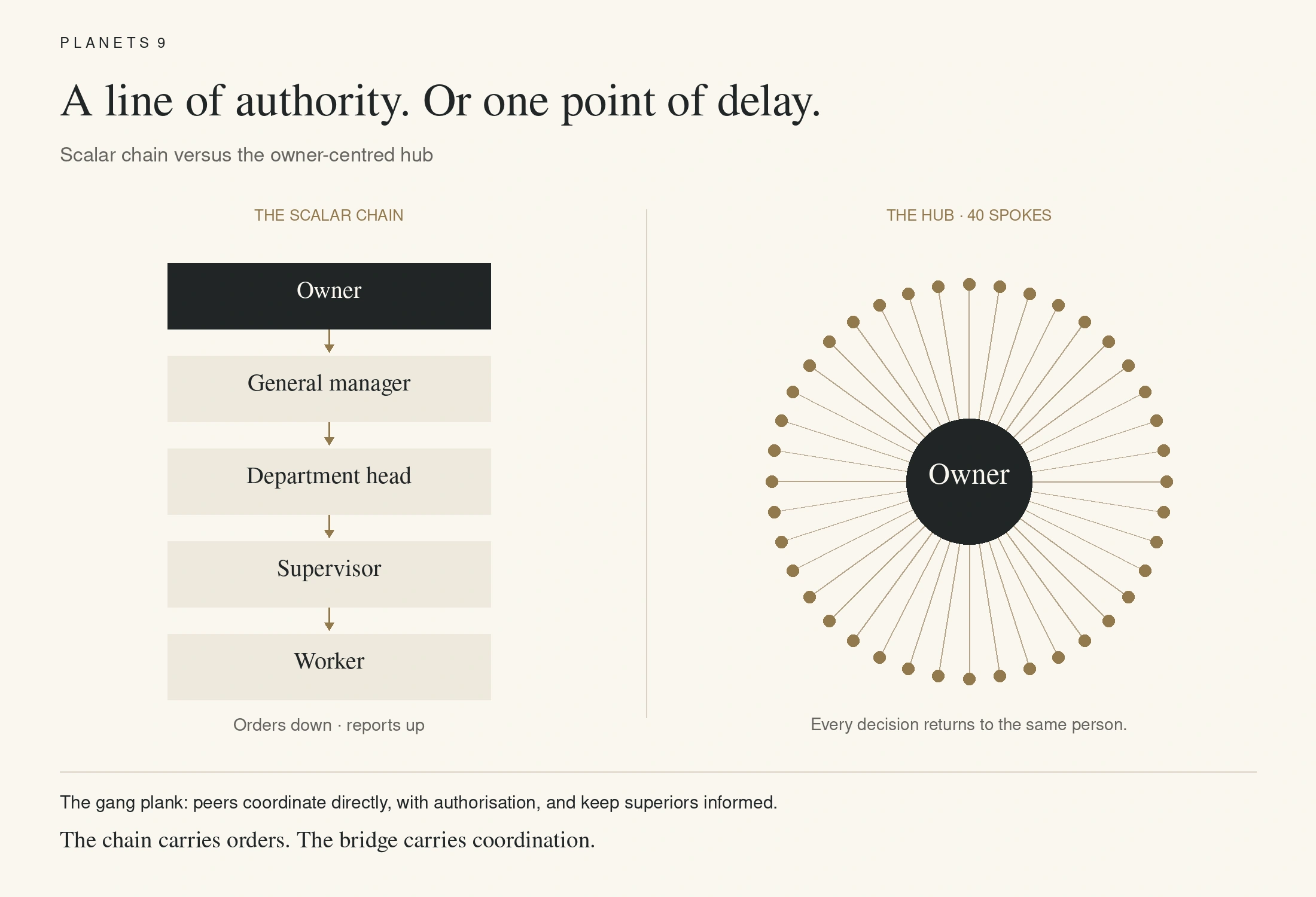
This page gives the principle, the gang plank, and the specific failure of owner-run companies, which is not a broken chain but a missing one.
What the principle says
The scalar chain, from scala, a ladder, is the sequence of superiors from the highest authority to the lowest rank. Every person in the organisation sits somewhere on it, knows who is above them and who is below, and communicates through it. Fayol's reasoning was that the chain is the route by which unity of command is maintained: if orders only travel along the chain, each person has one source of orders.
He then qualified it immediately. Following the chain for every communication is "sometimes disastrously lengthy", especially in large companies. A message from a clerk in one department to a clerk in another would travel up seven levels and down seven. So he proposed the gang plank: the two clerks talk directly, provided their immediate superiors have authorised it in general and are kept informed. The chain remains the route for orders; the plank is the route for coordination.
The gang plank
Fayol's bridge is the part of the principle that most companies get wrong in the opposite direction. Large bureaucracies over-follow the chain and everything is slow. Small companies ignore the chain entirely and everything goes to the owner.
The plank works when three things hold. The two people talking are at comparable levels. They have general authorisation from their superiors to coordinate directly. And they inform upward on what they agreed. Under those conditions, the sales coordinator and the dispatch supervisor sort out a delivery date between themselves in five minutes rather than escalating it through two department heads and the owner.
Under any other conditions it is not a plank, it is a bypass, and bypasses are how unity of command breaks.
Where owner-run companies fail: the hub
In a company of eight, the scalar chain is one level: the owner and everyone else. That is correct for eight.
At forty, the same structure is usually still in place. Supervisors have been added because the work needed them, but they report to the owner. Department heads have titles but their people still take instructions from the owner, because the owner still gives them. The chain never formed. What formed instead is a hub with forty spokes, and the hub is one person's attention.
Two things follow. Every coordination between two spokes goes through the hub, because there is no plank and no chain to bypass; it is the only route. And the hub's span of control is forty, which no person can manage, so the owner is not managing forty people. He is answering forty people's questions, which is different, and slower. The span of control spoke gives the numbers.
Building a chain where there is a hub
Four steps, and the first is the one owners resist.
Draw the real chain. Not the org chart for the bank. For each person, who do they actually take instructions from, and who do they actually report problems to. In most SMEs the honest drawing has one node in the middle.
Insert the middle level. Department heads with real authority over their people. The owner's direct reports drop from forty to five or six. This is the hire most owners defer, and the levels of management spoke covers why.
Route orders through the chain, always. The owner speaks to the floor through the head. The head speaks to the owner for the floor. The moment the owner gives a direct instruction to a supervisor, the chain has a bypass and the head has become a title.
Authorise the planks explicitly. Which pairs of roles may coordinate directly, on what, with what obligation to inform. Sales coordinator and dispatch supervisor on delivery dates. Purchase executive and stores in-charge on receipts. Written down once, so that coordination is fast and nobody wonders whether they were allowed.
The chain and the family
Family businesses often have two chains. The founder's chain, made of the people he hired, and the next generation's chain, made of the people they hired. Both run through the same departments. A manager on the founder's chain who receives an instruction from the son does not know whether it is an order or a plank, and the son does not know whether he has been obeyed or humoured.
The fix is the same as for unity of command: one chain, family authority divided by domain in writing, and planks between the domains authorised rather than assumed. The family business governance essay covers the structure.
What the chain cannot tell you
A chain is only as strong as its middle links. The department head inserted between the owner and the floor either holds authority, coordinates sideways, and carries the standard upward and downward, or becomes a relay that forwards questions in both directions. The structure is the same in both cases. The person is different.
That is the layer under the principle. The chain names the positions; it does not say who can hold them. The Business Pulse reads how the organisation actually runs, where decisions form and where they stall, and is the instrument for seeing which links in the chain are actually carrying weight.
Questions people ask about the scalar chain
What is the scalar chain in management?
Fayol's ninth principle: the unbroken line of authority from the top of the organisation to the bottom, through which orders pass down and reports pass up. It is sometimes called the chain of command.
What is the gang plank in the scalar chain?
Fayol's bridge: permission for two people at the same level in different chains to communicate directly, with their superiors' knowledge, rather than routing every message up one chain and down the other. It keeps the chain from making the organisation slow.
What is an example of the scalar chain?
Managing director to general manager to sales head to regional manager to sales executive. An order from the MD to a sales executive travels down that chain; a report from the executive travels up it.
What is the difference between scalar chain and unity of command?
Unity of command says each person has one boss. The scalar chain is the line of bosses from top to bottom along which that command travels. The chain is the route; unity of command is the rule that orders only travel along it.
What happens when the scalar chain is broken?
When a superior bypasses the chain and gives orders directly to someone two levels down, the intermediate manager loses authority, the subordinate has two sources of orders, and the chain reverts to a hub. In owner-run companies this is the usual state.
Who gave the scalar chain principle?
Henri Fayol, in his 14 principles of management, 1916.
Where to go deeper
Principles of Management — all 14, decoded.
Unity of Command — the rule the chain exists to protect.
Span of Control — how many spokes one hub can hold.
Levels of Management — the middle links most SMEs are missing.
The Decision Bottleneck — what a hub looks like from the owner's desk.