What Is Management? The 5 Functions of Management, and the One Owners Never Hand Over

Ask an owner what management is and the answer is usually a description of his own day. Ask a textbook and the answer is five verbs. Both are right, and the gap between them is where most companies between twenty and two hundred people get stuck.
Management is the process of getting work done through other people by planning what is to be achieved, organising the resources and roles to achieve it, staffing those roles, directing the people in them, and controlling results against the plan. Those five, planning, organising, staffing, directing and controlling, are the functions of management taught in most Indian syllabi; Fayol's original five were planning, organising, commanding, coordinating and controlling. The definition matters because it separates managing from doing, and most owners are still doing.
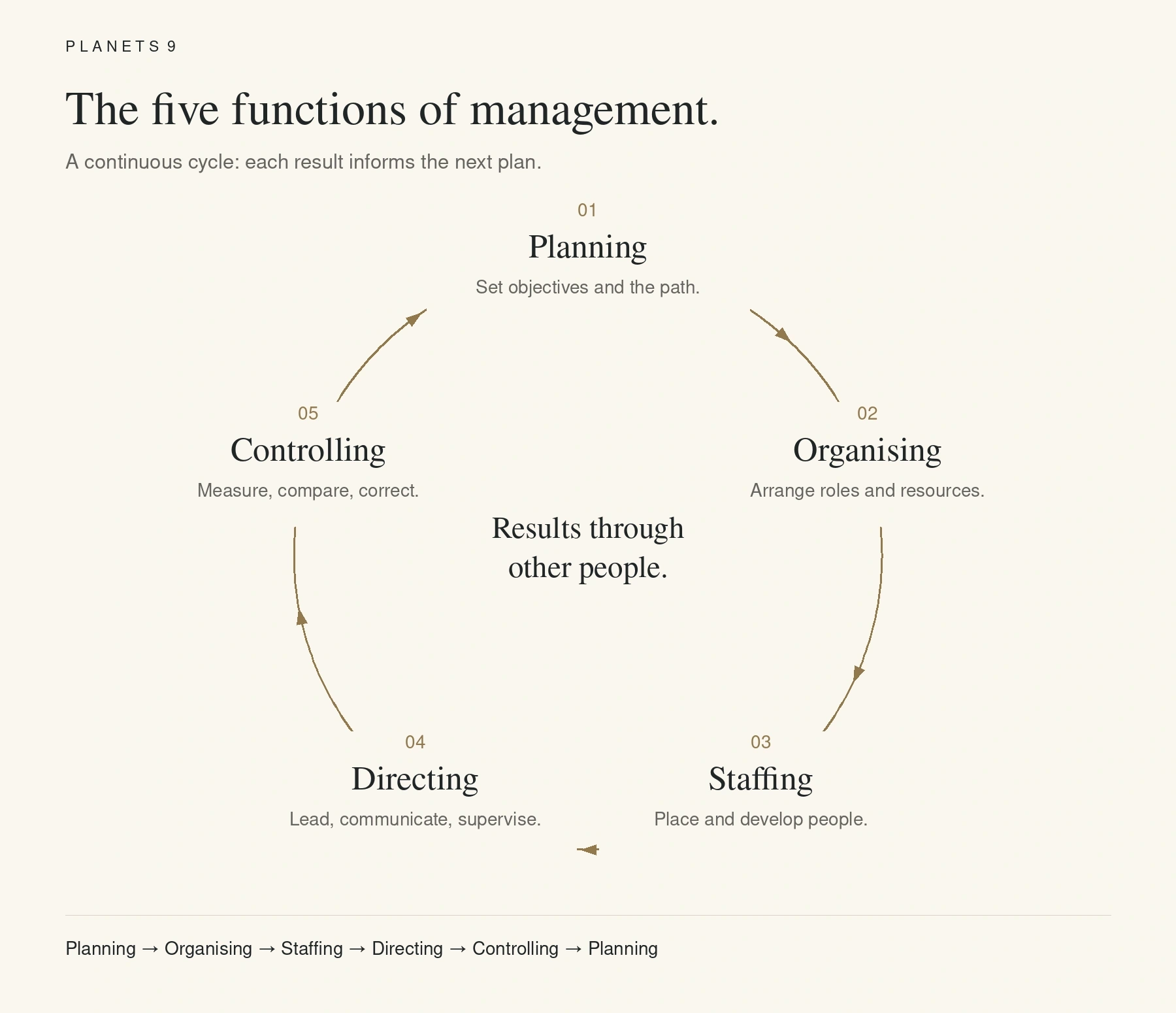
This page gives each function in its standard form, then what it looks like in an owner-run company, then the one function owners almost never hand over.
What is management, in one line
Management is getting results through other people, not alongside them. The word "through" is the whole definition. A founder who closes the biggest deal himself has produced a result; he has not managed. A founder who built the team, the process and the authority under which someone else closed it has.
Fayol's phrasing was that to manage is to plan ahead (his word was prévoir, to foresee), to organise, to command, to co-ordinate and to control. Modern authors merged command and coordination into directing and added staffing, because who is in the roles turned out to matter more than Fayol's generation had assumed.
The five functions of management
1. Planning
Deciding in advance what is to be done, by when, by whom, and with what. Planning sets objectives and chooses the path to them.
In an owner-run company the plan exists. It is in the owner's head, it changes on Tuesday, and the team finds out on Thursday. The company does not lack a plan; it lacks a written one that survives the owner's absence and that a manager can act on without checking. Every other function depends on this one, and it is the one most often skipped because the owner knows what he wants.
2. Organising
Arranging the work into roles, grouping roles into departments, and establishing who has authority over what. Organising turns the plan into a structure.
The structure in most SMEs is the org chart drawn for the bank. The real structure is that everything reports to the owner, which is not organising, it is the absence of it. The levels of management, span of control and scalar chain spokes are all about this function.
3. Staffing
Filling the roles with the right people: hiring, placing, developing and retaining them. Staffing is the function that decides whether the other four can work at all.
Owners hire on availability, loyalty and gut, and then organise around the person rather than filling the role. A weak manager is compensated for by the owner doing half the job. That is staffing failure showing up as a management workload.
4. Directing
Leading, motivating, communicating and supervising so that the people in the roles do the work the plan requires. Fayol split this into commanding and coordinating.
Directing is the function owners do most and enjoy most, and it is where the company's dependence on them is built. If the only person who can direct is the owner, the company runs at the speed of one person's attention.
5. Controlling
Measuring results against the plan, finding the variance, and correcting it. Controlling closes the loop back to planning.
In practice, control is the owner looking at the bank balance and asking the accountant. Without measures agreed in the plan, without records kept in the process, and without anyone but the owner reading them, there is no control function, only supervision.
The function owners never hand over
Of the five, four get delegated eventually. Someone runs operations, someone hires, someone supervises the floor, someone produces the MIS. Planning stays.
It stays because planning feels like ownership. Deciding what the company will do next year is the part that made the founder a founder. Handing it over feels like handing over the company. So the plan stays in one head, everyone else works from fragments, and the company cannot make a decision the owner has not already made.
The way out is not to hand planning to someone else. It is to write it down. A plan that exists on paper, with objectives, owners and measures, can be executed by the other four functions without the owner in the room. A plan that exists in the owner's head cannot. The decision bottleneck essay is the practical version of this.
Management versus administration, and management versus leadership
Two distinctions that turn up in exams and in real companies.
Administration is sometimes used, following Sheldon and others, for the top-level work of setting policy and objectives, with management as the execution of policy. In an owner-run company the two are the same person, which is why the distinction is felt as an overload rather than a concept.
Leadership is the part of directing that produces willing effort rather than compliance. Every leader is not a manager and every manager is not a leader, but a company of fifty people needs both in the same layer, and the owner cannot supply both to fifty people at once. The levels of management spoke is about building the layer that does.
Questions people ask about the functions of management
What are the 5 functions of management?
Planning, organising, staffing, directing and controlling, in the version most Indian syllabi teach. Henri Fayol's original list was planning, organising, commanding, coordinating and controlling.
What is management in simple words?
Getting work done through other people, by deciding what should happen, arranging the people and resources to make it happen, and checking that it did.
Who is the father of management?
Henri Fayol is called the father of modern management theory for his functions and 14 principles. Frederick Taylor is called the father of scientific management for his work on the shop floor. Peter Drucker is often called the father of modern management practice.
What is the most important function of management?
Planning, because the other four execute and check the plan. In owner-run companies it is also the function least often written down, which is why the others cannot run without the owner.
What is the difference between management and administration?
In one common usage, administration sets objectives and policy, management executes them. In small companies both are done by the same person and the distinction is academic.
Is management an art or a science?
Both, in the textbook answer: a science because it has principles that can be learned and tested, an art because applying them to particular people in a particular company takes judgement. The judgement part is where most of the difficulty in a real company sits.
Where to go deeper
Principles of Management — Fayol's 14, decoded for an owner.
Levels of Management — the layer that carries the functions when the owner does not.
Delegation of Authority — how the directing function moves.
Centralisation and Decentralisation — where the planning and control functions sit.
Owner Dependency: Why Your Business Can't Run Without You — what happens when all five functions live in one person.