Centralisation and Decentralisation: Fayol's 'Question of Proportion', and Choosing the Degree on Purpose

Every owner-run company is centralised. None of them decided to be. The question Fayol asked was not whether to centralise but how much, and the honest answer in most SMEs is that nobody has ever asked.
Centralisation is the concentration of decision-making authority at the top of an organisation; decentralisation is its dispersal to lower levels. Fayol's eighth principle says neither is right in itself: "the question of centralisation or decentralisation is a simple question of proportion", and the right degree depends on the size of the company, the ability of the managers, and the nature of the work. Everything that increases the importance of the subordinate's role is decentralisation; everything that reduces it is centralisation. The principle is not a preference. It is an instruction to choose.
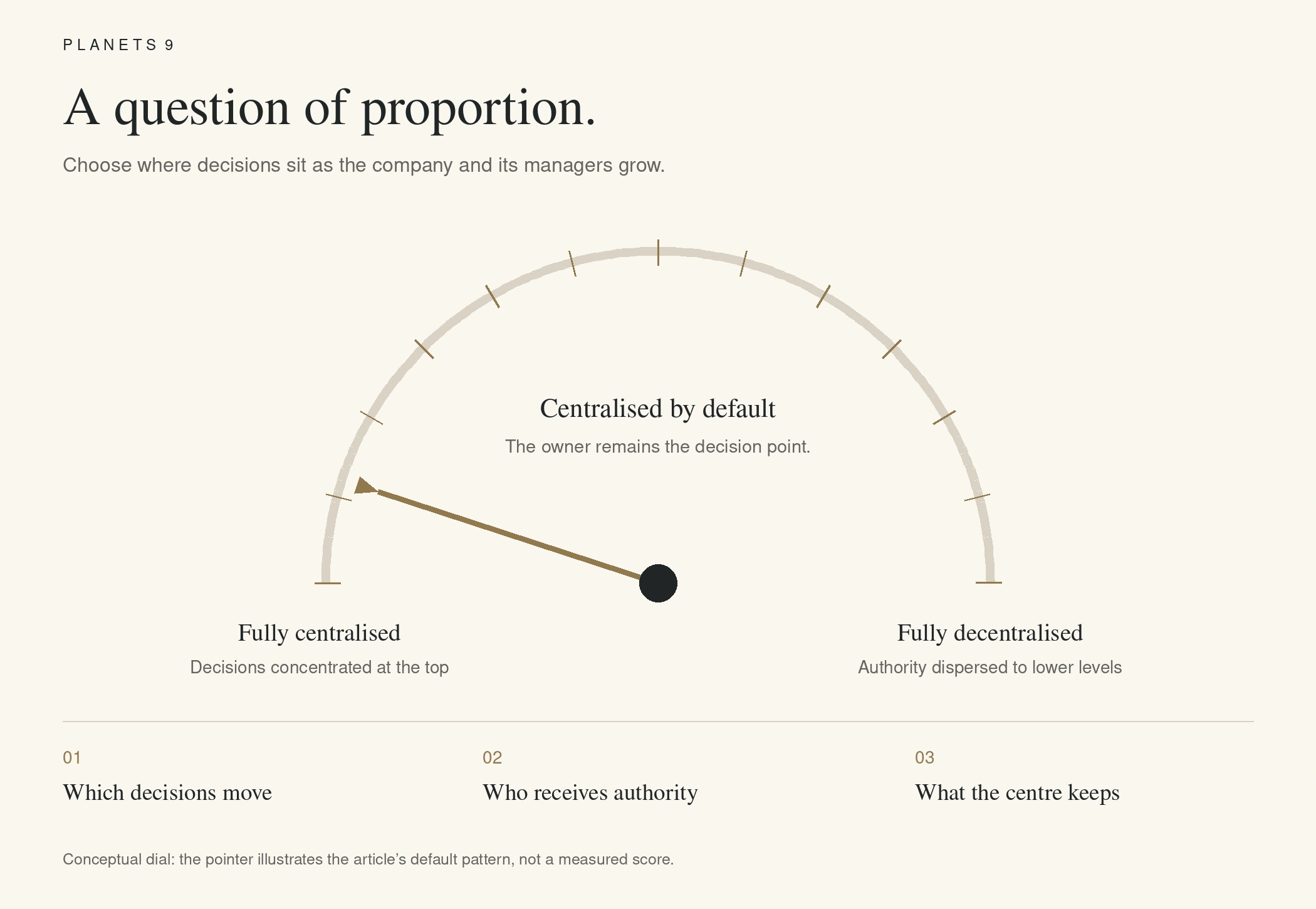
This page gives the distinction, the factors that set the degree, and the owner-run company's version: centralised by default, decentralised by accident, and never by design.
What the two terms mean
Centralisation: decisions are made at the top and passed down. The advantages are consistency, control, and a single view of the whole. The costs are slowness, overload at the top, and managers below who never learn to decide.
Decentralisation: decisions are made at the level closest to the work, within limits set above. The advantages are speed, responsiveness, and managers who grow. The costs are inconsistency, loss of the whole-company view, and the risk of a bad decision taken locally.
Fayol's point was that both exist in every organisation, in some proportion, and that the manager's job is to find the proportion that gives "the optimum utilisation of all faculties". He noted that in a small company with one owner, centralisation is natural; in a large one it is impossible; and in between it is a matter of judgement about the people.
Centralisation versus decentralisation versus delegation
Three terms that are confused.
Delegation is an act: one manager entrusts part of his authority to one subordinate. It is personal and reversible. Decentralisation is a state: the systematic dispersal of authority throughout the organisation, as a matter of design. A company can have plenty of delegation and still be centralised, if every delegation is ad hoc and revocable. The delegation of authority spoke covers the act; this one covers the design.
What sets the right degree
Size. Beyond the point where one person can see all the work, centralisation slows everything. Fayol put this first.
Ability of the managers below. Decentralisation to people who cannot hold authority produces bad decisions; centralisation over people who can produces frustrated managers who leave. The degree has to match the people, which means the people have to be known.
Cost and reversibility of decisions. Decisions that are expensive or irreversible belong higher; routine, reversible ones belong lower. This is what an authority matrix encodes; the authority and responsibility spoke shows the format.
Geography. Multiple locations force decentralisation, because the centre is not there.
Information systems. A company where the owner can see every number in real time can afford to decentralise more, because control does not require presence.
The owner's own disposition. Fayol did not list this. In practice it sets the degree more than any of the others.
The owner-run company: centralised by default
A company of eight is centralised because there is one decision-maker and the work fits in his head. Correct. A company of sixty run the same way is centralised not because anyone chose it but because nothing changed the default.
The signs are consistent. Decisions queue at the owner's door. Managers describe problems instead of solving them, because solving them is not theirs to do. The owner's absence slows the company measurably. And when the owner tries to decentralise, it happens as a series of personal delegations, each of which he can and does override, so that the degree of centralisation is exactly what it was, plus paperwork.
The owner dependency guide describes the full pattern; this spoke is about the one principle at the heart of it.
Decentralising on purpose
Fayol's proportion is set, in practice, by three decisions.
Which decisions move. Not "delegate more". A list: discount authority, purchase approval, hiring within budget, credit limits, overtime, customer remedies. For each, the level that decides and the limit up to which they decide. One page.
To whom they move. Not by title. By whether the person can hold the authority without checking, and will use it without being reckless. This is the decision most owners make on loyalty and availability, and it is the one Fayol's "ability of the managers" was pointing at.
What the centre keeps. Decentralisation is not abdication. The owner keeps the decisions that are expensive, irreversible, or define what the company is: major capital, key hires, pricing policy, the plan. Those are written down too, so that everyone knows what still goes up and why.
Then the degree of centralisation is a design, and it can be revisited as the company and its managers grow.
The person the degree depends on
Fayol's factors include the ability of the managers below, and he was clear that this is the factor that turns a principle into a judgement. Two managers with the same title and the same authority matrix will produce different degrees of decentralisation, because one will use the authority and the other will hand it back.
That is the question underneath the proportion. The Business Pulse reads how your organisation actually runs, where decisions form and where they stall, and is the instrument for seeing where authority given on paper is actually being held, and where it is travelling back to you.
Questions people ask about centralisation and decentralisation
What is centralisation and decentralisation in management?
Centralisation concentrates decision-making authority at the top; decentralisation disperses it to lower levels within set limits. Fayol's eighth principle says the right degree is a matter of proportion, set by size, the ability of managers and the nature of the work.
What is the difference between centralisation and decentralisation?
Where decisions are made. Centralised: at the top, passed down. Decentralised: at the level closest to the work, within limits. Centralisation gives consistency and control; decentralisation gives speed and develops managers.
What is the difference between delegation and decentralisation?
Delegation is one manager entrusting authority to one subordinate; it is personal and reversible. Decentralisation is the systematic dispersal of authority throughout the organisation as a design choice.
Which is better, centralisation or decentralisation?
Neither in itself. Small companies are naturally centralised; large ones must decentralise; in between the degree should match the ability of the managers and the cost of the decisions. The failure is not choosing.
What are examples of centralisation and decentralisation?
Centralised: every purchase above ₹10,000 approved by the owner. Decentralised: department heads approve up to ₹2 lakh within budget, general manager to ₹10 lakh, owner above.
Who gave the principle of centralisation?
Henri Fayol, as the eighth of his 14 principles of management, 1916.
Where to go deeper
Principles of Management — all 14, decoded.
Delegation of Authority — the act, as distinct from the design.
Authority and Responsibility — the one-page matrix that sets the degree.
Span of Control — what centralisation does to the owner's real span.
Owner Dependency: Why Your Business Can't Run Without You — centralisation by default, in full.