Principles of Management: Fayol's 14 Principles Decoded for Business Owners

A French mining engineer wrote down fourteen rules for running a company in 1916. Most of the people who search for them today are preparing for an exam. The rest are running a business and have just noticed that instinct stopped working somewhere past twenty people.
The 14 principles of management are Henri Fayol's list of the conditions under which a company runs without constant intervention: division of work, authority and responsibility, discipline, unity of command, unity of direction, subordination of individual interest, remuneration, centralisation, scalar chain, order, equity, stability of tenure, initiative and esprit de corps. They are a century old and they describe, with uncomfortable accuracy, what goes wrong in a ₹10 to ₹100 crore Indian company when the owner is the only management it has.
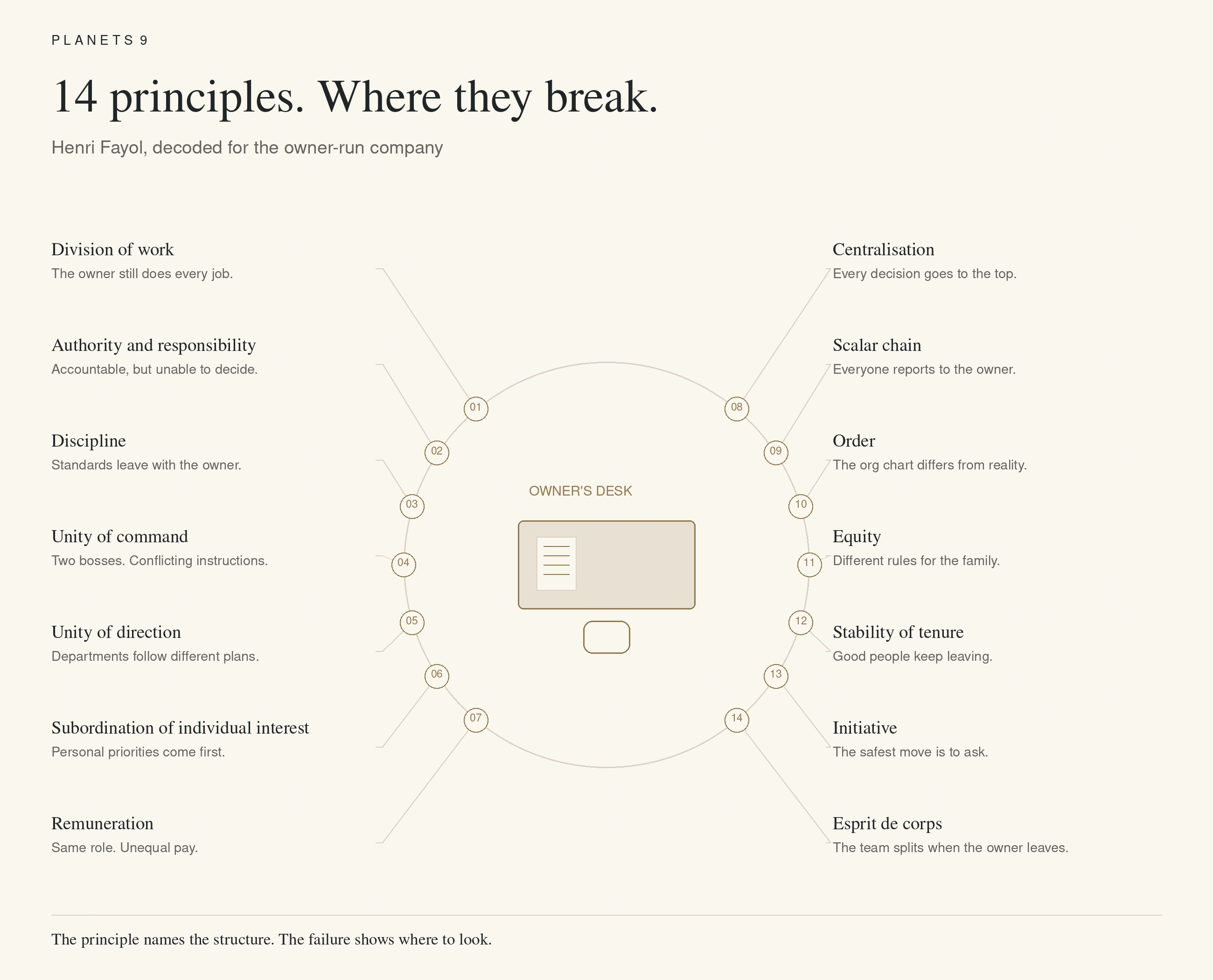
This page gives each principle in its textbook form, then what it looks like in an owner-run company, and where it breaks. The ten spokes go deeper on the ones that matter most.
Who was Henri Fayol, and why do his principles still rank
Henri Fayol ran a French mining and steel company, Commentry-Fourchambault, from 1888 to 1918, taking it from near-bankruptcy to one of the largest industrial concerns in France. He wrote Administration Industrielle et Générale in 1916 from the top of the company looking down, which is what makes him different from Taylor, who wrote from the shop floor looking up. Fayol's question was the owner's question: how does an organisation run when one person can no longer see all of it.
His answer had two parts. Five functions of management, which say what managing consists of. And fourteen principles, which say the conditions under which those functions work. The functions of management are their own spoke. The principles are below.
The 14 principles of management
1. Division of work
Specialisation raises output. The person who does one thing repeatedly gets faster and more accurate at it than the person who does everything.
In an owner-run company: the owner is the last generalist. Everyone else has a lane, except the person at the top who still quotes, buys, hires and signs. The principle is followed everywhere except where it matters most. The division of work spoke covers how far to take it before the lanes stop talking to each other.
2. Authority and responsibility
Whoever is responsible for a result must have the authority to produce it, and whoever holds authority is answerable for how it is used. The two are meant to travel together.
In an owner-run company they travel separately. The sales manager is responsible for the quarter and cannot approve a 5% discount. The authority and responsibility spoke is about matching the two, in writing.
3. Discipline
Obedience and respect for the agreements between the company and its people. Fayol was clear that discipline depends on the quality of leadership and the fairness of agreements, not on penalties.
In practice: discipline is whatever the owner enforces in person. When the owner travels, the discipline travels with him.
4. Unity of command
Each person receives orders from one superior only. Two bosses produce confusion, divided loyalty and work that is done twice or not at all.
The commonest violation in Indian family businesses: the father and the son both give instructions to the same manager, and the manager learns to wait until they agree. The unity of command spoke is about that.
5. Unity of direction
One head and one plan for each group of activities with the same objective. Unity of command is about the person; unity of direction is about the plan.
In practice: three departments each with their own idea of what the company is trying to do this year, because the plan exists only in the owner's head and is communicated in fragments.
6. Subordination of individual interest to the general interest
The company's goals come before any individual's or group's. Fayol's point was that this needs constant supervision, fair agreements and firm example from the top, because it does not happen on its own.
In practice: the star salesperson who keeps the best accounts to himself, the family member whose department is exempt from the rules, the owner who takes the largest client meeting personally because he enjoys it.
7. Remuneration
Pay must be fair to both the employee and the company, and it should reward well-directed effort without producing overpayment.
In practice: salaries set one negotiation at a time, so that two people in the same role earn 40% apart and everyone knows.
8. Centralisation
The degree to which decisions are concentrated at the top. Fayol did not say centralise or decentralise; he said the right degree varies with the company, and that the question is always which proportion of decisions should sit where.
In an owner-run company the degree is total, by default rather than by decision. The centralisation and decentralisation spoke is about choosing the degree deliberately.
9. Scalar chain
The line of authority from the top to the bottom, along which communication passes. Fayol added the gang plank: two people at the same level may talk directly, with their superiors' knowledge, rather than sending every message up one chain and down another.
In practice: the chain has one link. Everyone reports to the owner, so there is no chain, only a hub, and the hub is the bottleneck. The scalar chain spoke covers building one.
10. Order
A place for everything and everything in its place; a position for every person and every person in their position. Material order and social order.
In practice: the org chart that was drawn for the bank and describes a company that does not exist.
11. Equity
Kindness combined with justice. Managers must treat people fairly and be seen to.
In practice: equity is the principle family businesses fail on most visibly, because the rules apply differently to the family, and everyone outside the family has noticed.
12. Stability of tenure of personnel
High turnover is inefficient. A mediocre manager who stays is often worth more than an outstanding one who leaves, because it takes time to learn a job and a company.
In practice: the good people leave at year two or three, usually for a reason the owner does not see until the exit interview, and the reason is rarely salary.
13. Initiative
The freedom to propose and execute a plan is one of the keenest satisfactions of an intelligent person, and managers should sacrifice some personal vanity to grant it.
In practice: initiative is punished once, quietly, and never attempted again. The team has learned that the safe move is to ask.
14. Esprit de corps
Union is strength. Harmony among people is a great strength and managers should build it, not divide and rule, and not rely on written communication where a word would do.
In practice: the team that pulls together when the owner is in the room and splits into camps when he is not. The esprit de corps spoke is about what actually produces it.
What the fourteen have in common
Read as a list, they are a syllabus. Read as a set, they describe one thing: a company in which the work runs on structure rather than on the presence of one person. Division of work, authority, unity of command, scalar chain, centralisation and span of control are all answers to the question of how decisions move when the owner is not there. Discipline, equity, stability, initiative and esprit de corps are all answers to the question of why people stay and give their best when nobody is watching.
Fayol wrote for the second generation of managers, the ones who inherited a company they had not built. That is exactly the position of a founder who has built a company past the size he can personally run.
Where Fayol stops
The principles say what a well-run company looks like. They do not say who can run it.
Every principle above is carried by a person. Authority and responsibility are matched on paper, and then given to a manager who either holds authority comfortably or hands it back within a month. Unity of command is established, and then depends on whether the one commander is someone the team can actually take direction from. Esprit de corps is built, and then survives or does not depending on how the people in the room are wired to relate to pressure, to each other, and to the owner.
Before WHY, there is WHO.
Fayol's principles are the architecture. The people who inhabit them are the source. An owner who applies all fourteen and still finds the company routing everything back to him has not misread Fayol. He has put the right structure in the hands of people who were chosen for loyalty or availability rather than for how they actually operate. That is the layer below the principles, and it is the one that decides whether they hold.
Questions people ask about the principles of management
What are the 14 principles of management?
Division of work, authority and responsibility, discipline, unity of command, unity of direction, subordination of individual interest to general interest, remuneration, centralisation, scalar chain, order, equity, stability of tenure of personnel, initiative, and esprit de corps. Henri Fayol published them in 1916.
Who gave the 14 principles of management?
Henri Fayol, a French mining engineer and managing director of Commentry-Fourchambault, in his 1916 book Administration Industrielle et Générale, translated into English as General and Industrial Management in 1949.
What is the difference between unity of command and unity of direction?
Unity of command: one person takes orders from one superior. Unity of direction: one group of activities with one objective has one plan and one head. The first is about who a person reports to; the second is about how a plan is organised.
Are Fayol's principles still relevant?
Yes, and more so in small and mid-sized companies than in large ones, because large companies have already built the structures the principles describe. A company of twenty to two hundred people run by its founder is usually violating five or six of them at once without having decided to.
What is the most important principle of management?
Fayol did not rank them and said the list was not exhaustive. For an owner-run company, the four that decide whether the business can run without the owner are authority and responsibility, unity of command, scalar chain and centralisation.
What are the five functions of management?
Fayol's original five were planning, organising, commanding, coordinating and controlling. Most modern textbooks, including Indian class 12 syllabi, teach planning, organising, staffing, directing and controlling. The functions of management spoke covers both.
See who is carrying the structure
The principles tell you what the company should look like. They cannot show you how each person in it actually operates: who holds authority without checking, who can take direction from one person and not another, who builds esprit de corps and who quietly divides a team.
The Business Pulse reads how your organisation actually runs, where decisions form, where they stall, and how much still routes through you. Fifteen minutes, answered as the owner, before you redraw the org chart.
Where to go deeper
Functions of Management — what managing actually consists of, and which function the owner does alone.
Levels of Management — top, middle and first-line, and why the middle is missing.
Division of Work — specialisation, and the owner as the last generalist.
Authority and Responsibility — matching the two in writing.
Unity of Command — one boss per person, including in a family business.
Scalar Chain — building a chain where there is only a hub.
Span of Control — how many people one person can actually manage.
Centralisation and Decentralisation — choosing the degree on purpose.
Delegation of Authority — the handover that does not come back.
Esprit de Corps — what actually produces it.
Owner Dependency: Why Your Business Can't Run Without You — the pattern all fourteen principles are trying to prevent.