Span of Control: How Many People One Manager Can Handle, and the Owner's Real Number

The owner of a forty-person company has, on paper, six direct reports. In practice he has forty, because everyone in the building knows the fastest way to a decision is to walk into his cabin. His span of control is not six. It is the whole company, and it is why he is in the office at nine at night.
Span of control is the number of subordinates who report directly to one manager. A narrow span means few direct reports and more levels of management; a wide span means many direct reports and fewer levels. The classical guidance, from Urwick and Graicunas in the 1930s, was five or six subordinates where the work interlocks; modern practice in knowledge work runs to eight to twelve, and higher where the work is routine and the team experienced. The right number depends on the work, the people, and how much of the manager's time the direct reports actually consume.
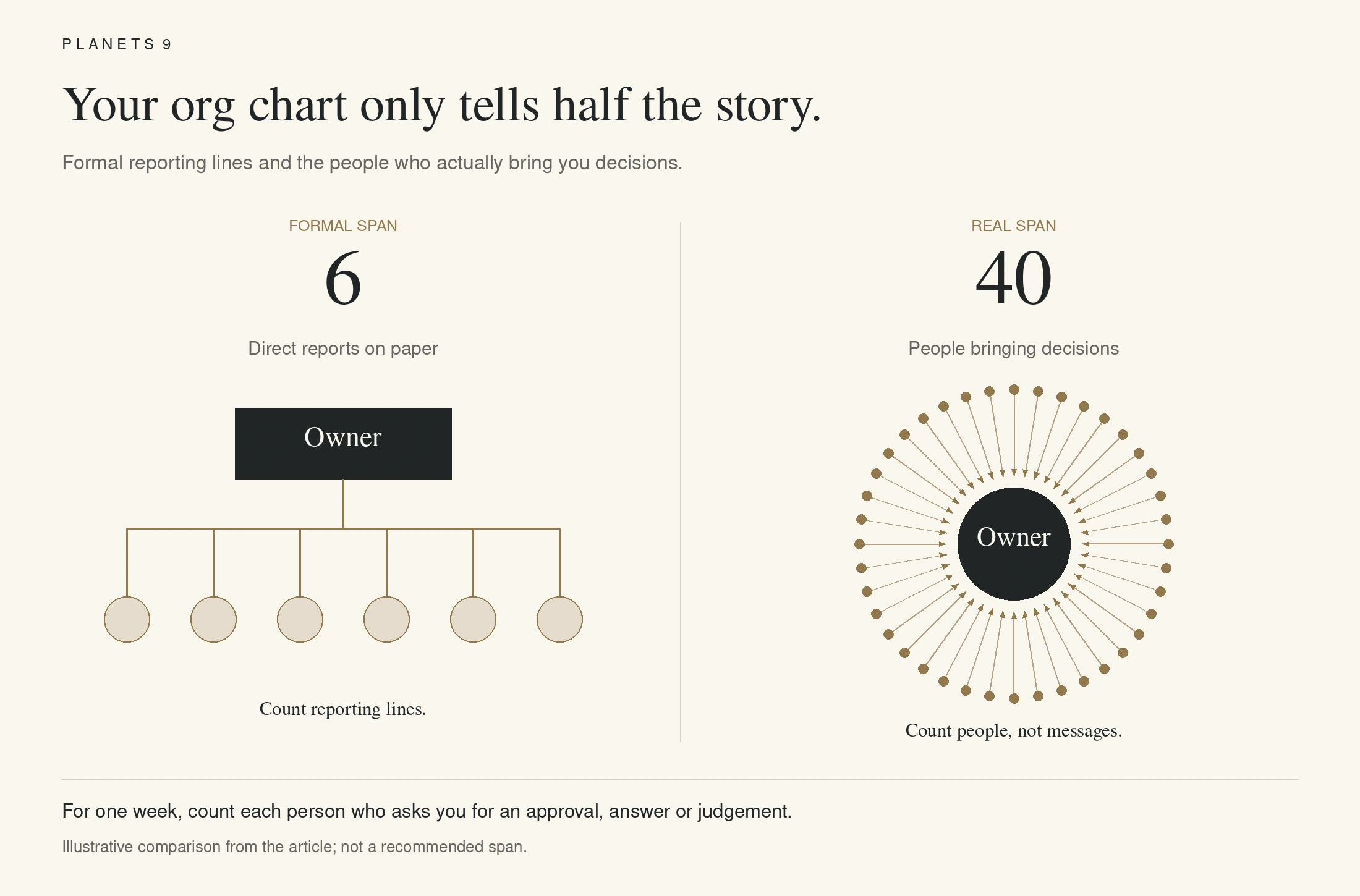
This page gives the concept, the factors that set the number, and the owner-run company's version of the problem, which is a formal span of six and a real span of forty.
What span of control means
Every manager has a limit to how many people they can direct, coordinate and control at once. Below the limit, the manager is present: reviewing, correcting, deciding. Above it, the manager is a queue.
V. A. Graicunas showed in 1933 why the limit arrives fast. Adding one direct report does not add one relationship; it adds the relationship with that person, the relationships between that person and each existing report, and the manager's relationships with every group. With five subordinates the manager is handling around a hundred possible relationships; with eight, over a thousand. Lyndall Urwick's rule of thumb followed: no superior should directly supervise more than five or six subordinates whose work interlocks.
Later research loosened this considerably where the work is routine, the subordinates are experienced, and the manager has good information systems. A production supervisor with fifteen trained operators on a stable line is fine. A general manager with fifteen department heads whose work interlocks daily is not.
What sets the right number
How much the work interlocks. Independent tasks allow a wide span; tasks that depend on each other need coordination and narrow it.
How routine the work is. Standardised work with written procedures needs less supervision per person. The SOP guide is, among other things, a way to widen span.
How experienced the people are. New or junior people need more of the manager's time.
How far the manager's authority extends. A manager who can decide within written limits handles more people than one who must escalate; the authority and responsibility spoke covers this.
How much of the manager's time is non-supervisory. An owner who also sells, buys and negotiates with the bank has less time to manage, and therefore a smaller real span than his title suggests.
Geography. People in one room are easier to manage than people across three cities.
Narrow versus wide: the trade
A narrow span produces tall organisations: many levels, close supervision, slow communication, high management cost. A wide span produces flat ones: few levels, more autonomy, faster communication, but thin supervision and a risk that the manager becomes a bottleneck.
The trend since the 1990s has been toward wider spans and flatter structures, driven by better information systems and more capable workers. That trend is correct for companies that have written procedures, clear authority and experienced people. It is a trap for companies that have none of those, which is most owner-run SMEs, where "flat" means "everything comes to the owner".
The owner's real span
Two numbers matter for an owner, and the org chart shows only one.
The formal span is how many people report to the owner on paper. In a forty-person company it is usually four to eight.
The real span is how many people bring the owner decisions. Count them over a week: everyone who walked into the cabin, called, or sent a WhatsApp for an approval, an answer or a judgement. In most SMEs the honest count is most of the company. Supervisors bypass the department head because the owner answers faster. The department head brings things upward because his authority does not cover them. Family members walk in because they are family.
A real span of thirty or forty is not management. It is the owner functioning as the company's single decision queue, and the decision bottleneck essay is what that looks like from the desk. The scalar chain spoke is about why the chain that would contain the span never formed.
Bringing the real span down
The formal span comes down by inserting a middle level: the levels of management spoke. That is necessary and not sufficient. The real span comes down only when three other things happen.
The middle level has written authority, so the questions stop at that level. The owner refuses to answer below the line, even when asked, even when he knows. And the procedures exist, so that the routine questions have an answer that is not a person. Each of these reduces the real span; none of them changes the org chart.
Then the owner's span is five or six department heads whose work interlocks, which is exactly the number Urwick proposed, and which leaves the owner with time to do the two or three things only he can do.
The person at the centre of the span
The number of people one manager can handle depends on the manager as much as on the work. Some people hold a wide span comfortably; they decide quickly, delegate cleanly and do not need to be in every conversation. Some hold a narrow span and are excellent at it, because depth with five people is how they operate. Put the second kind in charge of twelve and the span is not wide, it is broken, whatever the chart says.
That is the layer under the number. The Business Pulse reads how your organisation actually runs, where decisions form and where they stall, and is the instrument for seeing which of your managers can carry the span you have given them.
Questions people ask about span of control
What is span of control in management?
The number of subordinates who report directly to one manager. It determines how many levels the organisation needs and how much supervision each person receives.
What is the ideal span of control?
There is no single number. The classical guidance was five or six for interlocking work; modern practice in knowledge work is eight to twelve; routine, standardised work with experienced people supports fifteen or more. The right figure depends on the work, the people and the manager's other duties.
What is the difference between narrow and wide span of control?
A narrow span means few direct reports, more levels, closer supervision and higher cost. A wide span means many direct reports, fewer levels, more autonomy and thinner supervision.
What factors affect span of control?
How much the work interlocks, how routine it is, how experienced the people are, how much authority the manager has, how much of the manager's time is non-supervisory, and geography.
Who gave the concept of span of control?
The term is associated with Lyndall Urwick, who proposed the five-or-six rule, and V. A. Graicunas, whose 1933 formula showed how relationships multiply with each added subordinate. Henri Fayol's scalar chain is the related principle.
What is Graicunas' formula?
Graicunas expressed the number of possible relationships a manager must handle as n(2^(n−1) + n − 1), where n is the number of subordinates. It rises from 100 at five subordinates to over 1,000 at eight, which is why the classical limit was set so low.
Where to go deeper
Principles of Management — all 14, decoded.
Levels of Management — the layer that brings the span down.
Scalar Chain — the hub-and-spoke problem in full.
Delegation of Authority — what has to move for the span to hold.
The Decision Bottleneck — the owner as the single queue.