Levels of Management: Top, Middle and First-Line, and Why the Middle Is Missing in Most SMEs

Every textbook draws three levels of management as a pyramid. Every owner-run company between twenty and two hundred people draws it as a pyramid for the bank and runs it as a wheel: one hub, many spokes, and no layer in between.
The three levels of management are top level, which sets objectives and policy for the whole organisation; middle level, which translates those objectives into departmental plans and coordinates between departments; and first-line or supervisory level, which directs the people who actually do the work day to day. Some texts add a fourth, the operative or worker level, below supervisory. In a company run by its founder, the top and first-line levels usually exist and the middle level is either missing or exists in title only.
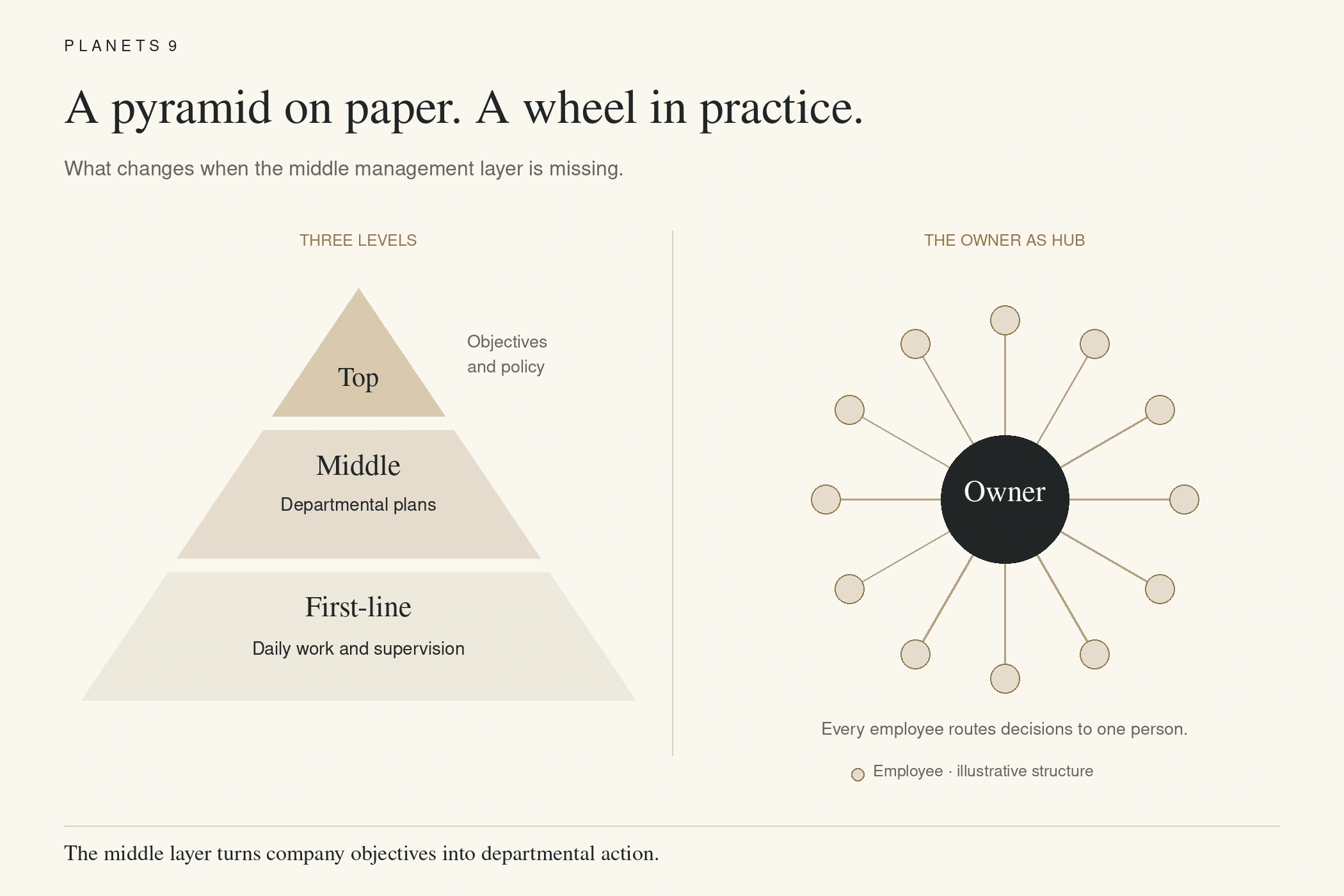
This page gives each level in its standard form, then the failure pattern specific to owner-run Indian companies, and what a real middle level takes.
The three levels of management
Top level management
The board, managing director, CEO, owner, and in larger companies the functional heads who report to them. Top management sets the objectives, decides policy, approves the plan and the budget, represents the company outside, and is accountable to the owners for overall performance.
In an owner-run company, top level is the owner and perhaps a family member. That part is fine. The problem is that top level also does everything else.
Middle level management
Department heads, plant managers, regional managers, branch heads. Middle management receives the objectives from the top, converts them into plans and targets for its department, staffs and directs the first-line managers below it, coordinates with other departments, and reports upward on progress.
This is the layer that turns "grow 25% this year" into a sales plan with a territory structure, a hiring plan and a monthly number, and then makes the people below it deliver. It is also the layer most SMEs do not have.
First-line or supervisory management
Supervisors, team leaders, foremen, shift in-charges. First-line management directs the workers or executives who perform the operations: allocating work, checking quality, handling day-to-day problems, training, and reporting to the middle level.
Most SMEs have this layer because the work demands it. Somebody runs the shift. The question is who that person reports to, and the answer, usually, is the owner.
Why the middle level is missing
Three reasons, and they compound.
The company grew from a team where the owner was the middle level. When there were eight people, the owner planned, coordinated and supervised. Growth added first-line supervisors as the work required, but nobody added the layer above them, because the owner was already doing it. Now there are fifty people, eight supervisors, and one person converting the plan into everyone's targets.
The middle level costs money that does not obviously produce anything. A supervisor produces output. A department head produces coordination, which is invisible when it works. Owners under margin pressure cut, or never make, the hire whose value they cannot see on the floor.
And a real middle manager needs authority, which is the thing the owner has not yet learned to give. A department head who cannot approve a purchase, set a discount or hire a replacement is a supervisor with a bigger title. The authority and responsibility spoke covers the mismatch; the middle management essay covers why the layer fails even when it is hired.
What the missing middle costs
The owner's day is the cost. Every question a department head would have answered comes up one level. Every coordination between sales and dispatch, which a middle layer would have handled, waits for the hub. The owner is doing middle management for six departments and calling it being hands-on.
The second cost is that first-line managers never grow. With no layer above them to learn from and no room to move into, the good ones leave for a company that has one. The reasons managers leave are mostly this.
The third is that the company cannot be sold, handed to the next generation, or run while the owner is away, because the level that would carry it does not exist.
What a real middle level takes
Three things, in order, and hiring is the third.
A written plan with departmental targets. A middle manager translates the company plan into a departmental one. If the company plan is in the owner's head, there is nothing to translate and the manager will end up asking the owner what to do, which is the failure the hire was meant to prevent.
Written authority. Discount limits, purchase approval, hiring within budget, disciplinary action up to a defined level. The middle manager decides within those limits without checking. The delegation of authority spoke is the mechanics.
The right person. Not the best supervisor promoted, and not the most loyal employee. A middle manager holds authority without checking, coordinates across departments without escalating, and carries the owner's standard in the owner's absence. Those are dispositions, not skills, and the best first-line supervisor frequently does not have them. The Peter principle is the usual result of promoting on performance in the previous job.
Levels of management and span of control
The two are linked. A company where twelve people report directly to the owner has no middle level and a span of control of twelve at the top. Adding a middle level reduces the owner's span to four or five department heads, each of whom has their own span of six to ten. The span of control spoke gives the numbers; the scalar chain spoke shows how the levels connect.
Questions people ask about levels of management
What are the 3 levels of management?
Top level, which sets objectives and policy; middle level, which converts them into departmental plans and coordinates between departments; and first-line or supervisory level, which directs the people doing the work.
What are the functions of middle level management?
Interpreting the top level's plan for the department, setting departmental targets, staffing and directing first-line managers, coordinating with other departments, and reporting on progress upward.
What are the 4 levels of management?
Some texts add an operative level below supervisory: the workers and executives who perform the tasks. The management levels proper remain three.
What is the difference between top level and middle level management?
Top level decides what the whole company will do; middle level decides how its part of the company will do it. Top level is accountable to the owners; middle level is accountable to the top.
Which level of management is most important?
Each is necessary. In owner-run companies the middle level is the one most often missing, and its absence is why the top level ends up doing first-line work.
What is the role of a supervisor in management?
First-line management: allocating work, checking quality, solving day-to-day problems, training the team, and reporting to the department head. The supervisor is the level that directly touches the work.
Where to go deeper
Principles of Management — Fayol's 14, decoded for an owner.
Span of Control — how many people each level can actually manage.
Scalar Chain — how the levels connect.
Delegation of Authority — giving the middle level something to decide.
Why Middle Management Fails in Promoter-Led Businesses — what goes wrong after the hire.