Division of Work: Fayol's First Principle, and the Owner as the Last Generalist

The first principle on Fayol's list is the one every company follows without being told, right up to the top, where it stops.
Division of work is the principle that splitting work into specialised tasks, each done by a person or group that does it repeatedly, produces more and better output than having everyone do everything. Fayol placed it first among his 14 principles and applied it to managerial work as much as to manual work. The idea is older than Fayol; Adam Smith's pin factory in 1776 is the standard example. What Fayol added was the claim that it applies to managers too.
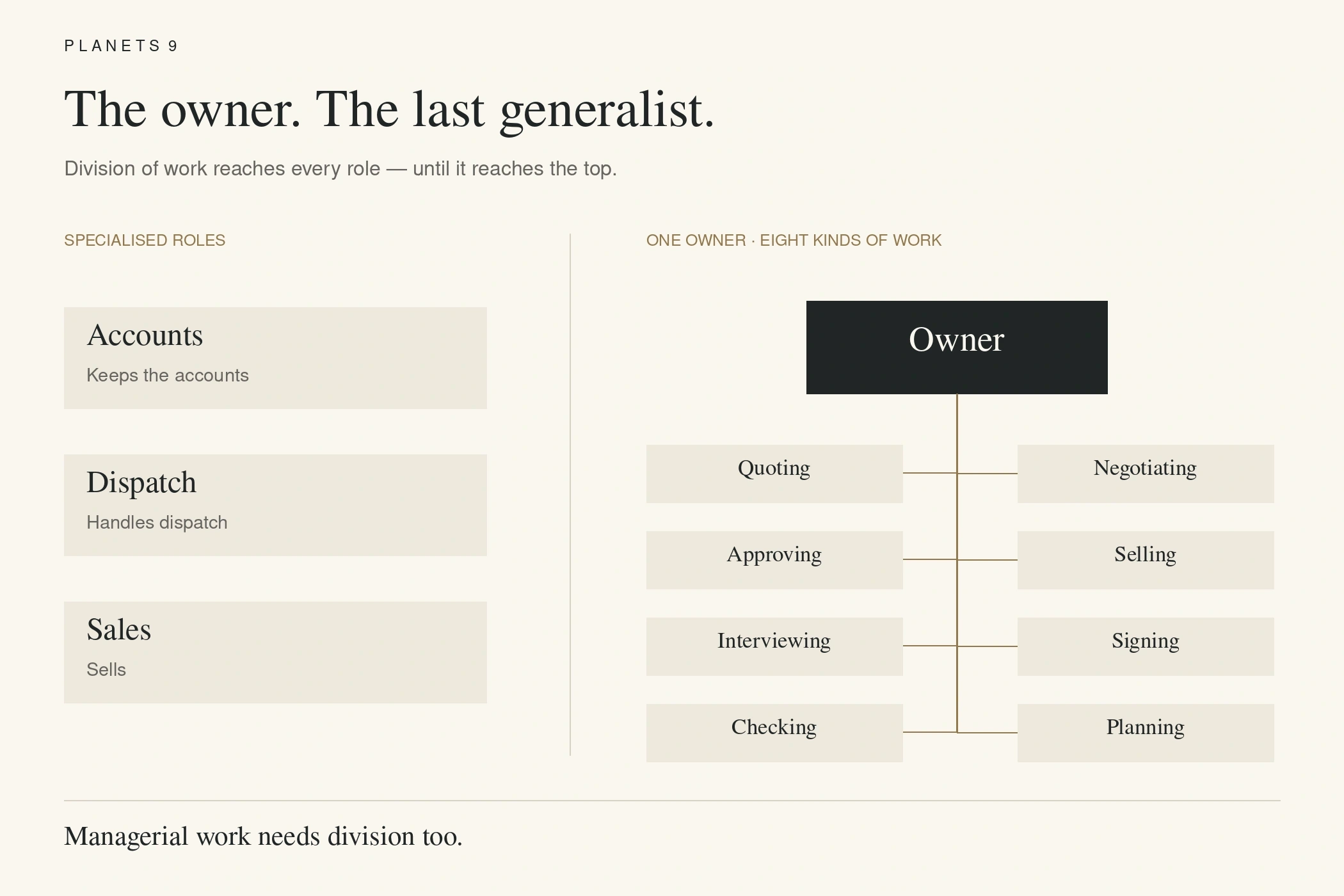
This page gives the principle, its limits, and the specific way it fails in an owner-run company: everyone specialises except the owner.
What division of work means
Specialisation raises output through three effects. Skill: a person who does one task repeatedly gets faster and more accurate at it. Focus: less time is lost switching between unlike tasks. Fit: work can be matched to the person best suited to it rather than to whoever is available.
Fayol's phrasing was that division of work "has as its object to produce more and better work with the same effort", and that it applies "to all work, technical as well as managerial". The second half is the part that matters for an owner. Managerial work also divides: someone plans, someone organises the floor, someone handles customers, someone controls the money. When one person does all of it, the company is violating the first principle at its most expensive point.
The limits Fayol set
Fayol was explicit that division of work has limits "which experience and a sense of proportion teach us not to exceed". Two of them show up in every SME that has taken specialisation seriously.
Over-specialisation produces silos. When sales, dispatch and accounts each do their job well and nobody owns the hand-off between them, the customer experiences three companies. The principle needs the scalar chain and coordination to work; on its own it fragments.
And specialisation without depth produces fragility. If only one person can do the task, division of work has created a key-person risk rather than efficiency. The remedy is documentation, the subject of the SOP guide, and a second person trained on every critical task.
The owner as the last generalist
In a twenty-person company the division of work is usually clean below the owner. Accounts does accounts. Dispatch dispatches. The sales team sells. Each of these people is a specialist and the company benefits.
Then there is the owner, who quotes the large jobs, approves every purchase, interviews every hire, checks every dispatch above a certain value, negotiates with the bank, handles the two most important clients personally and signs the payroll. The one person in the company doing eight jobs is the person whose time is worth the most, and every one of those eight jobs is done less well than a specialist would do it, because nobody can be expert at eight things.
This is not a failure of delegation, though it looks like one. It is the first principle applied everywhere except the top. Division of work says the managerial functions should be divided too: planning, organising, staffing, directing and controlling are separate work, and past a certain size they belong to separate people. The functions of management spoke lists them; the levels of management spoke is about the layer that carries them.
How to apply division of work at the top
Start from the owner's week, not from the org chart. List every distinct kind of work the owner did in the last fourteen days: quoting, approving, interviewing, checking, negotiating, selling, signing, planning. Then apply three tests to each.
Does this need to be done by the owner because only the owner has the authority, or because only the owner has the knowledge, or because only the owner has ever done it. The first is a design decision to revisit, the second is a documentation gap, the third is habit.
Would a specialist do it better. For most of the eight, yes: a purchase manager buys better than an owner who buys between meetings.
What would break if it moved. Usually nothing, if the authority moves with it.
The work that survives all three tests is the owner's real job. It is usually two or three things, and they are usually the things the owner has the least time for now.
Division of work in a family business
Family businesses have a specific version of the problem: work is divided by family position rather than by task. The elder son has sales because he is the elder son. The son-in-law has accounts because he is trustworthy. The division is real but the fit is accidental, and the company gets the third of Fayol's three effects, matching work to the person suited to it, only by luck. The family business governance essay covers the structure; the question of who is actually suited to which work is the one underneath it.
Questions people ask about division of work
What is division of work in management?
The principle that work should be split into specialised tasks performed by people who do them repeatedly, because specialisation raises quantity and quality of output. It is the first of Fayol's 14 principles and applies to managerial as well as technical work.
What is the difference between division of work and division of labour?
They are used interchangeably. Division of labour is Adam Smith's term for specialisation in production; Fayol used division of work and extended it to management.
What are the advantages of division of work?
Higher skill through repetition, less time lost switching tasks, and the ability to match each task to the person best suited to it.
What are the disadvantages of division of work?
Monotony, silos between specialised groups, and key-person risk when only one person can do a task. Fayol said the principle has limits that "a sense of proportion" sets.
What is an example of division of work?
Adam Smith's pin factory: ten workers each doing one step produced far more pins than ten workers each making whole pins. In a company: accounts, dispatch and sales as separate roles rather than everyone doing everything.
Does division of work apply to the owner?
Yes, and it is where the principle is most often ignored. Managerial work divides into planning, organising, staffing, directing and controlling; past a certain size each belongs to a different person.
Where to go deeper
Principles of Management — all 14, decoded.
Functions of Management — the managerial work that also divides.
Levels of Management — the layer that takes the divided work.
Authority and Responsibility — what has to move with the work.
Owner Dependency: Why Your Business Can't Run Without You — the last generalist, in full.