SOPs for a Small Business: The First 10 to Write, Department by Department

The owner who decides to "put SOPs in place" usually starts in the wrong department, with the wrong task, and stops after the third document. Not from lack of will. From lack of a list.
A small business needs SOPs first where the same task comes out differently depending on who does it, where an error costs money or a customer, or where only one person knows how. Across the six departments an SME actually has, that produces a first list of ten: complaint handling, lead follow-up, quotation, purchase order, goods receipt, tax invoice, payment release, dispatch inspection, employee onboarding and month-end close. Two a month, tested before issue, and the set is done in five months.
This page gives the department-by-department list, the order to write them in, and how to tell when a business is too small to need any.
Does a small business need SOPs at all
Under ten people in one room, usually not. Everyone can see everyone; the standard is enforced by proximity and the owner's presence. The costs of SOPs, the writing and the maintenance, exceed the cost of the variation they prevent.
Three events change that. The company passes fifteen to twenty people, and the owner can no longer see every task. The company opens a second location or a second shift, and the standard has to travel without the owner. Or a key person who holds a process in their head becomes a risk: resigning, going on leave, or being the owner who would like to stop approving everything. At any of those points, the absence of SOPs starts costing more than writing them.
The six departments and their first SOPs
Sales
Lead follow-up. First response time, qualification questions, follow-up cadence, when a lead goes dormant. Variation here is invisible and expensive: the lead that got a call in an hour and the one that waited three days both look the same in the CRM.
Quotation. Who can quote, from which price list, with what discount authority, in what format, validated by whom above what value. The single most common source of margin leakage in a trading or manufacturing SME.
Customer credit approval. Documents required, limits by authority level, the rule that holds further credit when an account is overdue.
Purchase and stores
Purchase order. Requisition, stock check, quotes above a threshold, approval by value, PO before commitment. The SOP that stops the ₹3 lakh purchase made on a phone call.
Goods receipt and inspection. What is checked against the PO on arrival, what happens to a short or damaged consignment, when Accounts is told it can pay.
Vendor onboarding. Documents, GST verification, bank details confirmed by a second person before the first payment. The procedure that prevents the fake-vendor invoice.
Accounts
Tax invoice. Raised from an approved order, GSTIN verified, HSN and rate confirmed, e-invoice where required, sent to the registered address. The SOP that reduces credit notes.
Payment release. PO-matched invoice, GRN confirmed, approval by value, two people on every bank transfer above a threshold.
Month-end close. A checklist with a date. Without it, the books close when they close, and the owner sees the numbers three weeks late.
Operations, production or delivery
Pre-dispatch or pre-delivery inspection. A checklist signed before anything leaves. The cheapest SOP to write and the one that stops the most complaints.
Job or work order. How a confirmed order becomes a schedule: who plans it, in what system, how the floor or the delivery team knows what to do today.
Nonconforming output. What happens to a rejected batch or a failed service delivery: segregate, record, decide, and who decides.
Customer service
Complaint handling. Log, acknowledge, categorise, resolve within authority, record. The full worked example is on the examples page.
Warranty or returns. Separate from complaints, because the decision rules and the records differ.
People and administration
Employee onboarding, first five days. Documents, access, equipment, induction, SOP training for the role, a check-in on day five.
Leave and attendance processing. How a request is raised, who approves, how it reaches payroll. Small, frequent, and a constant irritant when undefined.
Exit formalities. Handover, asset return, access removal, full and final settlement. The SOP most companies write after the first bad exit.
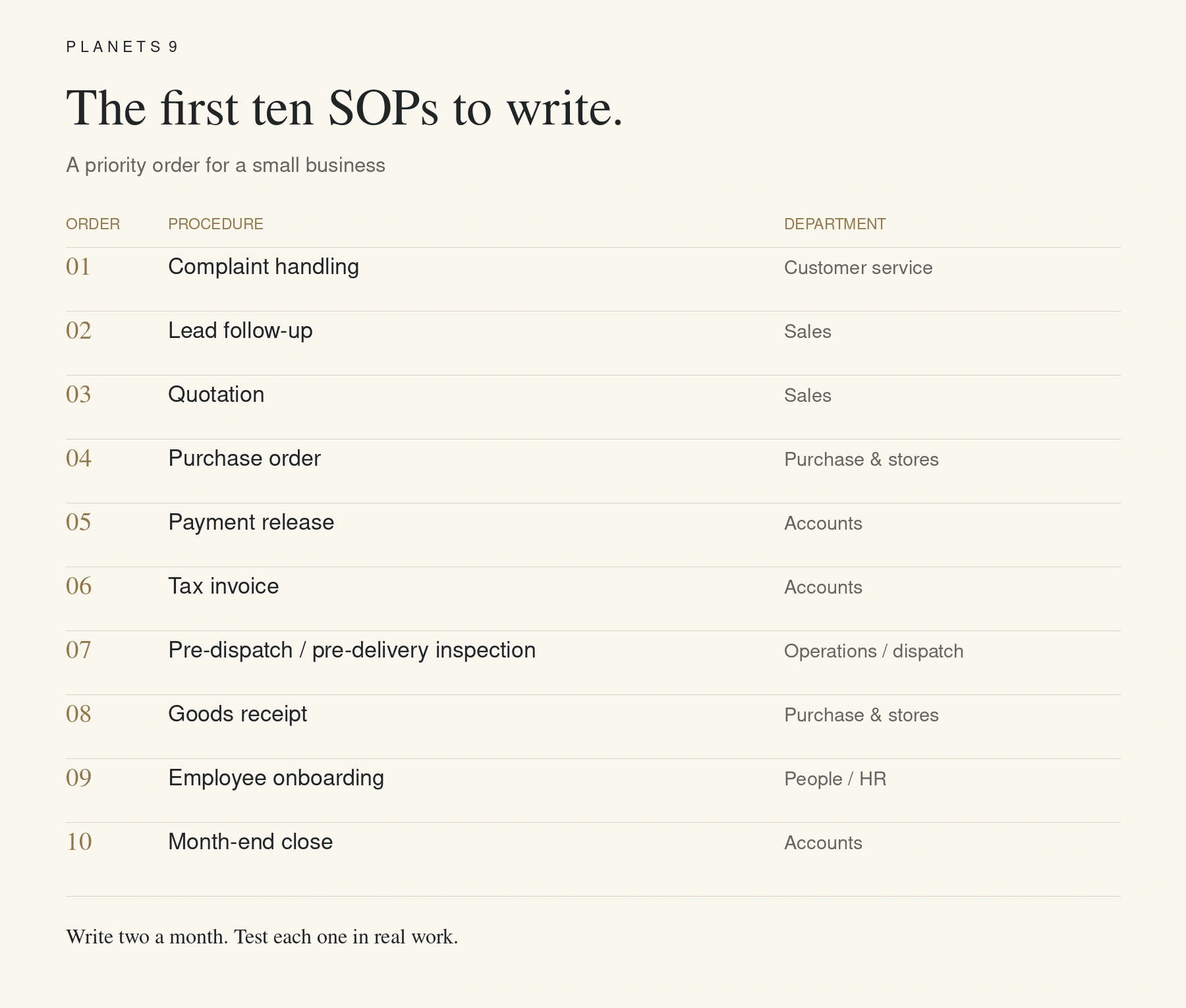
The first ten, in order
Not every department first. The order below follows where the money and the risk are in most SMEs.
Complaint handling — because it is where the owner's phone rings.
Lead follow-up — because it is where revenue leaks silently.
Quotation — because it is where margin leaks.
Purchase order — because it is where cash leaks.
Payment release — because it is where fraud happens.
Tax invoice — because it is where GST errors and credit notes come from.
Pre-dispatch or pre-delivery inspection — because it prevents the complaints in item one.
Goods receipt — because it closes the loop on item four.
Employee onboarding — because every new person otherwise learns the job from whoever is nearest.
Month-end close — because without it the owner is managing on old numbers.
Two a month. Each written from observation, using the seven steps, tested on someone who did not write it, issued with an owner and a review date. Faster than that and the quality drops; slower and the effort stalls. Five months to the first ten, and the company is different at the end of it.
What each SOP should settle
The thing that makes these ten worth writing is not the steps. Most of the team already knows the steps. It is the decision rules: the discount authority, the purchase approval threshold, the payment sign-off value, the complaint remedy limit. In an owner-run business, every one of those currently reads "ask the owner". Writing the number is what moves the decision into the company. The decision bottleneck essay is the place to start if setting the number feels harder than writing the procedure.
Where small-business SOPs go wrong
Starting with HR. Leave policies and dress codes are easy to write and change nothing about how the business runs. Start where money moves.
Writing all ten in a month. Ten untested procedures issued together will be ten procedures ignored together.
Copying a template without watching the task. The procedure describes a company that does not exist, and the team knows.
Keeping the owner as the approver in every SOP. The documents then describe the dependency instead of removing it.
No owner for the set. Someone, a role, keeps the SOP register, chases review dates and holds the master copies. Without that person the set decays in a year.
After the first ten
The next ten usually appear on their own, because the process of writing the first ten shows where else the variation is. Vendor onboarding, job orders, nonconforming output, warranty, exit formalities, and whatever is specific to the sector. By that point the company has a way of writing SOPs, which matters more than any individual document.
What the SOPs will not have settled is who carries them. A quotation SOP with a 10% discount authority for the sales manager works when the sales manager is a person who can hold that authority without checking, and fails quietly when he is not, however good the document. That is the layer below the procedure, and it is the one that decides whether the business actually runs differently at the end of the five months. The full SOP guide and the spoke on why SOPs fail cover it.
Questions people ask
What SOPs should a small business have?
At minimum: complaint handling, lead follow-up, quotation, purchase order, payment release, tax invoice, pre-dispatch inspection, goods receipt, employee onboarding and month-end close. Then sector-specific procedures as the first ten reveal where else variation sits.
How many SOPs does a small business need?
Ten to twenty for a company of twenty to fifty people; twenty to forty for a hundred. More than that usually means procedures have been written for tasks that were already consistent, or work instructions have been counted as SOPs.
Which department should write SOPs first?
Whichever department's variation is costing the most. In most SMEs that is customer service and sales, followed by purchase and accounts. HR SOPs are the easiest to write and the least consequential; leave them for later.
How do I start SOPs in my business?
Pick the task that is failing most visibly, watch it done twice by two people, write the steps and the decision rules, test the draft on someone new, and issue it with an owner and a review date. Then the next one. The template gives the layout.
Can a small business use free SOP templates?
Yes. The layout is standard and the template on this site is complete. The content has to come from watching the task in your company; that is the part no template supplies.
Where to go deeper
SOP Examples — eight of the ten above, written out in full.
How to Write an SOP — the method for each one.
SOP Template — the layout.
Why SOPs Fail — the people question under the documents.
Owner Dependency: Why Your Business Can't Run Without You — the pattern the first ten SOPs begin to change.