How to Write an SOP for Your Business in 7 Steps (With a Worked Example)

The usual way an SOP gets written in an Indian SME is that the owner sits down on a Sunday and types out how the task is done. The document is finished by evening. It is wrong by Monday, because it describes how the owner did the task in the year the company was half its size.
To write an SOP that people follow: choose a task that is failing or that only one person can do, watch it performed twice by two different people, write the outcome in one sentence, list the steps in order with one action each, state the rule at every decision point, test the draft on someone who did not write it, and assign an owner and a review date. Seven steps. The first two are the ones everyone skips, and they are the ones that make the difference.
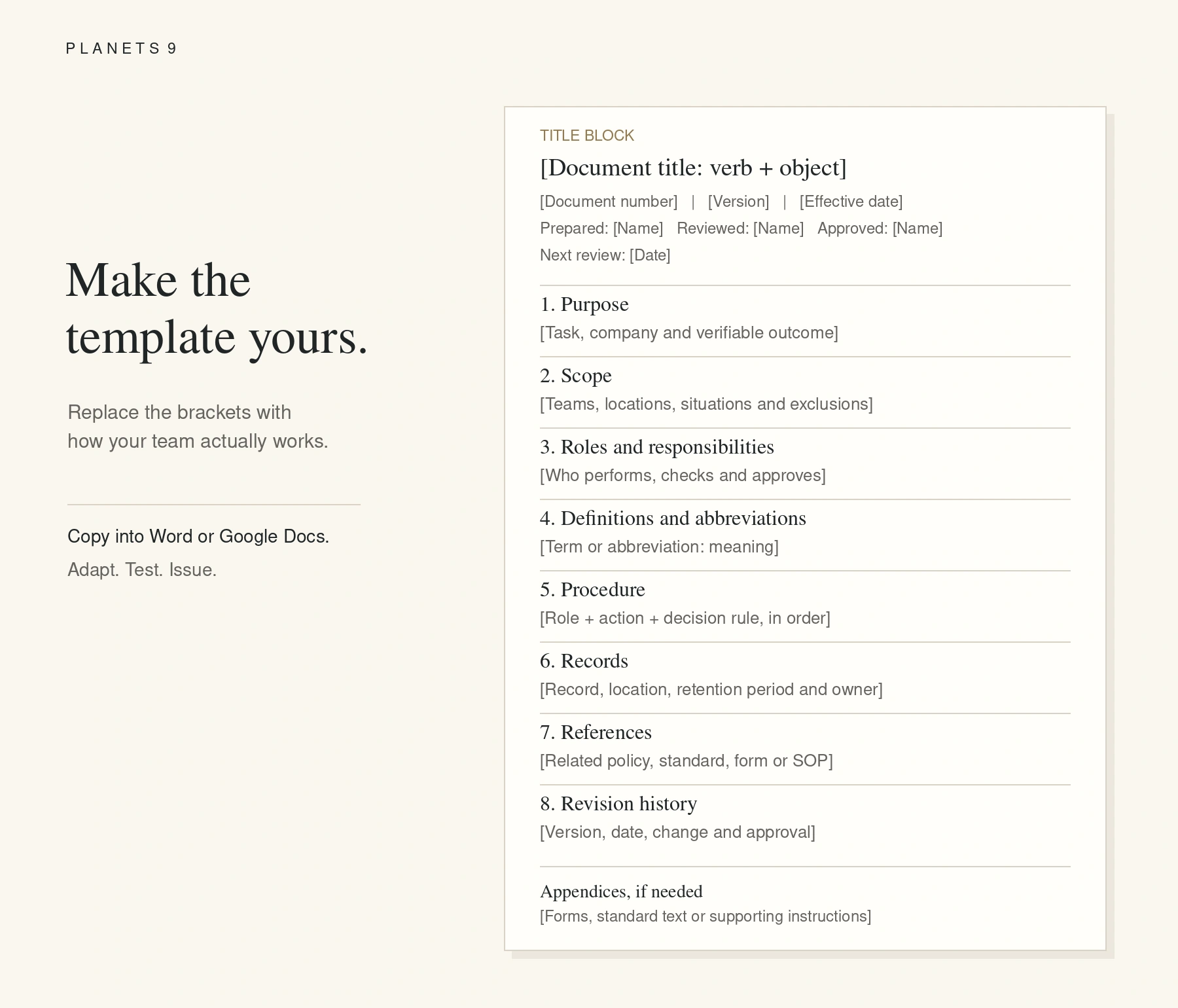
This page walks through each step with one running example, a customer complaint procedure for a twenty-person trading company. The SOP format page gives the sections of the finished document; this one is about getting the content right.
Step 1 — Choose the task that is costing you, not the one that is easy
The first SOP sets the company's opinion of SOPs. If it is a procedure for something trivial, the team learns that SOPs are paperwork. If it is a procedure for the thing that goes wrong every month, the team learns that SOPs solve problems.
Three tests for the first task. It fails or varies often enough that people can name the last time. It costs money or a customer when it fails. Or it can only be done by one person, and that person could be absent.
In the running example: complaints from customers arrive by phone, WhatsApp and email. Some are answered in an hour, some in four days, and two last quarter reached the owner directly because nobody else had responded. That is the task.
Step 2 — Watch the task, twice, by two people
Do not write from memory. Do not write from the job description. Sit beside the person who does the task and watch it happen, then do the same with a second person. Note every action, every system they open, every question they ask someone, every place they pause.
Where the two people differ is the substance of the SOP. One logs the complaint in a register, the other keeps it in WhatsApp. One calls the customer back to confirm, the other does not. One asks the owner before offering a replacement, the other offers it and informs the owner later. None of these differences is visible from a desk, and each is a decision the SOP has to make.
If you are the owner and you are the only person who does the task, have someone watch you, and ask you why at every step. The answers are the procedure.
Step 3 — Write the outcome in one sentence
Before a single step, write what "done" means, in a way that anyone could verify. Not "complaint handled" but "the customer has received a written response within one working day, the complaint is logged with a category and an owner, and the resolution is recorded within five working days."
If you cannot write that sentence, the task does not yet have a standard. It has a habit. The sentence becomes the Purpose section of the SOP and the measure by which you will know whether it is being followed.
Step 4 — Write the steps in order, one action each
Plain language. Present tense. Imperative mood. Each step starts with a verb and names the role that performs it.
Sales Coordinator logs the complaint in the Complaint Register (Form SER-01) within one hour of receipt, with date, customer, channel, product and a one-line description.
Sales Coordinator sends the customer an acknowledgement by the same channel the complaint arrived on, using the standard acknowledgement text in Appendix A.
Sales Coordinator assigns a category: quality, delivery, billing, or service.
"Handle the complaint" is not a step. "Ensure customer satisfaction" is not a step. If a step contains "and", it is two steps. If it needs three lines of explanation, the explanation is a work instruction and belongs in an appendix, not in the procedure.
Write for a competent person who has never done this task in your company. Not for an expert, who does not need the SOP, and not for a fool, who will not read it.
Step 5 — State the rule at every decision point
This is the step that separates an SOP that removes the owner from the loop from one that merely documents the loop.
Everywhere the person performing the task has to choose, write the rule that decides. Who can offer a replacement, up to what value. When a complaint escalates, and to whom. What happens if the customer does not respond.
If the complaint is a quality issue under ₹10,000 in invoice value, the Sales Coordinator offers replacement or credit note directly, records it, and closes.
If the value is between ₹10,000 and ₹50,000, the Sales Manager approves the remedy within one working day.
Above ₹50,000, or any complaint that mentions legal action or a regulator, the owner is informed the same day.
Every place where the honest answer is "it depends, ask sir" is a decision the owner has been making by phone. Writing the rule is what moves the decision into the company. If there is no rule yet, deciding one is the most valuable thing the SOP exercise will produce, and the decision bottleneck essay covers how to set the thresholds.
Step 6 — Test it on someone who did not write it
Hand the draft to a person who has never done the task. Give them a real or realistic case. Watch, and say nothing. Every question they ask is a missing line. Every place they hesitate is a step written from the writer's knowledge rather than the reader's.
Correct the draft, then test it once more with a different person. Two clean runs and it is ready to issue. One run is not enough, because the first tester's questions were specific to them.
Context over conclusions.
The tester does not need to be told the answer. They need the document to contain enough context that the answer is obvious. That is the standard the SOP has to meet, and it is stricter than the writer thinks.
Step 7 — Assign an owner and a review date
Put a name on it. Not the owner's name, unless the owner performs the task. The role that performs it owns the document, the role that manages it reviews, and a third name approves. Fix a review date: six months for anything customer-facing or compliance-related, twelve for the rest, and immediately whenever the system, supplier, law or product changes.
Issue the SOP, train the people who perform it, keep a record of who was trained on which version, and put it where the task happens: pinned above the desk, in the shared drive folder they already use, inside the system if the system allows it. An SOP in a folder nobody opens is not issued.
What the finished SOP looks like
For the running example: a two-page document, SER-SOP-001, "Handling a Customer Complaint", version 1.0. Purpose, scope with warranty claims excluded, three roles, four definitions, a twelve-step procedure with three decision rules, a records section naming the Complaint Register and the monthly complaint summary, a reference to the Credit Note SOP, and a revision block. The SOP examples page has it in full, alongside seven others.
Mistakes to avoid while writing
Writing from memory instead of observation. The SOP describes the past.
Writing for the auditor instead of the performer. The SOP describes a fiction.
Using "should" and "may". The SOP is instructions; "does" and "must".
Escalating every decision to "management". The SOP documents dependency instead of removing it.
Producing the whole set at once. Ten SOPs written in a fortnight will be ten SOPs nobody follows. Two a month, tested, will hold.
Asking a language model to write it and issuing the result. A generic procedure that does not match your company teaches the team that SOPs are decoration.
Questions people ask about writing an SOP
Who should write an SOP?
The person who performs the task, with their manager reviewing. The owner should approve, not draft, except for tasks only the owner performs. A consultant can facilitate and format; a consultant should not be the source.
How long does it take to write an SOP?
For a task of twenty steps: two observation sessions of an hour each, two hours of drafting, two test runs of an hour each, and revisions. Roughly a working day spread over two weeks. Faster than that usually means steps two and six were skipped.
What software is used to write SOPs?
Word or Google Docs for most companies, issued as PDF. Larger companies use document control systems; smaller ones do not need them. The controls that matter are the document number, the version and a single master location.
Can employees write their own SOPs?
They should. The person who does the work knows the steps; the manager and owner know the standard and the decision thresholds. The document needs both, which is why the writing is done by the performer and the approval by the role above.
How do I get employees to follow SOPs?
By writing procedures that describe the work as it actually happens, testing them on the people who will use them, and never overriding them in person without also changing the document. The spoke on why SOPs fail covers the people side, which is usually the real reason.
Where to go deeper
SOP Format — the nine sections and four body formats.
SOP Template — copy the structure directly.
SOP Examples — eight finished SOPs including the complaint procedure above.
Process Documentation — map the end-to-end process before you write the procedure inside it.
What Is an SOP? — the full guide.