Organisational Development: What It Means for a Growing Private Company

The company that was easy to run at fifteen people is hard to run at sixty. Nothing broke. The same people, the same product, the same owner. And every week there is a new meeting about a problem that did not exist two years ago, and the meeting produces another process, and the process produces another meeting.
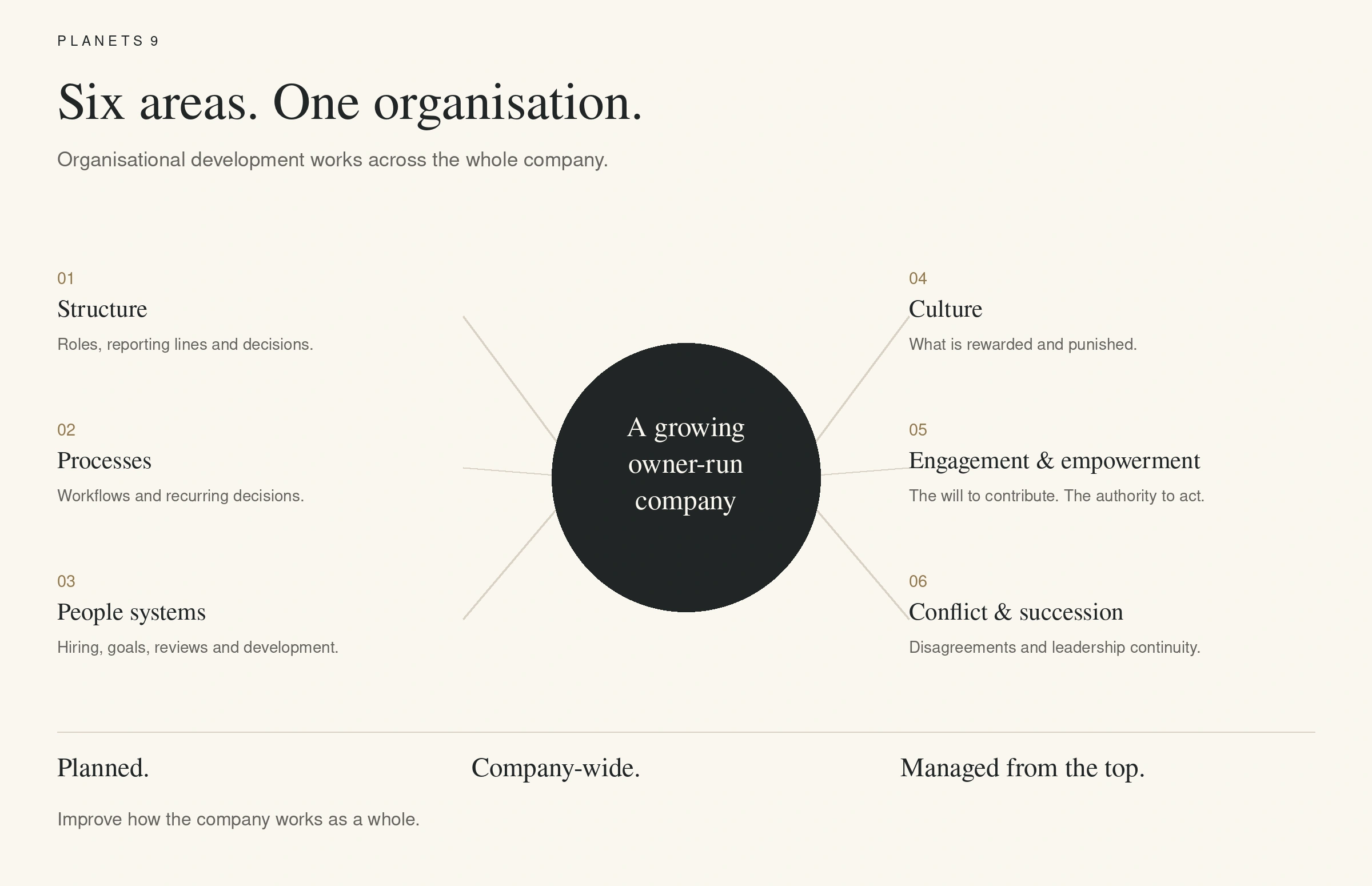
Organisational development, or OD, is the planned, company-wide effort to improve how an organisation works, managed from the top, through deliberate changes to its structure, processes, culture and people, using what is known about how groups of people actually behave. Richard Beckhard's 1969 definition is still the one textbooks use. Stripped of the vocabulary, it means: the business has outgrown the way it was organised, and somebody has to reorganise it on purpose rather than let it reorganise itself by accident.
This page covers what OD is and is not, where the idea came from, the areas it works on, the process, and the specific form the problem takes in an owner-run Indian company between twenty and two hundred people. The ten spokes go deeper on each area.
What organisational development actually means
Three words in the definition do the work.
Planned. OD is deliberate. Most companies change their organisation constantly, by hiring a person and giving them whatever was lying around, by adding a rule after a mistake, by letting the org chart drift from the reality. That is change; it is not development. Development is when someone looks at the whole company and decides what it should look like next.
Company-wide. OD works on the system, not on one department or one person. Training a manager is training. Redesigning how departments hand work to each other, how decisions are made and how people are held to account is OD.
Managed from the top. Nobody below the owner can reorganise the company, because the owner's own role is usually the thing that most needs to change. That is why OD in an SME either starts with the owner or does not start.
Where the idea came from
OD grew out of Kurt Lewin's work in the 1940s on how groups change, his action research method, and the T-group experiments at what became the National Training Laboratories. Lewin's three-step model of change, unfreeze, change, refreeze, is still the skeleton of most change programmes and is covered in the change management spoke.
The field took its modern shape in the 1960s with Beckhard, Warren Bennis and Edgar Schein, whose model of organisational culture is the standard one. From the 1980s it absorbed strategy, structure design and performance systems, and today an OD function in a large company covers everything from org design to engagement surveys.
In a company of sixty people there is no OD function. There is an owner who has noticed the company is harder to run than it used to be. Everything below is written for that person.
The six areas OD works on
Structure
Who reports to whom, how work is grouped into departments, how many people each manager has, where decisions are made. In an owner-run company the structure on paper and the structure in practice diverged years ago. The organisational structure spoke covers the types and how to choose one; the principles of management cluster covers span of control, scalar chain and centralisation underneath.
Processes
How work flows across departments, and how the recurring decisions are made. The SOP cluster covers documenting the work; the management by objectives spoke covers the goal-setting process that connects the company plan to individual targets.
People systems
How the company hires, sets goals, reviews, pays, develops and promotes. The performance management and talent management spokes cover the two systems most SMEs run informally until something goes wrong.
Culture
What the company actually rewards and punishes, as opposed to what the values poster says. The organisational culture spoke uses Schein's three levels to show why culture in an owner-run company is the owner's habits, scaled.
Engagement and empowerment
Whether people give discretionary effort, and whether they have the authority to. The employee engagement and employee empowerment spokes are the two halves: the will and the means.
Conflict and succession
What happens when people disagree, and what happens when the person at the top has to be replaced. The conflict management spoke covers the first; the succession planning spoke covers the second, which in a family business is the OD question that decides all the others.
The OD process
Textbooks give five to eight steps. In practice, four matter.
Assess before designing. Find out how the company actually works: where decisions form, where they stall, where work waits, who people really take instructions from. Not how the owner believes it works. Most OD failures start with a design built on the owner's picture rather than the company's reality.
Choose the intervention for the problem. A structure problem is not solved by a culture workshop. A culture problem is not solved by a new org chart. OD interventions fall into four groups: human process (team building, conflict resolution, group facilitation), techno-structural (structure and job redesign), human resource (performance, pay, talent) and strategic (culture, direction, large-scale change). Match the group to the assessment.
Change the system, not the person. If the sales manager keeps escalating, the question is whether the authority, the targets and the information he has make escalation the rational move. Usually they do. Fix that before concluding he is the wrong person.
Hold the change until it is the new normal. Lewin's refreeze. A structure change that is not enforced for two quarters reverts, because every person in the company has a habit that the old structure rewarded.
What OD looks like in an owner-run company
The pattern is specific enough to describe.
The company grew around the owner. Every process, every approval, every relationship routed through one person because at eight people that was the fastest way. At forty it is the slowest, but nothing changed it, because the person who would have to change it is the person it routes through.
The symptoms are the ones every OD textbook lists, with an Indian accent. Decisions queue at the owner's cabin. Department heads have titles and no authority. The org chart was drawn for the bank. Meetings produce processes and processes produce meetings. Good people leave at year two. The family is in the structure but not on the chart. And the owner is working harder every year for a company that grows slower every year.
OD, for this company, is not a programme. It is a sequence of six or seven decisions the owner has been avoiding: what the structure should be, who decides what, how goals are set and reviewed, what the culture actually rewards, who the next layer of leaders is, and what happens when he steps back. The owner dependency guide is the map of that sequence from the owner's side; this cluster is the OD vocabulary for the same work.
What OD cannot do
Every OD intervention is a change to a system, and every system is inhabited by particular people. A new structure works when the people in the new roles are built to hold them. A performance system works when the managers running it can have the conversation. A culture change works when the people whose habits define the culture can actually operate differently.
We work below strategy.
OD, done properly, works one level below the plan: on the structure, the processes and the people systems the plan runs on. There is a level below that, the operating nature of the people who inhabit the structure, and it is the one no OD framework reaches. An owner who has redesigned the structure, rewritten the goals and run the workshop, and still finds the company routing everything back to him, has usually not failed at OD. He has put the right design in the hands of people chosen for loyalty or availability, and the question of who is actually built for each seat is the one underneath all six areas.
Questions people ask about organisational development
What is organisational development in simple words?
Deliberately improving how a company works, across the whole company, by changing its structure, processes, culture and people systems, rather than letting it reorganise itself by accident as it grows.
What are the objectives of organisational development?
To increase the organisation's effectiveness and health: better decisions made faster at the right level, work that flows across departments, people who stay and give their best, and a company that can adapt without depending on one person.
What are the types of OD interventions?
Four groups: human process interventions (team building, conflict resolution), techno-structural interventions (structure and job redesign), human resource management interventions (performance, pay, talent systems) and strategic interventions (culture and direction).
What is the difference between organisational development and HRD?
Human resource development works on individuals, through training and career development. OD works on the whole organisation, through its structure, processes and culture. HRD is one of the instruments OD uses.
Who is the father of organisational development?
Kurt Lewin, for his 1940s work on group dynamics, action research and the three-step change model. Richard Beckhard gave the field its standard definition in 1969.
Does a small company need organisational development?
Under about fifteen people, rarely; proximity and the owner's presence do the job. Past that, and especially past the point where the owner cannot see every task, the absence of deliberate organisation is what most owners experience as "the company got harder to run".
See how the organisation actually runs
Every OD process starts with an assessment, and every assessment depends on seeing how the company actually operates rather than how the owner believes it does. Where decisions form. Where they stall. How much still routes through one person. Which of the people in the structure are built to hold the seats they are in.
The Business Pulse reads how your organisation actually runs. Fifteen minutes, answered as the owner, before the redesign.
Where to go deeper
Organisational Structure — the types, and how to choose one at twenty, fifty and two hundred people.
Change Management — Lewin, Kotter, and why the company resists every change.
Organisational Culture — Schein's three levels, and the owner's habits scaled.
Employee Engagement — what it is, what it is not, and why India's numbers are what they are.
Employee Empowerment — authority without losing control.
Management by Objectives — Drucker's method, and the version that survives contact with an SME.
Performance Management — the system, for companies that have been running on the owner's opinion.
Talent Management — the next layer of leaders, and how to see it.
Conflict Management — for owners who end up as the referee.
Succession Planning — the OD question that decides all the others.
Owner Dependency: Why Your Business Can't Run Without You — the same work, from the owner's side.