Notice Period During Probation: How Much Notice, Resigning on Probation, and Ending It From the Employer's Side

A quality engineer at a Chakan auto-parts supplier resigns in week nine of a six-month probation. His letter says fifteen days' notice during probation. The plant head, short-staffed, tells him the company's notice is ninety days and he cannot leave before then. Two weeks later the engineer stops coming, the company withholds his salary, and both sides are now arguing about a clause neither had read.
The notice period during probation is whatever the appointment letter or company policy states for probationers, commonly seven days to one month, and usually shorter than the notice after confirmation. It applies in both directions: an employee on probation can resign by serving it, and the employer can end the employment by giving it or paying salary in lieu. If the letter is silent, the company's standing orders, policy and state rules decide, which is why the letter should never be silent. Short notice is the point of probation, not a loophole in it.
This page covers how much notice applies during probation, resigning on probation, ending employment from the employer's side, pay in lieu and settlement, and the documentation that keeps it clean. The probation period pillar covers the rest.
How much notice applies during probation
The appointment letter decides. Common Indian practice:
- Seven to fifteen days for junior and operational roles.
- Fifteen days to one month for managers and specialists.
- One month for most senior hires, even where post-confirmation notice is three months.
Some companies write "no notice during probation" or "either side may end employment without notice." That reads as flexible and works badly. It invites abrupt exits, unpaid last days and disputes about final pay. A short, stated notice in both directions is cleaner.
The appointment letter spoke shows how to write the probation and notice clauses together, so the two periods cannot be confused.
Resigning during probation
An employee on probation can resign by giving the notice the letter states for probationers. The company cannot apply the post-confirmation notice to someone who has not been confirmed, unless the letter clearly says the longer notice applies throughout.
For an owner, a resignation in probation is information, not betrayal. The two common reasons are that the role was described differently from what it turned out to be, and that the first month left the person without direction. The onboarding spoke covers the second. The offer letter spoke covers the first.
What to do when a probationer resigns:
- Accept it in writing with the last working day as per the probation notice.
- Ask one honest question about why, and write down the answer.
- Waive or shorten the notice if the handover is small. Holding someone for a full notice they have mentally left rarely helps.
- Complete the final settlement on time.
Ending employment during probation from the employer's side
Probation exists so an employer can end a poor fit early. That right is real, and it still needs to be exercised with care.
Termination simpliciter. Ending employment because the probation was not completed satisfactorily, stated plainly, without allegations of misconduct. This is what probation allows. Give the notice or pay in lieu, and write a short letter that refers to the role and the probation.
Termination with stigma. If the letter accuses the person of dishonesty, misconduct or similar, it is no longer a simple probation decision. Allegations of misconduct need a proper inquiry, whatever the employee's status. Keep probation exits to fit and performance against the role, and take legal advice before any letter that alleges misconduct.
The full process, including documentation and final settlement, is in the how to terminate an employee in India explainer.
Notice during probation and after confirmation
The difference between the two periods is the reason probation exists.
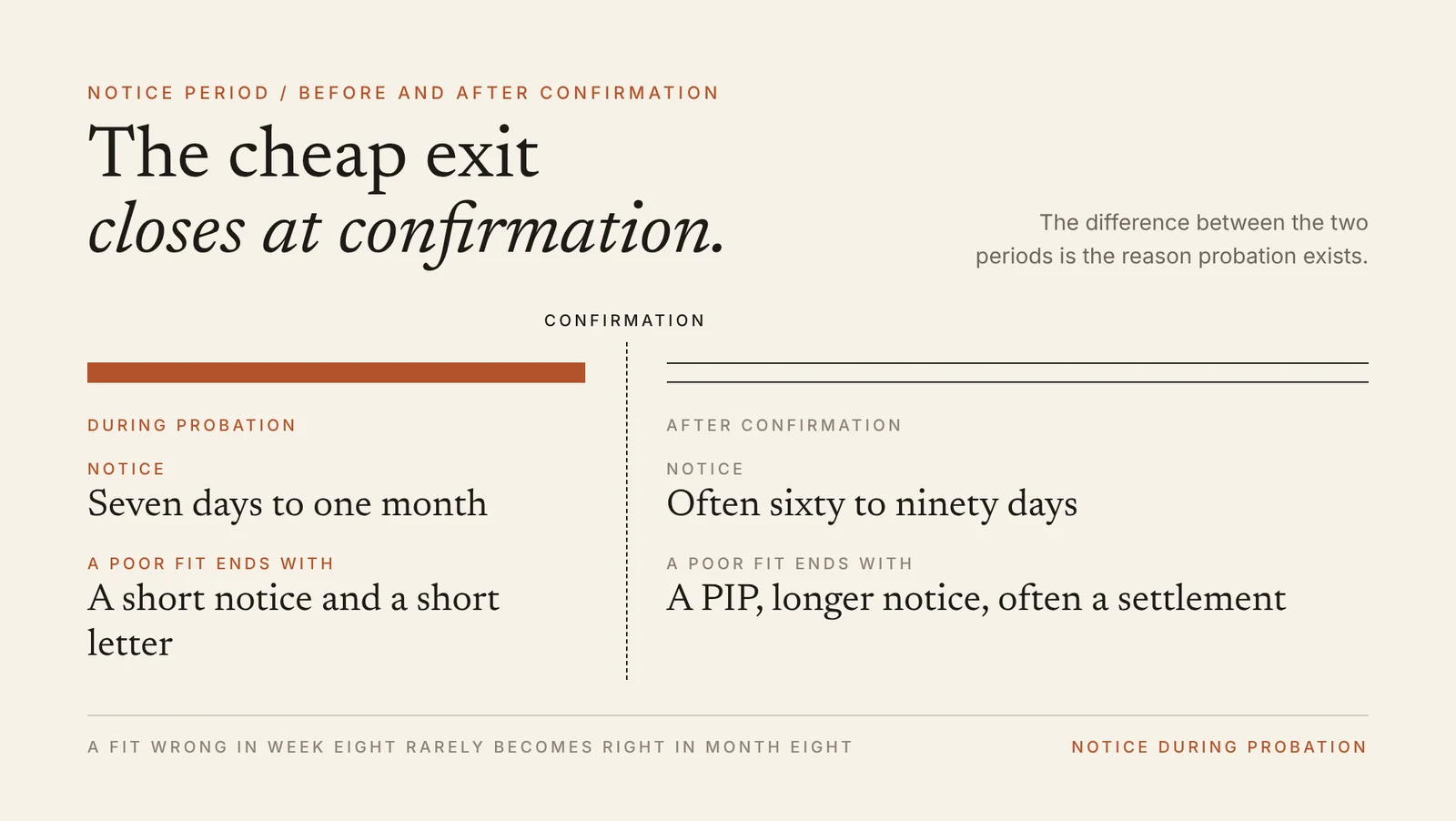
During probation, a poor fit ends with a short notice and a short letter. After confirmation, the same poor fit usually needs a documented performance improvement plan, a longer notice and often a negotiated settlement. The cost of keeping an underperformer essay shows how the difference adds up.
Pay in lieu of notice and final settlement
Either side can usually end the notice early by paying salary for the unserved days, if the letter allows it. Employers commonly pay in lieu when the person should leave the same day.
The final settlement during probation includes:
- Salary for days worked, and notice pay if paid in lieu.
- Encashment of accrued leave as the state rules and policy require.
- Reimbursements due, and recovery of any advances as agreed in writing.
- PF transfer or withdrawal support and the relieving and experience letters.
Withholding salary because notice was not served in full is a frequent source of disputes. Recover only what the letter clearly allows, and settle the rest on time. Confirm specifics for your state with your lawyer or CA.
Writing the notice clause so it cannot be misread
One sentence for each period, in the same paragraph: "During probation, either party may end this employment by giving fifteen days' written notice or salary in lieu. After confirmation, the notice period is sixty days." Add whether notice can be waived or bought out, and by whom. A clause written this way ends most of the disputes in this page before they start.
The decision that should not wait
Most owners do not end probation too quickly. They end it too late, after the date has passed and the short notice has gone with it.
A fit that is wrong in week eight rarely becomes right in month eight. The probation period pillar gives four checkpoints that bring the decision forward, and the should I fire this employee essay covers the judgement itself. The Business Pulse reads how your organisation actually runs, where decisions form and where they stall, which is often why the probation decision stalls too.
Questions people ask about notice period during probation
What is the notice period during probation?
Whatever the appointment letter or company policy states for probationers, commonly seven days to one month. It is usually shorter than the notice after confirmation and applies both ways: the employee can resign by serving it, and the employer can end employment by giving it or paying salary in lieu.
Can I resign during my probation period?
Yes. An employee on probation can resign by giving the notice stated for probationers in the appointment letter. The company cannot apply the longer post-confirmation notice unless the letter clearly says it applies throughout. Serve the notice, complete the handover and ask for the final settlement and relieving letter.
Can a company terminate an employee during probation without notice?
Only if the letter allows it, and even then paying salary in lieu of notice is the safer practice. Ending employment because probation was not completed satisfactorily is allowed; it should be in writing, refer to the role, and avoid allegations of misconduct, which need a proper inquiry.
Is notice pay given during probation?
If the employer ends employment without letting the person serve the notice stated in the letter, salary in lieu of that notice is normally paid. If the employee leaves without serving notice, the employer may recover only what the letter clearly allows, and should settle everything else on time.
What happens if no notice period is mentioned for probation?
The company's standing orders, HR policy and applicable state rules then decide, and the outcome can be argued either way. Both sides lose certainty. Every appointment letter should state the notice during probation and after confirmation separately, in plain words, so the question never arises.
Does resignation in probation affect the experience letter?
It should not. An employee who resigns and serves the probation notice is entitled to a relieving letter and a factual experience letter for the period worked. Owners gain nothing by withholding them, and a short, fair exit is better for the company's reputation among future candidates.
Where to go deeper
- Probation Period — meaning, duration, rules in India and the three outcomes.
- Probation Period Salary — pay, PF, ESI and leave during probation.
- Extending Probation — when more time is fair, and the letter.
- Appointment Letter — writing the probation and notice clauses together.
- How to Terminate an Employee in India — the full process after confirmation.
- Should I Fire This Employee — the judgement before the paperwork.