Nepotism in the Workplace: What It Does to the People Who Are Not Family

The operations head has run the plant for nine years. The owner's son joined operations in April. By June the plant supervisors had started copying the son on emails to the operations head, and by August the operations head had a conversation with a competitor that he did not mention to anyone.
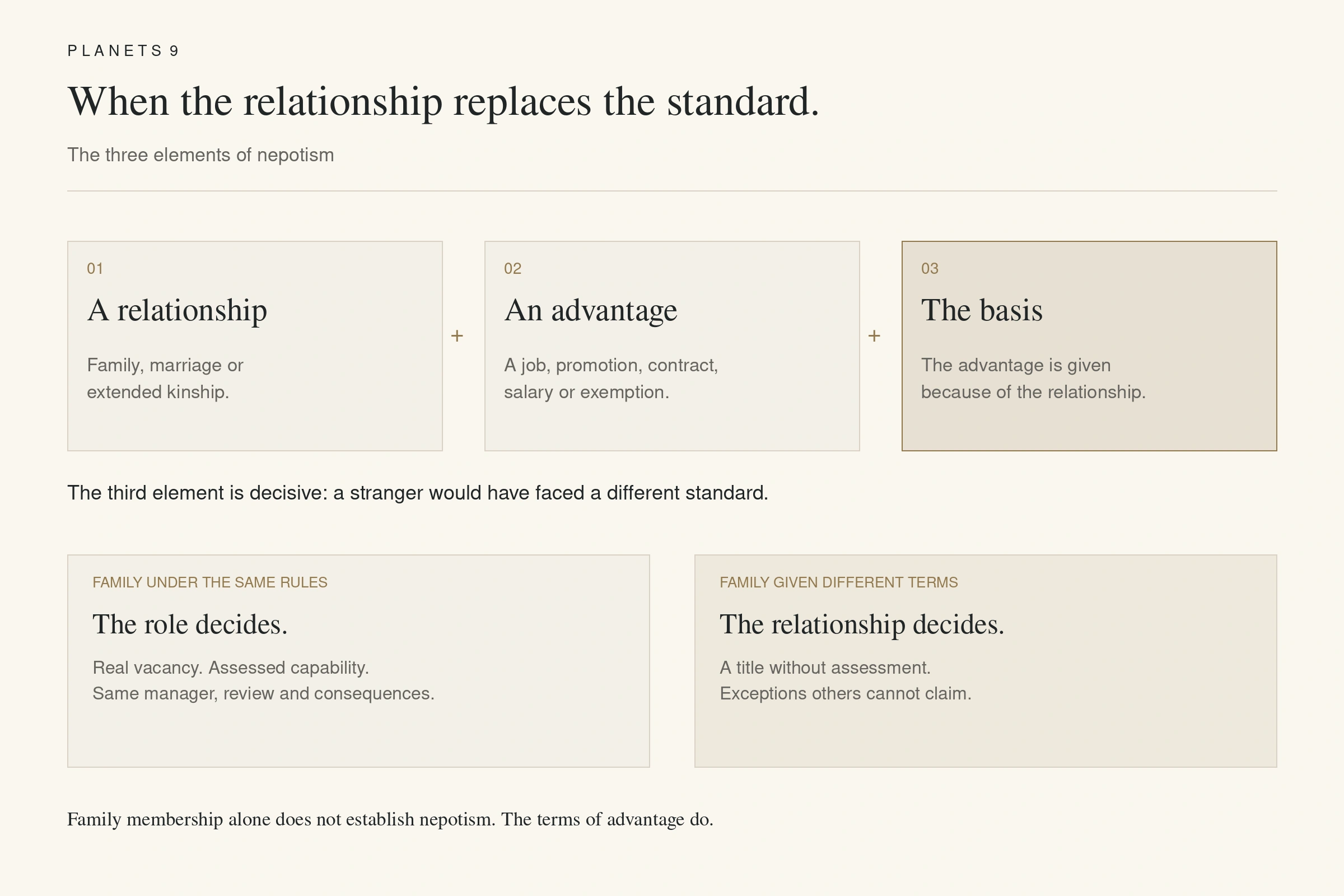
Nepotism in the workplace is what the practice of favouring relatives looks like from inside the company: the effect on the non-family managers and employees who work alongside, under or, in theory, above the relative. Its effects are a visible ceiling for capable people, authority that stops being real below the family line, standards that split into two versions, honest information that stops reaching the top, and a slow exit of the people the company most needed to keep. The owner sees a son learning the business. The company sees a new organisation chart that nobody drew.
This page is written from the company's side: what non-family people observe, how they respond, what the relative experiences, and what an owner can do about the effects once the relative is already in the building. The nepotism pillar covers the meaning and the entry rules; the hiring family members spoke covers doing it right from the start.
What the company observes
Non-family employees notice things the owner does not, because they are looking for them.
Whether the relative was interviewed, and by whom. Whether he started at a level his experience would have earned him elsewhere. Whom he actually takes instructions from. Whether his manager's corrections hold, or are reversed at dinner. Whether he is in the review cycle. Whether he keeps the hours, the rules and the process everyone else keeps. What happens the first time he makes a mistake that would have cost someone else a warning.
Each observation is a data point about the real structure of the company. Within a quarter the company has redrawn its own chart, with the relative connected directly to the owner and everyone else adjusting their behaviour to that line.
How people respond
Four patterns, roughly in order of how capable the person is.
The capable leave. The best non-family managers work out where their ceiling now is and begin looking. They rarely say why. The why managers leave essay calls it the ceiling test; the why high performers leave essay covers the moment the decision is made, usually months before the resignation.
The competent adjust. They stay, do the job, and stop bringing problems up. They manage around the relative, copy him on what he needs to see, and keep their real opinions for the car park. The company keeps their hands and loses their judgement.
The political attach. Some people move toward the relative as the new channel to the owner. They become his allies, his informants and eventually his faction, and the conflict management spoke describes the department wars that follow.
The loyal endure. The early employees who are loyal to the owner personally accept the relative as an extension of him. They are the ones who will train him, and the ones he will find easiest to overrule.
What the relative experiences
The relative's side is rarely written about, and it is not comfortable.
He knows he was not interviewed. He knows the operations head did not choose him. He receives compliance where a hired manager would receive engagement, and cannot tell the difference from inside. He is told what people think the owner wants him to hear. When something goes well he cannot be sure it was his doing; when something goes wrong, he knows who the company blames.
If he is capable, this is a waste of him. If he is not, the company will find out slowly and expensively, and the second-generation challenges essay describes the particular difficulty of being handed something you have not earned in front of people who earned theirs.
The effect on authority
The authority and responsibility spoke gives the principle: authority and responsibility have to match, and an owner-run company usually gives responsibility without authority. Nepotism produces a specific version.
The relative's manager is responsible for the department's results and cannot direct the relative, because every instruction can be appealed. The relative has informal authority over people he does not manage, because they have seen his manager overruled. The department now has two authority structures, and the unity of command spoke covers what two principals do to the people below them.
The effect on standards
The why SOPs fail spoke names the mechanism: one exemption at the top makes the rule optional everywhere. The relative who does not follow the process, keep the hours, or submit to the review is the exemption, and every supervisor who enforces the standard on his own people while watching the relative ignore it is enforcing something he no longer believes in.
The organisational culture spoke calls the real culture the third level: the unspoken rules people learn from what is rewarded and punished. A relative exempted from the standard teaches the third level faster than anything the owner says at the town hall.
What an owner can do once the relative is already in
The entry rules in the hiring family members spoke are for before. These are for after, when the relative has been in the building for a year and the operations head is talking to a competitor.
Give the relative a real manager and say so in front of both. The owner tells the relative, with the manager present, that the manager runs the department and that appeals to the owner will be refused. Then refuses them. For a month, at least.
Put the relative in the review cycle, on the same page, this cycle. Reviewed by his manager, with the same measures and the same consequences. The company will watch the first review, and decide from it whether the standard is real.
Apply the first rule that the relative breaks, visibly. Not harshly. Visibly. The message is that the process is the process.
Move the relative out of the department where the damage is done, if it is done. A head who has been undermined for a year cannot be restored by an announcement. The relative goes to a different function, under a different manager, and starts again on terms.
Talk to the capable ones before they resign. The retention conversation the talent management spoke describes: tell them what the relative's role will and will not be, what their own path is, and mean it.
Get the relative out of the company for three years, if he is young enough. The rule that most of India's durable family groups apply: outside experience, in a company where nobody cares whose son he is. The relative who returns has been corrected by strangers, and the company knows it.
The person under the relationship
The effects above follow from structure, and structure can be fixed. What the fix cannot supply is the answer to the question underneath: whether this particular relative is built for the seat he has been given. Some sons and daughters carry authority naturally, take correction, and earn a team's following within a year of arriving. Some, given exactly the same seat and the same rules, cannot, and no entry process will change that. The family relationship is what got the person in. It says nothing about how the person operates.
That is the layer under the effects. The Business Pulse reads how your organisation actually runs, where decisions form and where they stall, and is the instrument for seeing whether the relative is holding the seat or being held in it.

Questions people ask about nepotism in the workplace
What is nepotism in the workplace?
Favouring relatives in hiring, promotion, pay, assignments or exemptions from rules, as experienced by the non-family people who work alongside them. It is defined by the terms the relative receives, not by the relative's presence.
What are the effects of nepotism in the workplace?
Capable non-family managers leave, authority stops being real below the family line, standards split into two versions, honest information stops reaching the owner, factions form around the relative, and the relative himself cannot tell compliance from engagement.
How do employees react to nepotism?
The most capable leave, usually without saying why. The competent stay and stop raising problems. Some attach themselves to the relative as the new channel to the owner. The loyal early employees accept the relative as an extension of the owner.
How does nepotism affect the relative who benefits?
He is untested, receives compliance rather than engagement, is told what people think the owner wants him to hear, and cannot be sure any result was his own. If capable, he is wasted; if not, the company finds out slowly.
How should an owner handle nepotism that is already in the company?
Give the relative a real manager and refuse appeals; put him in the review cycle on the same page; apply the first rule he breaks visibly; move him if a department head has already been undermined; talk to the capable managers before they resign; and, if he is young, send him outside for three years.
Can nepotism ever be positive?
Family in the business can be, when the relative is capable, entered on the same terms as anyone else, and carries the company's standard. What is never positive is the exemption: a relative held to a different standard from everyone else, whatever his ability.
Where to go deeper
Nepotism: Meaning, Examples, and the Family-Business Version — the pillar.
Hiring Family Members — the entry rules, for before.
Why Your Managers Leave — the ceiling test.
Unity of Command — two authority structures in one department.
Second-Generation Challenges — the relative's side.