Hiring Family Members: The Rules Before Your Son, Daughter, Nephew or Son-in-law Joins

The son finishes his degree in May. The father has been saying for twenty years that the business is for him. Nobody has discussed what he will do on the first Monday, whom he will report to, what he will be paid, or what happens if it does not work, because discussing it would suggest it might not.
Hiring family members into a business is not nepotism in itself. It becomes nepotism when the relative is brought in on terms a stranger would not have received: no vacancy, no process, no real manager, no review, no consequences. The rules that separate the two are known, and most of the Indian business families that have lasted three generations apply some version of them: outside experience first, a real role with a real vacancy, a non-family manager whom the owner will not overrule, the same standard visibly applied, and ownership kept separate from employment. The rules are simple. Applying them to your own child is not.
This page gives the rules, the reasons behind each, the version of a family employment policy that fits on one page, the objections owners raise and the answers to them, and the question underneath that no policy answers.
Why the rules exist
The nepotism in the workplace spoke describes what the company does when a relative arrives on soft terms: the capable leave, authority hollows out, standards split. The rules exist to prevent that, and for a second reason that gets less attention: they protect the relative.
A son who joins at twenty-three, reports to his father and is never corrected by anyone else does not learn. He is deprived of the thing that made his father capable: years of being wrong in front of people who did not care whose son he was. The rules give the relative a career rather than an inheritance.
The rules
Outside first. Three to five years in another company, in a real role, preferably in the same industry, ideally in a bigger company than the family's. The relative learns how a professional organisation works, is reviewed and promoted or not by strangers, and comes back with a reference the family company cannot manufacture. This is the rule most durable Indian family groups treat as non-negotiable, and the one most first-generation owners skip because they want the help now.
A real vacancy. The relative fills a seat the company would have filled anyway, at the level his experience earns. If there is no vacancy at his level, he waits, or takes the level that exists. A title invented for him is a title everyone can see was invented.
A process. An interview by the department head, a work sample where the role allows one, a comparison with what an outside candidate would have offered. Not to reject him; to make his entry legible. The department head who interviewed and chose him can manage him. The department head who was told he starts Monday cannot.
A non-family manager, backed. The relative reports to a professional, not to the owner, and the owner tells both of them, together, that he will not hear appeals. Then he refuses the first appeal, which arrives within a fortnight. The unity of command spoke covers why one line matters; the delegation of authority spoke covers why authority given and then overridden is worse than authority never given.
Market pay. The salary the seat pays, on the payroll, reviewed with everyone else's. Not an allowance dressed as salary, and not a discount to prove a point. Money that does not match the role tells the company the role is not real.
The same standard, visibly. Same objectives, same review page, same reviewer, same consequences, same rules on hours, process and expenses. The performance management spoke gives the minimum system. The company decides whether the standard is real the first time it is applied to the relative; the owner should plan for that moment rather than be surprised by it.
Ownership separate from employment. Shares pass by the family's rules; roles are earned by the company's. A relative can own a quarter of the company and hold no role in it, or hold a senior role and own nothing yet. Confusing the two is where most third-generation disputes begin, and the family business governance essay covers the mechanisms that keep them apart.
An exit that is not a catastrophe. Agreed in advance: if the role does not work, the relative leaves the role, not the family. Saying this out loud before the first day is the single thing that makes every other rule enforceable.
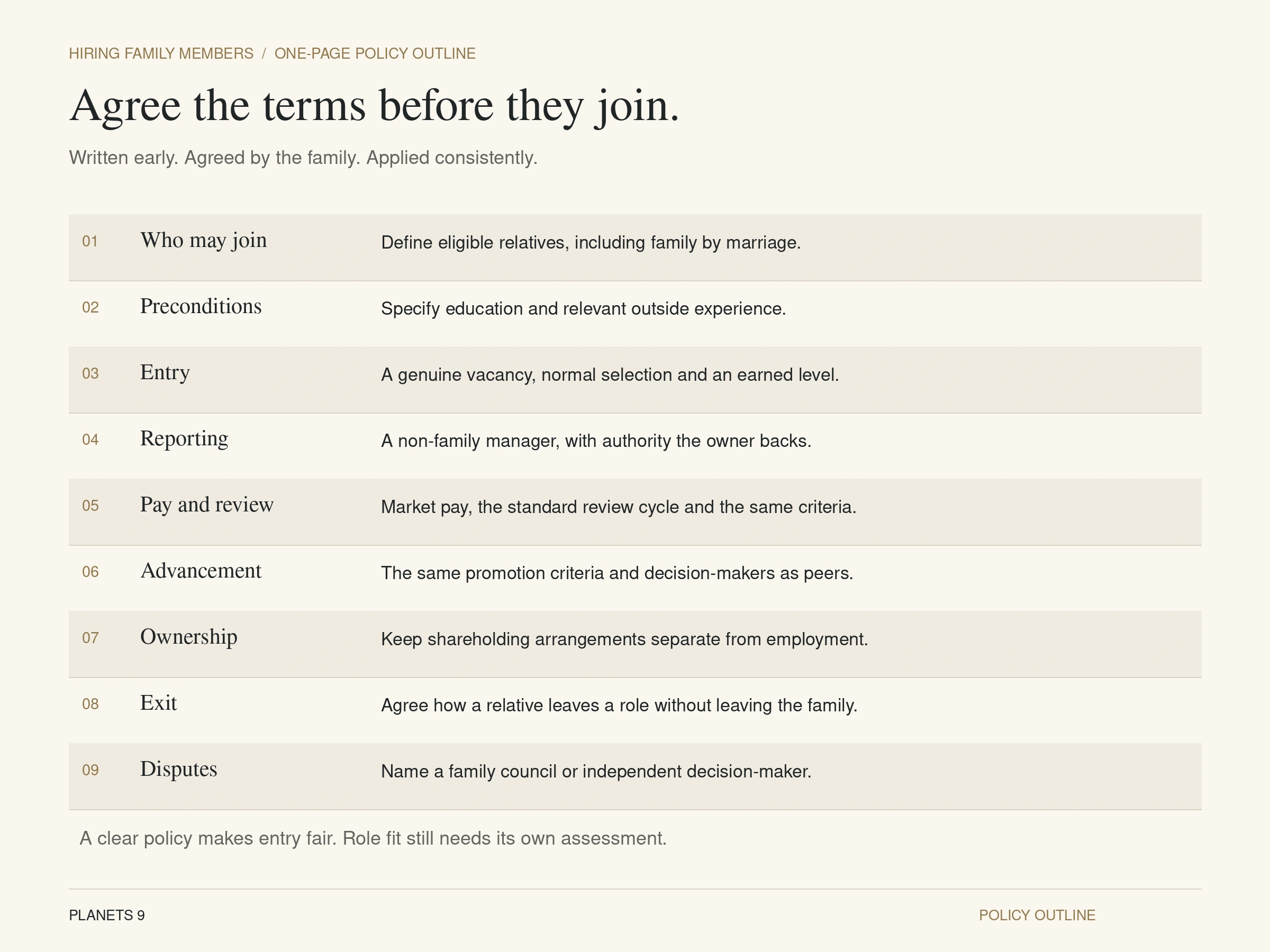
A family employment policy, on one page
Written before anyone's child is old enough to test it, and agreed by the family, not announced by the founder.
Who may join: by blood and marriage, and to what degree.
Preconditions: education, years of outside experience, and in what kind of company.
Entry: only into a genuine vacancy, through the company's normal process, at the level earned.
Reporting: to a non-family manager wherever one exists; never to a parent.
Pay and review: market rate, standard cycle, same reviewer as peers.
Advancement: on the same criteria as non-family, decided by the same group.
Ownership: separate from employment; set out in the shareholders' agreement or family constitution, not in the employment policy.
Exit: how a family member leaves a role, and what that does and does not change.
Who decides disputes: the family council, or a named independent, not the founder alone.
The objections, and the answers
He can learn faster here, with me. He can learn the business faster. He cannot learn to be managed, corrected and judged, which is what the role will require of him later, because nobody here will do it to your son.
Nobody outside will hire him at the level he deserves. Then the level he deserves is the level they offer. That is the information the rule is designed to produce.
The company needs him now. The company has needed several things for years and survived. Three years is short against a forty-year career in the business.
It will look like I do not trust him. It looks like the opposite to the professionals, who read the rules as a sign that the company is one they can stay in. And the son who is told the rules apply to him has been told he is expected to earn it, which capable children prefer.
My father never did any of this for me. True, and the company was eight people. It is sixty now, and the sixty are watching.
The daughter, the son-in-law, the nephew
The rules are written as if for a son because that is how most Indian owners picture it. Three variations deserve a sentence each.
Daughters are still, in many Indian families, assumed out of the business and then discovered to be the capable one. The rules apply identically, and the family that applies them to daughters from the start has twice the candidates.
Sons-in-law arrive with a status the rules were not written for: family by marriage, often more experienced than the children, and with loyalties that run to two families. The rules apply, and the ownership line is the one to be clearest about.
Nephews and cousins arrive as favours to a sibling, and the favour is the problem. The rule is that the favour is done outside the company or through the process, never around it.
The question no policy answers
Before WHY, there is WHO.
The rules above decide the terms on which a relative enters. They do not decide whether this particular person is built for the seat he is entering, and that question is the one on which everything else turns. A son who operates by seeking his father's approval will seek it whatever the reporting line says. A daughter who holds authority naturally will hold it whether or not the policy is written. The policy makes the entry fair. It does not make the person fit.
The Business Pulse reads how your organisation actually runs, where decisions form, where they stall, and how much still routes through you, and is the instrument for the question the family employment policy leaves open: not whether the relative may join, but what seat this person is actually built to hold.
Questions people ask about hiring family members
Is it a good idea to hire family members in a business?
It can be, when the relative is capable and enters on the same terms as anyone else: a real vacancy, a process, a non-family manager, market pay, the same review and the same rules. It is a bad idea on soft terms, for the company and for the relative.
What rules should a family business have for hiring relatives?
Outside experience first, entry only into a genuine vacancy through the normal process, reporting to a non-family manager the owner will not overrule, market pay, the same standard visibly applied, ownership kept separate from employment, and an agreed exit.
What is a family employment policy?
A one-page document, agreed by the family, stating who may join the business, the preconditions, how entry, reporting, pay, review, advancement and exit work for family members, and who decides disputes. Written before it is needed.
Should a son report to his father in the family business?
No, wherever a non-family manager exists. A parent cannot correct a child in front of the team, and the team knows it. The relative reports to a professional, and the owner refuses appeals.
Why should the next generation work outside the family business first?
To be managed, corrected and judged by people who do not care whose child they are, to learn how a professional organisation runs, and to return with a reference the family company cannot manufacture. Most durable Indian family groups require three to five years.
How much should a family member be paid in the family business?
The market rate for the seat, on the payroll, reviewed in the standard cycle. Not an allowance disguised as salary, and not a discount. Pay that does not match the role tells the company the role is not real.
Where to go deeper
Nepotism: Meaning, Examples, and the Family-Business Version — the pillar.
Nepotism in the Workplace — what happens without the rules.
Handing Over the Business to Your Son — the later stage.
Family Business Governance in India — the constitution the policy sits inside.
Unity of Command — why the relative needs one manager.