Conflict of Interest: Meaning, Types, Examples, and How to Handle It in an Owner-Run Company

The purchase head's brother-in-law runs a transport company. The transport company has had the contract for four years. Nobody decided this was wrong, because nobody decided it at all; the contract arrived through a relationship, and the relationship was never written down anywhere the company could see it.
A conflict of interest is a situation in which a person who makes or influences a decision for an organisation has a personal interest, financial, family or otherwise, that could affect, or appear to affect, how they decide. The conflict is the situation, not the misconduct: a person can have a conflict of interest and act with complete integrity. What the organisation needs is to know the conflict exists, so that the decision can be made by someone who does not have it, or with the conflict declared and managed. In owner-run companies the conflicts are everywhere and the declarations are nowhere, and the gap is where the money goes.
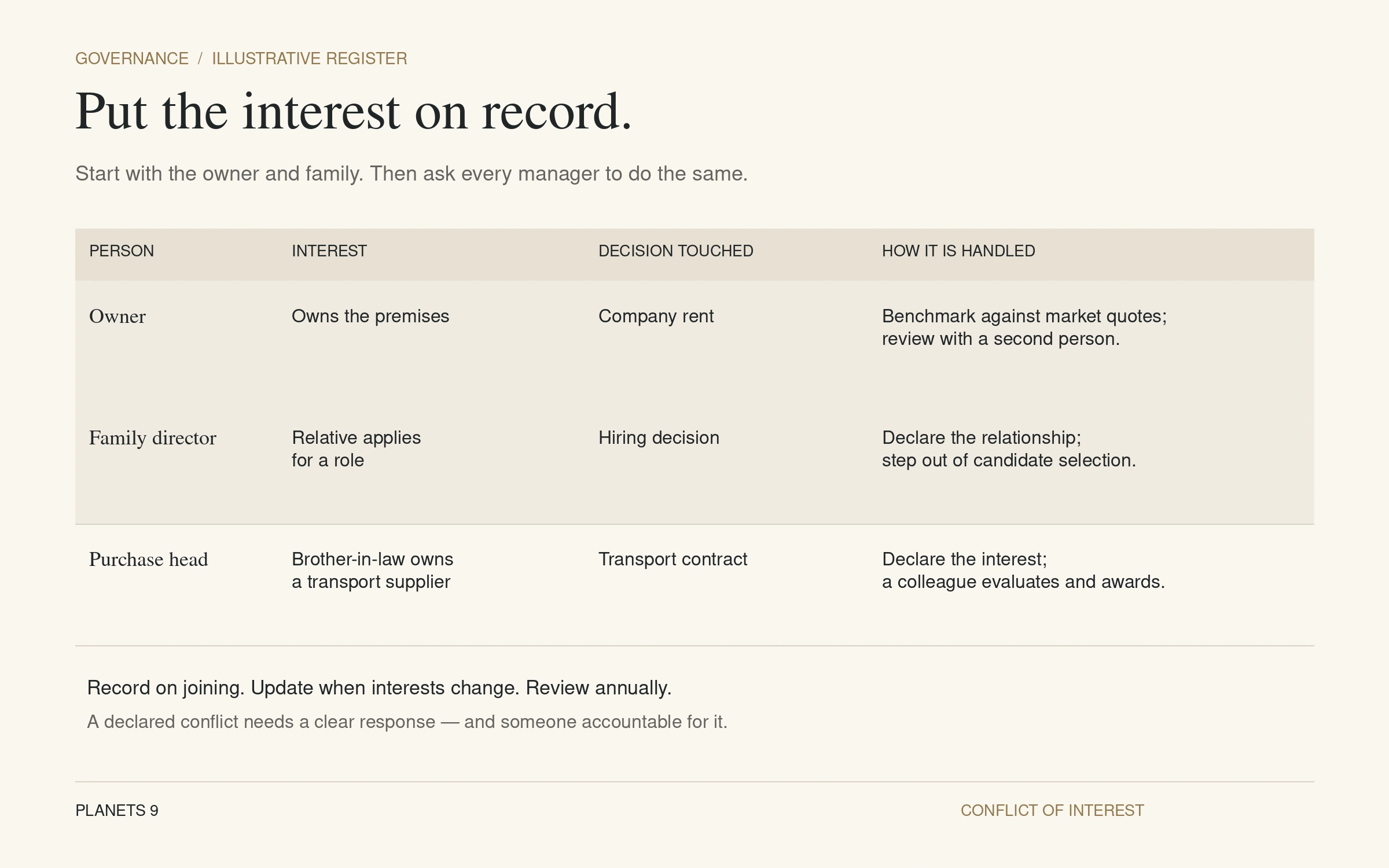
This page gives the meaning, the types, the examples that actually occur in a company of twenty to two hundred people, the difference between having a conflict and acting on one, and the one-page register that handles most of it.
What a conflict of interest is, and is not
Three things have to be true. The person has a role that involves deciding or influencing something for the company. The person has a separate interest that the decision could serve. And a reasonable observer, knowing both, would wonder whether the interest affected the decision.
The last part matters. A conflict of interest exists when the appearance exists, whether or not the person was actually swayed. The purchase head may have awarded the transport contract entirely on merit. The company cannot know that, the other transporters cannot know that, and the purchase head's own staff, who know about the brother-in-law, have drawn their conclusion.
A conflict is not the same as wrongdoing. Having one is normal in any company where people have families and histories. Hiding one, or deciding while having one without anyone else knowing, is where it becomes a problem.
Types
Financial. The decider or their family stands to gain money: a stake in a vendor, a commission, a side business that competes or supplies.
Family. A relative is the applicant, the vendor, the customer or the employee being reviewed. Nepotism is a conflict of interest acted upon.
Relational. A friend, former colleague or community connection is on the other side of the decision. Cronyism is this one acted upon.
Positional. The person holds two roles whose interests differ: the director who is also the supplier, the manager who approves his own expenses, the owner who is landlord to his own company.
Competing loyalty. The employee with a second job, a side business in the same market, or an interest in a competitor.
Gifts and hospitality. The vendor who pays for the holiday. Small enough to seem harmless, large enough to shape the next tender.
Examples from owner-run companies
The textbook examples involve directors and shareholders. These are the ones that actually happen at sixty people.
The owner's company rents its premises from the owner personally, at a rent the owner set, which the company's managers are not allowed to discuss.
The sales head's wife runs a small agency that gets the company's design work.
The accounts head recommends the auditor, who is his former partner.
The production manager's cousin supplies consumables, and the production manager signs the GRNs.
The HR person's nephew is one of the candidates.
The owner sits on the board of a customer.
The general manager has a stake in a company that distributes the same product line in a neighbouring state.
None of these is necessarily corrupt. Each is a decision being made, or influenced, by someone with a stake in the outcome, without the company having chosen to allow it.
Why owner-run companies have so many, and declare so few
Because the company was built on relationships, and relationships are what a conflict of interest is made of. The early vendors were friends. The early hires were family. The premises were the owner's. There was no one to declare anything to, because the owner was the company.
At sixty people there are managers making decisions with their own relationships in them, in a culture that never declared anything, because the owner never did. The organisational culture spoke calls this the owner's habits scaled: what the owner did at eight people is the unspoken rule at sixty.
The result is not usually fraud. It is a steady leak: prices not negotiated, candidates not compared, quality not enforced, decisions made by the person least able to make them cleanly.
Handling it: declare, remove, or manage
Three responses, in order of preference.
Remove the conflicted person from the decision. The purchase head with the brother-in-law does not award the transport contract; his colleague does, on the written specification. Simple, and the standard response in any company that has thought about it.
Declare and manage. Where removal is impractical, the conflict is written down, the decision is made in the open with a second person, and the terms are benchmarked. The owner-landlord's rent is set against two market quotes and minuted.
Prohibit. Some conflicts the company decides not to allow at all: a stake in a competitor, a side business in the same market, approving one's own expenses.
The instrument is a register. One page, kept by whoever the owner trusts to keep it, listing every known interest that could touch a company decision: person, interest, the decisions it touches, and how it is handled. Every manager fills in their own lines on joining and updates them annually. The family's lines are on it too, which is the part that gives it credibility, and the family business governance essay covers the forum that reviews it.
The owner's own conflicts
The largest conflicts in an owner-run company are the owner's, and they are the least discussed. Owner as landlord. Owner's other companies as suppliers or customers. Owner's family on the payroll. Owner deciding his own remuneration. These are legal and often sensible, and they still shape every decision the managers make about what is safe to raise. The related-party dealings page covers the vendor side; the point here is that an owner who declares his own conflicts first is the only owner whose managers will declare theirs.
The person who declares
The register works when people fill it in honestly, and honesty about one's own interests is not evenly distributed. Some managers declare everything, including things that do not need declaring. Some declare nothing and consider the question an insult. A few declare selectively, and those are the ones the register was for. The difference is not integrity in the moral sense; it is how a person relates to scrutiny, which is part of how they are built.
That is the layer under the register. The Business Pulse reads how your organisation actually runs, where decisions form and where they stall, and is the instrument for seeing which decisions in your company are being made by people with something in them.
Questions people ask about conflict of interest
What is a conflict of interest in simple words?
A situation where someone making a decision for an organisation has a personal interest that could affect, or appear to affect, that decision. The conflict is the situation; acting on it is the misconduct.
What are examples of conflict of interest in business?
A purchase manager awarding a contract to a relative's company, an owner renting premises to his own company at a rent he sets, a manager recommending a former partner as auditor, an employee with a side business in the same market, and a director who is also a supplier.
What are the types of conflict of interest?
Financial, family, relational, positional (holding two roles with differing interests), competing loyalty (a second job or a stake in a competitor), and gifts and hospitality.
How do you handle a conflict of interest?
Remove the conflicted person from the decision where possible; otherwise declare it in writing, make the decision in the open with a second person and benchmark the terms; and prohibit the conflicts the company decides not to allow. Keep a one-page register.
Is a conflict of interest illegal?
Having one is not. Acting on an undeclared one can breach company policy, a contract, directors' duties under the Companies Act for a registered company, or, in public office, anti-corruption law. In a private company the main cost is organisational.
What is a conflict of interest policy?
A short written statement of what counts as a conflict in this company, who must declare, how and when, how declared conflicts are handled, and which conflicts are prohibited. One page is enough for a company under two hundred people.
Where to go deeper
Nepotism: Meaning, Examples, and the Family-Business Version — the pillar.
Cronyism — the vendor and adviser conflicts.
Favouritism at Work — the conflict in how employees are treated.
Family Business Governance in India — the forum that reviews the register.
Organisational Culture — why nobody declares in a company where the owner never did.