Favouritism at Work: Signs, the Difference From Earned Trust, and the Owner's Blind Spot

Every owner has a favourite. He would call the person reliable, or loyal, or someone who gets it. The rest of the company calls it what it is, and adjusts.
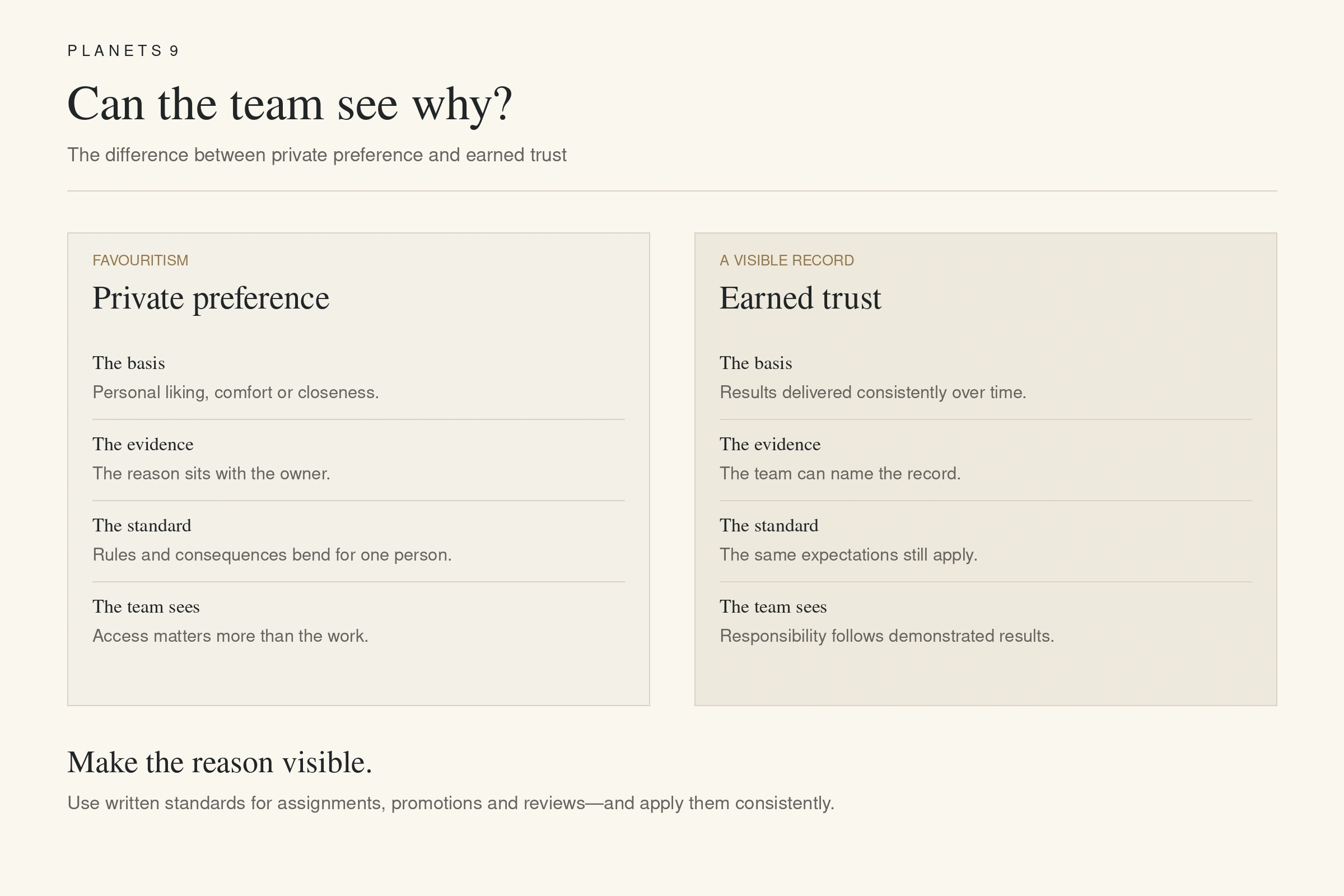
Favouritism at work is the practice of treating one employee or a small group more favourably than others for reasons unrelated to performance: personal liking, shared background, length of association, or the comfort of dealing with someone who agrees. It differs from nepotism, which is advantage by family, and from earned trust, which is advantage by a record everyone can see. Spelt favoritism in American English and favouritism in Indian and British English, it is the same thing. It is the most common form of unfairness in owner-run companies, and the one owners least often notice in themselves.
This page gives the signs, the difference between favouritism and earned trust, why owners are especially prone to it, what it does to the rest of the team, and how to correct it without pretending the owner has no preferences.
Favouritism, nepotism and earned trust
Nepotism is advantage by relationship. The nepotism pillar covers it; the relative is favoured because he is a relative. Favouritism has no family element. The favoured person is the one the owner likes, or has known longest, or finds easiest.
Earned trust looks like favouritism from a distance and is the opposite. The person who is given the difficult customer, the confidential project and the benefit of the doubt has a record: results, delivered, over time, that everyone in the company could name. The test is whether the rest of the team can see why. If they can, it is trust. If the only visible explanation is that the owner likes him, it is favouritism, whatever the owner believes.
The signs
The same person gets the visible assignments. The client meeting, the site visit with the owner, the new project. Others get the maintenance work.
Rules bend for one person. Late arrivals that are noticed for everyone else. A missed deadline that becomes a conversation for others and a shrug for him.
Feedback is asymmetric. The favourite's mistakes are explained; others' mistakes are recorded.
Access. The favourite walks into the owner's cabin. Others book time, or go through the favourite.
Promotion without a process. The favourite is promoted when a vacancy appears, without the role being discussed or anyone else considered.
Information flows one way. The favourite knows things before his manager does, because he heard them from the owner.
The favourite's opinion of colleagues carries weight. People manage their relationship with the favourite because he is a channel to the owner. The favourite becomes a second, informal, reporting line.
Why owners are prone to it
Not from bad character. From how an owner-run company is built.
The owner hired the early people personally and worked beside them. The one who was there at the beginning, who stayed through the bad year, who never argued, has a claim on the owner's feeling that the later, better-qualified hires do not. That is loyalty, and it is real. It becomes favouritism when it is paid in authority and exemption rather than in gratitude.
The owner has no peer and no manager. Nobody corrects his preferences. In a larger company a favourite would be noticed by HR or a board; in a company of sixty the only person who could raise it is the favourite's colleague, who has worked out what raising it would cost.
The owner is busy, and the favourite is easy. Delegating to the person who already understands you is faster than delegating to the person who is better at the job. Speed compounds into a pattern.
And the owner often cannot see it, because favouritism is experienced from the inside as good judgement. He trusts the favourite because the favourite has never let him down. The favourite has never let him down partly because he has never been held to the standard that would have revealed it.
What it does to the rest of the team
The employee engagement spoke lists the conditions that produce discretionary effort, and favouritism removes three at once: clarity about what is rewarded, a voice that counts, and a manager who is fair.
People stop competing on work and start competing on proximity. The capable manager who will not cultivate the owner concludes, correctly, that capability is not the currency here, and either leaves or reduces effort to what the job requires. The why high performers leave essay describes the moment the calculation is made.
The favourite's manager, if he has one, loses authority the first time the favourite goes over his head and wins. After that the manager manages around the favourite, which the team observes.
The favourite is damaged too. He is resented for advantages he may not have asked for, isolated from colleagues who no longer speak freely near him, and untested, because the standard that would have developed him was never applied.
Correcting it without pretending
An owner will have preferences. The correction is not to have none; it is to stop paying them in the company's currency.
Write the standards. What earns an assignment, a promotion, an exemption, a raise. The performance management spoke gives the minimum system. Once the standard is written, the favourite either meets it visibly or the gap is visible.
Route through the structure. The favourite reports to his manager. The owner declines the appeal, every time, for a month. The unity of command spoke is about what a second channel does to the first.
Distribute the visible work deliberately. The client meeting goes to whoever owns the account. The site visit goes to whoever runs the site. For a quarter, the owner checks the distribution rather than his instinct.
Apply the rule to the favourite in public, once. The company is waiting to see whether the standard is real. The first time it is applied to the favourite, the answer is given.
Ask the question the owner cannot answer alone. Which of my people do I favour, and why. The department heads know. So does the favourite.
The person the owner favours
Favouritism has a pattern under it that is worth naming. Owners tend to favour people who operate the way they do, or the way they wish they did: the decisive one if the owner is decisive, the steady one if the owner is volatile and knows it. The favourite is usually a mirror or a complement, and the manager who is neither, however capable, never quite registers.
That is the layer under the pattern. The Business Pulse reads how your organisation actually runs, where decisions form and where they stall, and is the instrument for seeing whose judgement the company actually runs on, and whether it is the people the chart says.
Questions people ask about favouritism at work
What is favouritism in the workplace?
Treating one employee or group more favourably than others for reasons unrelated to performance: personal liking, shared background, length of association or ease of dealing with them. Spelt favoritism in American English.
What is the difference between favouritism and nepotism?
Nepotism is advantage given because of family relationship. Favouritism is advantage given because of personal preference, to anyone. Both replace a visible standard with a private relationship.
What are the signs of favouritism at work?
The same person gets the visible assignments, rules bend for one person, feedback is asymmetric, one person has informal access to the owner, promotions happen without a process, and colleagues manage their relationship with the favourite as a channel to the top.
How does favouritism affect employees?
People stop competing on work and start competing on proximity. Capable people who will not cultivate the owner leave or reduce effort. The favourite's manager loses authority, and the favourite is isolated and untested.
How should an owner deal with favouritism?
Write the standards for assignments, promotions and exemptions; route everything through the structure and decline appeals; distribute visible work deliberately; apply the rule to the favourite in public once; and ask the department heads whom he favours.
Is favouritism illegal in India?
Not in itself in a private company. It becomes a legal matter only when the preference is based on a protected ground such as religion, caste or sex, or when it breaches a contract or a company's own policy. Its cost is otherwise organisational rather than legal.
Where to go deeper
Nepotism: Meaning, Examples, and the Family-Business Version — the pillar.
Cronyism — favouritism in contracts and appointments.
Meritocracy — the standard favouritism replaces.
Why High Performers Leave — the calculation the capable ones make.
Performance Management — the written standard.