Meritocracy: Meaning, Origin, Objections, and Whether an Owner-Run Company Can Have One

Every owner says the company is a meritocracy. The company has a different opinion, and it is expressed in who leaves.
A meritocracy is a system in which positions, rewards and advancement go to people on the basis of demonstrated ability and performance, rather than birth, wealth, relationship or seniority. The word was coined in 1958 by the British sociologist Michael Young, as satire: his book described a society that sorted people so completely by measured merit that it produced a new and more arrogant elite. It has since been adopted, without the irony, as the ideal most organisations claim. Whether an owner-run company can be one is a harder question than the word suggests.
This page gives the meaning and the origin, what merit means in practice, the standard objections, why owner-run companies find meritocracy so hard, and the version of it that is achievable in a company of twenty to two hundred people.
What merit means, in practice
The word hides a decision: merit at what, measured how, judged by whom.
In a sales team merit is visible. Revenue, margin, collection, in a ledger. In a production team it is mostly visible: output, quality, waste. In a finance or support team it is partly visible. In management it is barely visible at all, because a manager's results arrive through other people and over years, and the talent management spoke covers why performance in one seat is not potential for the next.
So a company that claims to be a meritocracy has to answer, for every kind of role, what it counts. Most owner-run companies have never written the answer, which means merit is what the owner noticed, and the favouritism spoke covers what he tends to notice.
The standard objections
Three are worth taking seriously.
Merit is measured by people with interests. Whoever defines and judges merit shapes who wins, and tends to define it as the qualities they have. A company run by an engineer measures engineering merit and under-sees the salesperson's. A company run by a salesman does the reverse.
Starting points differ. The person who could afford to spend three years in a poorly paid apprenticeship arrives with more demonstrable merit than the person who could not. Meritocracy rewards the demonstration, not the underlying capacity, and the demonstration depends on opportunity.
Meritocracy produces its own entitlement. Young's original point. People who rise in a system they believe is fair conclude they deserve everything they have, and that those below them deserve their position too. In a company this is the senior manager who was promoted on results and now cannot be told anything.
None of these makes the alternative better. A company that does not try to reward merit rewards something else, and the something else is relationship, tenure or noise.
Why owner-run companies find it hard
Four reasons, all structural.
The family is exempt. A meritocracy with a reserved tier at the top is not one, and everyone below the tier knows it. The nepotism pillar covers what the exemption does; the point here is that no amount of merit-based process below the family line makes the company a meritocracy, because the line is the first thing every capable person sees.
Loyalty was the original merit. The early employees earned their place by staying through the hard years, which was the merit the company needed then. Now it needs capability, and the loyal early employees hold the seats. Replacing them feels like betrayal, and often is. The right person, wrong company stage essay is about this exactly.
Merit is never written down. No objectives, no reviews, no criteria for promotion. The performance management spoke gives the minimum system; without it, merit is opinion and opinion is the owner's.
The owner is the only judge. One person's view of forty people, from memory. Even a fair judge cannot see enough, and the managers who could see are not asked, because they have no authority to rate.
The achievable version
Not a perfect meritocracy. A company in which the connection between what a person does and what happens to them is visible, consistent and applies to everyone.
Write what merit means, per role type. Three measures for sales, three for production, three for support, and for managers, the results of their team plus how they got them. One page.
Judge in a group, not alone. The department heads rate their people; the owner calibrates across departments; the 9-box once a year puts the whole company on one page. Group judgement is not fair, but it is fairer than one person's memory.
Make the process visible. People know how promotions are decided, who was considered, and why the decision went as it did. A fair decision made in secret reads as unfair.
Apply it to the family, and say so. Family members are rated by the same heads on the same page. If the company will not do this, it should stop using the word meritocracy, because the professionals will.
Separate loyalty from merit and pay each in its own currency. Loyalty earns gratitude, security, and a role that fits. Merit earns advancement. The early employee who is loyal and not capable of the next level is kept, honoured and not promoted.
Look for merit that the current measure cannot see. The quiet manager whose team never has a crisis. The salesperson whose customers never leave. Every measure has a shadow, and the talented people who aren't promoted essay describes who is standing in it.
Merit and the seat
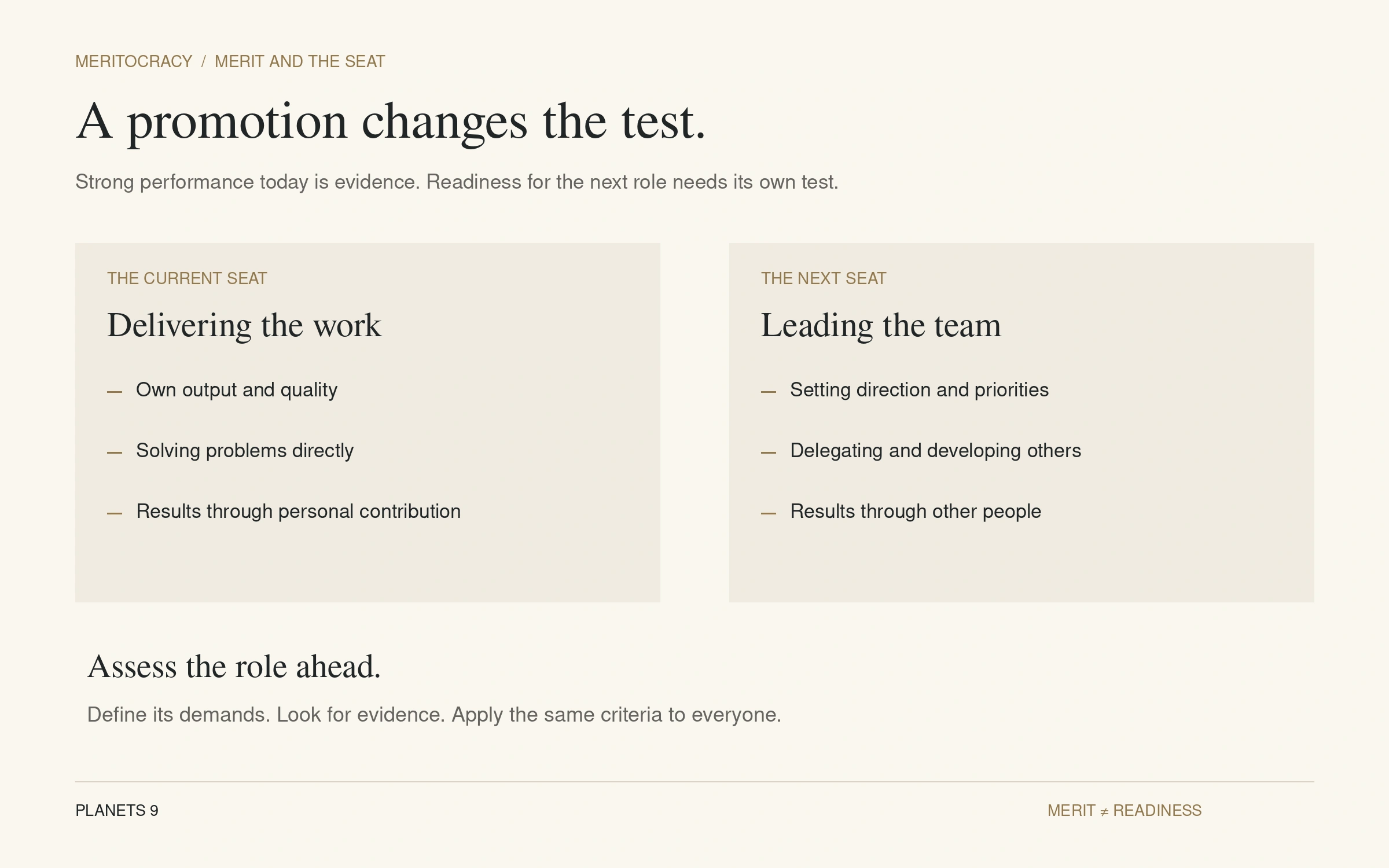
The deepest problem with meritocracy is one the word cannot express. Merit is demonstrated in a seat, and seats differ. The person who is outstanding in the seat they hold may be mediocre in the seat above, not from lack of ability but because the seat above needs a different operating nature: authority held rather than earned, a team carried rather than a task delivered. Promoting on merit, done honestly, moves people into the seats their merit did not test them for.
That is the layer under the word. The Business Pulse reads how your organisation actually runs, where decisions form and where they stall, and is the instrument for the part of merit that the ledger does not show: whether the person is built for the seat they are being considered for, not only the one they are in.
Questions people ask about meritocracy
What is meritocracy in simple words?
A system where positions, rewards and advancement go to people because of demonstrated ability and performance, not birth, wealth, relationship or seniority.
Who coined the term meritocracy?
Michael Young, a British sociologist, in his 1958 book The Rise of the Meritocracy. He meant it as satire: a society sorted entirely by measured merit that produced a new, self-satisfied elite. The word was later adopted as an ideal.
What is an example of meritocracy in business?
A company where promotions are decided on written objectives and reviews, by a group of managers rather than one person, with the criteria known in advance and applied to everyone, including the owner's family.
What are the problems with meritocracy?
Merit is defined by people with interests, starting points differ so the demonstration of merit depends on opportunity, and people who rise in a system they believe is fair develop entitlement. None makes the alternatives, relationship or tenure, better.
What is the opposite of meritocracy?
Advancement by relationship (nepotism, cronyism, favouritism), by birth (aristocracy), by wealth (plutocracy) or by seniority alone. In owner-run companies the usual opposite is a mix of family exemption and loyalty rewarded as if it were capability.
Can a family business be a meritocracy?
Only if family members are hired, reviewed and promoted through the same process as everyone else, and the company says so. A family business with a reserved tier at the top can be fair below the line, but it should not use the word.
Where to go deeper
Nepotism: Meaning, Examples, and the Family-Business Version — the pillar.
Favouritism at Work — what the owner tends to notice instead of merit.
Talent Management — the 9-box, and why potential is the axis nobody can see.
Performance Management — merit, written down.
Why Your Most Talented People Aren't Being Promoted — the merit the current measure cannot see.