Family Business: Meaning, Types, Advantages and Disadvantages, and the Indian Version

Most Indian companies are family businesses. Most of their owners would not use the phrase, because to them it is simply the business, and the family is simply who runs it.
A family business is a company in which one family holds a controlling share of the ownership and has, or intends to have, members of the family in its management or governance across more than one generation. The three elements are ownership, management and continuity; a company can have the first without the second, and the intention of the third is what separates a family business from a business that happens to be owned by relatives. By that definition, about three-quarters of India's listed companies and nearly all of its private companies between twenty and two hundred people qualify.
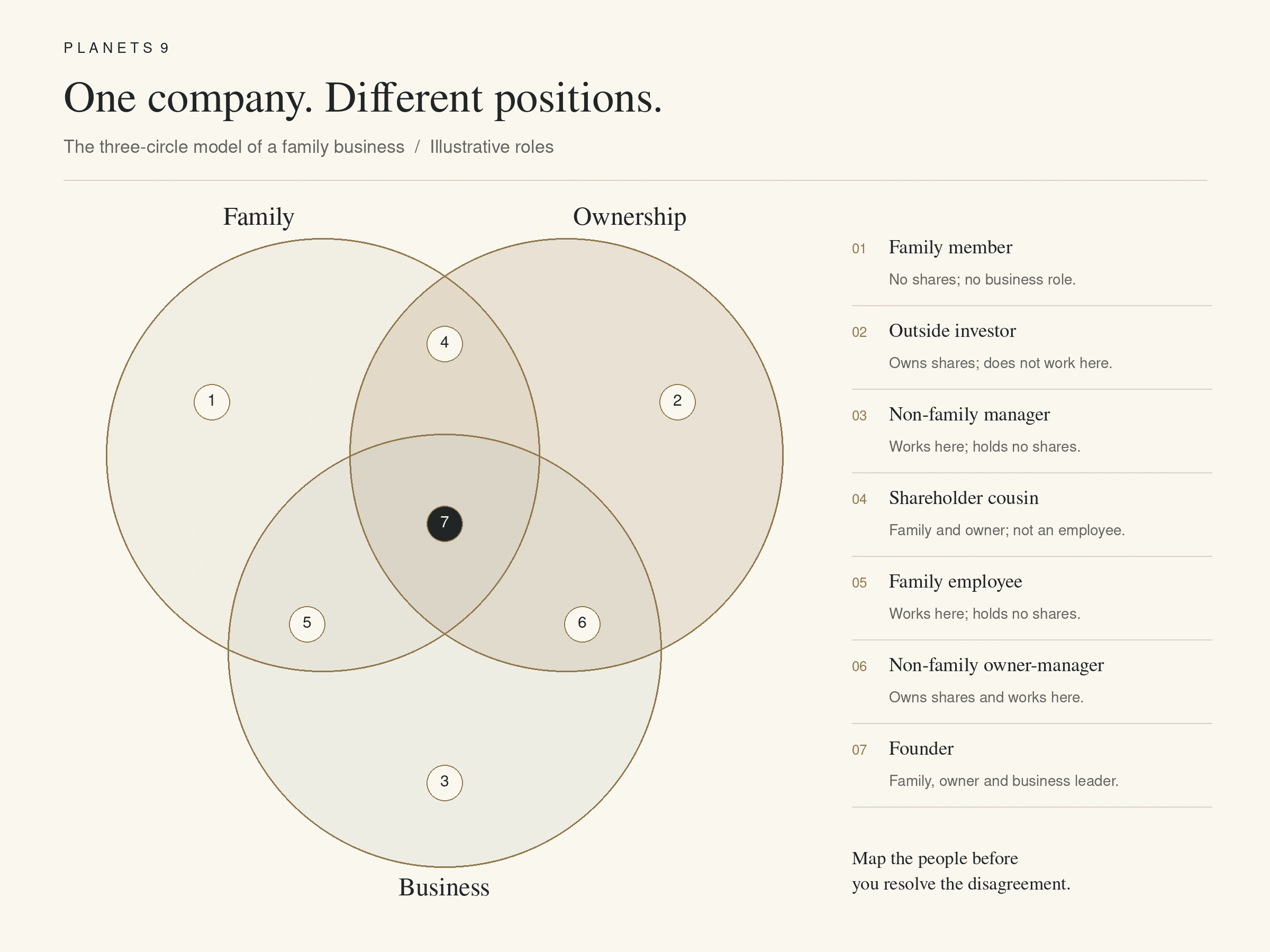
This page gives the definition, the types, the honest version of the advantages and disadvantages, the Indian pattern, and the point the textbooks make politely: the strengths and the weaknesses of a family business are the same things.
What makes a business a family business
The academic definition uses three circles: family, ownership and business. Every person connected to the company sits in one, two or all three. A non-family manager is in business only. A cousin with shares who does not work there is in family and ownership. The founder is in all three, and most of the difficulty of a family business comes from people occupying different circles and assuming the others see what they see.
A useful test for an owner: draw the three circles for your own company and place every person who matters in them. The picture usually explains at least one recurring argument.
Types of family business
Founder-controlled. One person owns and runs it. The family is in the business informally, if at all. Most companies under fifteen years old.
Sibling partnership. The second generation, two or more brothers and sisters, owning together and dividing the running between them. The stage at which most Indian family businesses either split or professionalise. The siblings in business spoke covers it.
Cousin consortium. The third generation and beyond: many owners, few of them in management, a family council or trust, and a professional management layer. The large Indian groups that have survived a century are here.
Family-owned, professionally managed. The family holds the shares and sits on the board; a non-family chief executive runs the company. The destination the professionalising a family business spoke describes.
Joint Hindu family business. The legal form specific to India, with the karta and the coparceners. The joint Hindu family business spoke covers what it is and what it does to decision-making.
Advantages, honestly
The usual list is long-term thinking, loyalty, quick decisions, low overheads, trust and a reputation carried across generations. Each is real, and each has a condition attached.
Long-term thinking exists because the owner is not answering to a quarterly market. It survives only as long as the family's own horizon is long; a family in a succession fight thinks in months.
Quick decisions exist because one person decides. That is a strength at fifteen people and the decision bottleneck at sixty.
Loyalty exists because people stay for the family. It becomes a weakness when loyalty is what gets rewarded, and the talented people who aren't promoted essay describes what that costs.
Trust exists because family members do not need contracts with each other. It is also why they do not write anything down, and why the third generation goes to court over what the first generation agreed at a dinner table.
Disadvantages, honestly
Nepotism. Roles by birth rather than by fit. The nepotism pillar is about this, and about how to bring family in without it.
Succession. The founder who does not leave, the successor chosen by birth order, the handover date that keeps moving. The family business succession essay and the succession planning spoke cover the structural and the personal sides.
Conflict that cannot be resolved because it cannot be raised. A partner dispute between strangers ends in a buyout. A dispute between brothers ends at their mother's table, or not at all. The conflict management spoke covers why it arrives at the top already old.
The ceiling for professionals. Every capable non-family manager can see the level above which the seats are reserved. The why managers leave essay calls it the ceiling test.
Family emotion in business decisions. The underperforming cousin who cannot be removed. The division that stays open because it is the brother's. The salary that is really an allowance.
Informality. No board, no minutes, no written authority, no family agreement, because the family trusted each other. The family business governance essay is about the mechanisms that replace trust when trust is no longer enough.
The Indian pattern
Three things make the Indian family business its own case.
The family is wider. Cousins, in-laws and community networks are treated as kin and enter the business as kin. A Western family business has a founder and children; an Indian one can have fifteen people with a claim.
The founder stays longer. PwC's 2026 survey found 52% of Indian family businesses naming resistance from the senior generation as the biggest barrier to next-generation leadership, against 29% globally. The father who won't let go essay is about what is actually stuck.
Ownership and management are almost never separated. The person with the most shares runs the company, whether or not he is the person built to. Every large Indian group that has survived the third generation separated the two, usually after a split that taught them why.
The strength and the weakness are the same thing
Every item on the advantages list reappears on the disadvantages list in a different form. Speed becomes the bottleneck. Loyalty becomes nepotism. Trust becomes informality. Long horizons become a founder who will not leave.
That is not a coincidence. A family business runs on the founder's operating nature scaled up, and the same nature that built it constrains it. What changes as the company grows is not the nature but the size of the consequences, and the point at which the business needs the second generation, the professionals and the structure to be chosen for how they are built rather than for who they are related to.
The Business Pulse reads how your organisation actually runs, where decisions form, where they stall, and how much still routes through you, and is the instrument for seeing which of the family's strengths have already become the company's constraints.
Questions people ask about family business
What is a family business?
A company in which one family controls the ownership and has, or intends to have, family members in its management or governance across more than one generation. Ownership, management and the intention of continuity are the three elements.
What are the types of family business?
Founder-controlled; sibling partnership; cousin consortium; family-owned but professionally managed; and, in India, the joint Hindu family business under a karta. Most companies move through the first three in order, and many split at the second.
What are the advantages of a family business?
Long-term thinking, fast decisions, loyalty, low overheads, trust between owners and a reputation carried across generations. Each holds only under conditions: the horizon stays long, the company stays small enough for one decider, and loyalty is not what gets rewarded.
What are the disadvantages of a family business?
Nepotism, succession disputes, conflict that cannot be raised, a visible ceiling for non-family managers, family emotion in business decisions and informality in place of governance. Each is the reverse side of one of the advantages.
What percentage of Indian businesses are family businesses?
Roughly three-quarters of India's large listed companies are family-controlled, and among private companies of twenty to two hundred people the share is close to all of them. India is among the countries with the highest concentration of family businesses in the world.
Why do family businesses fail in the third generation?
Because the number of owners multiplies while the number of seats does not, because ownership and management were never separated, and because the informal agreements the first generation made were never written down. The saying about shirtsleeves to shirtsleeves in three generations describes the pattern in most cultures.
Where to go deeper
Nepotism: Meaning, Examples, and the Family-Business Version — the pillar.
Siblings in Business — the second-generation partnership.
Professionalising a Family Business — separating ownership from management.
Family Business Governance in India — the council, the constitution and the board.
Family Business Succession in India — why the plan is not the problem.